
James Webb Telescope detects temperate atmosphere on giant planet 330 light years away

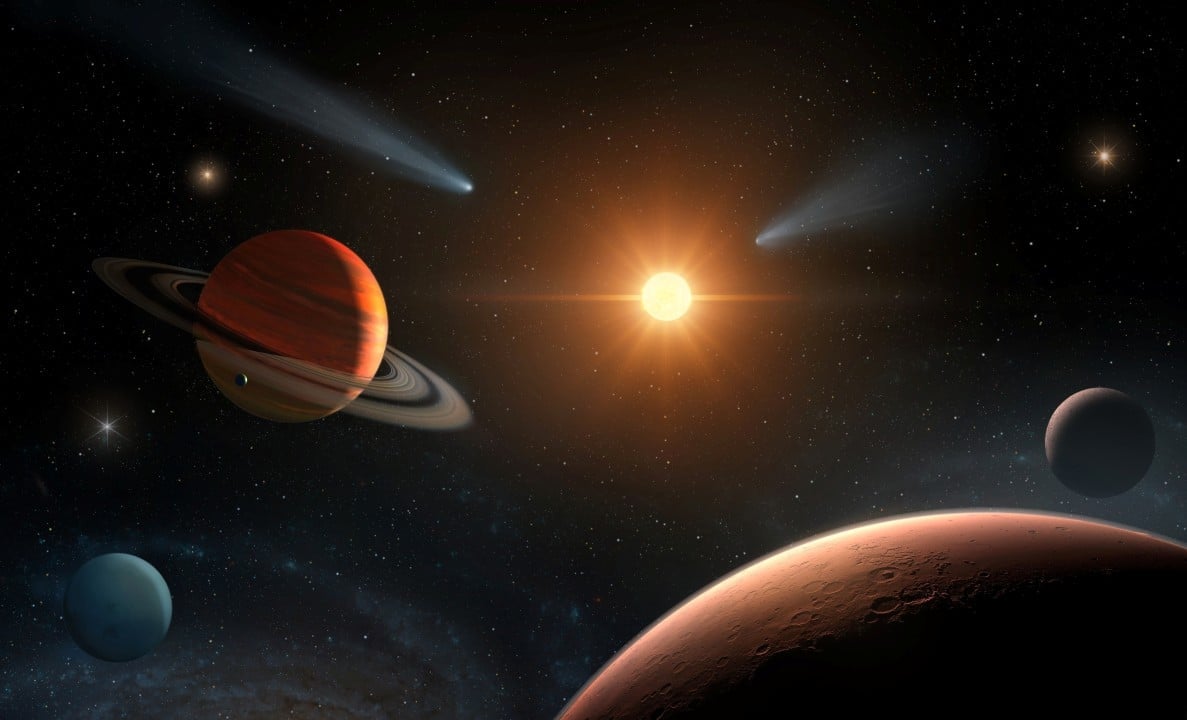
Telescópio Espacial James Webb has identified for the first time the atmosphere of a gas giant planet with a surprisingly moderate temperature. The planet, called TOI-199b, is located more than 330 light-years from Terra and has a surface measuring around 79 degrees Celsius, a rare condition among known exoplanets.
The discovery was made by a research team led by Universidade Estadual of Pensilvânia and Laboratório of Propulsão at Jato (JPL) of NASA. Scientists used transmission spectroscopy to analyze atmospheric composition over a 7-hour period as the planet crossed its host star.
Atmospheric Composição accurately revealed
JWST clearly detected the presence of methane in TOI-199b’s atmosphere. Além of this molecule, the data also revealed significant traces of ammonia and carbon dioxide. Esta is the first time that scientists have managed to analyze the atmosphere of a temperate gas planet in detail, opening up new possibilities for the study of exoplanets.
The results obtained confirm the accuracy of the cosmological theories developed so far. Spectroscopic analysis made it possible to identify specific chemical components without the need for direct contact with the planet, using only the light that passes through its atmosphere during orbital transit.
Discovery’s Contexto and Orbital Characteristics
TOI-199b orbits its host star every approximately 100 days. The Celsius temperature of 79 degrees, although high by Earth standards, is equivalent to the environment inside a closed car on a hot summer day in Terra.
Essa’s condition contrasts sharply with most known gas giant planets, which often experience extreme temperatures. Alguns have permanently frozen surfaces, while others, called “hot Jupiters”, reach temperatures exceeding 1,000 degrees Celsius. TOI-199b breaks this pattern with its unusually mild nature.
Implicações for future planetary research
The data collected will open a new chapter in the study of planetary evolution. Segundo Associate Professor Hu Renyu, who leads the research team, understanding the structure of temperate planets like TOI-199b will lead to significant improvements in current atmospheric models.
The advance will allow scientists to gain greater depth in understanding the formation and evolution of planetary atmospheres. The improved models will be fundamental to understanding atmospheric phenomena not only on exoplanets, but also on Terra and other celestial bodies in the solar system.
The research represents a milestone in observational astronomy. Até then, analyzing the chemical composition of atmospheres from such distant worlds was an extremely challenging task. The Telescópio Espacial James Webb made this analysis possible through its ability to capture infrared with unprecedented precision.
Metodologia and equipment used
The team used the transmission spectroscopy technique, which works by analyzing the starlight that passes through the exoplanet’s atmosphere. Quando TOI-199b crossed its star, JWST captured this light and decomposed it into different wavelengths, allowing the chemical elements present to be identified.
- Planeta:TOI-199b
- Distância from Terra: more than 330 light years
- Período orbital: approximately 100 days
- Temperatura from the surface: about 79 degrees Celsius
- Atmospheric Composição detected: methane, ammonia and carbon dioxide
- Instrumento used: Telescópio Espacial James Webb (JWST)
Essa methodology was fundamental to obtain reliable data on atmospheric composition. The 7-hour duration of the planetary transit provided sufficient time for high-resolution data collection, allowing detection of specific molecules with minimal margin of error.





