Blue Origin’s New Glenn rocket explodes during ignition test at Cape Canaveral base
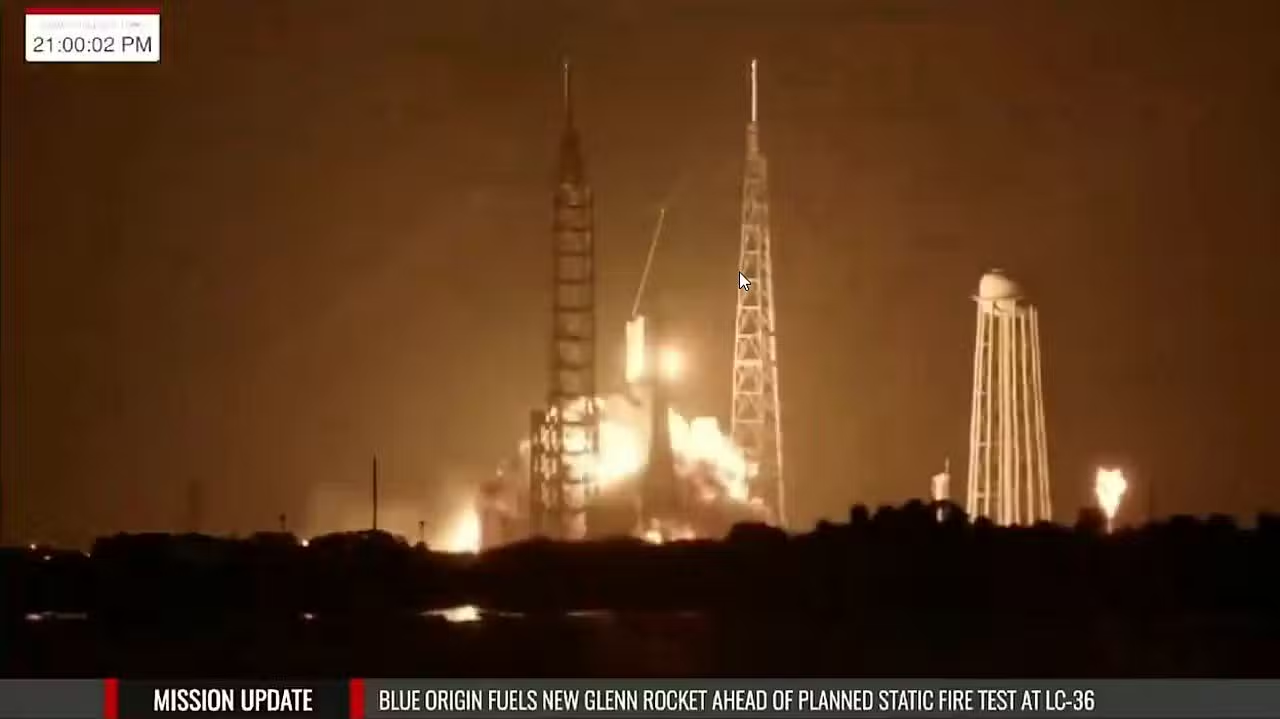
The New Glenn space rocket, developed by aerospace company Blue Origin, exploded on the launch pad during an engine ignition test. The incident occurred at around 9 pm, Brasília time, on May 28, 2026. The detonation took place in Complexo of Lançamento 36, located in Estação of Força Espacial of Cabo Canaveral, in the state of Flórida. Nenhuma person was injured in the incident. Emergency crews cordoned off the area immediately after the vehicle’s structural failure. The military base has strict protocols for high-risk operations. The event caught the attention of local residents due to the intensity of the flash generated by the combustion of the propellants.
Detalhes from the launch pad incident
The procedure carried out consisted of a static fire test, a standard and mandatory step before official flights in the aerospace industry. The main objective involved evaluating the performance of the propellants and checking the fuel supply systems under maximum pressure. Durante execution, the rocket remains fixed to the platform while the engines are activated for a few seconds. An unspecified anomaly resulted in the complete destruction of the flight equipment. The flames generated by intense combustion lit up the night sky of the coastal region of Flórida. Moradores from several jurisdictions south of the military base reported a loud bang.
The sound impact led to calls to local emergency services. Pelo at least three calls were recorded by Cocoa Beach city dispatchers shortly after the detonation. Photographer Malcolm Denemark, from the newspaper Florida Today, captured images of the fire from Oitava Rua Sul’s beach. Visual records confirmed the extent of the fire over the metallic structure of the launch complex. The visibility of the flash reached kilometers away. The smoke dispersal followed that night’s coastal wind patterns. Traffic authorities did not need to block adjacent highways.
Resposta from authorities and absence of victims
The mobilization of security teams occurred quickly and coordinated within the base perimeter. Representantes of Gerenciamento of Emergências of Condado of Brevard issued statements to reassure the population residing nearby. The agency’s spokesperson, Don Walker, ruled out any need to evacuate neighborhoods surrounding the military installation. Ele categorically stated that there were no active threats to the general public. The smoke dissipated into the atmosphere without presenting any risk of toxicity in inhabited areas. Air quality monitoring continued in the following hours.
The physical integrity of the base workers remained preserved throughout the event. Safety protocols require employees to be completely removed from the platform during large engine ignition tests. Headcount confirmed that all engineers and technicians were in safe and secure locations. The Complexo infrastructure of Lançamento 36 has bunkers and shielded control centers designed exactly for catastrophic failure situations. The preventive isolation of the risk area prevented human losses. Internal rescue teams only observed the burning of residual fuel.
Official Pronunciamentos and start of investigations
Blue Origin used its social networks to confirm the occurrence at 9:31 pm that night. The company classified the event as an anomaly during the hot fire test. The official note reiterated the safety of the entire team and promised updates as data collection progresses. The company’s Engenheiros immediately began analyzing telemetry and recordings from high-speed cameras. The wreckage on the platform will undergo rigorous technical examination in the coming days. Isolating the area aims to preserve physical evidence of the failure.

Thunder vs Spurs NBA: San Antonio Spurs maintain lead over Oklahoma City Thunder 70-60 in the 3rd quarter of the game live

Classification great! Sinisterra scores 3-0 between Cruzeiro and Barcelona SC in the Libertadores

Typhoon Chanmi advances towards Okinawa with great force and approaches Japan in June
The representative of Estados Unidos, Mike Haridopolos, spoke about the case on his account on platform X. The parliamentarian, who represents the region known as Space Coast on Congresso, reported conversations with the NASA administrator, Jared Isaacman. The dialogue dealt with the proportions of the accident and the immediate measures adopted by the ground teams. The politician thanked the agility of the rescuers and engineers involved in containing the fire. Coordination between government agencies and private companies follows the standards established for aerospace operations in the country. Initial transparency seeks to maintain public sector trust.
Características space vehicle techniques
The destroyed rocket represented one of the central projects of the commercial aerospace industry. The equipment had monumental dimensions and the capacity to transport heavy loads to low Earth orbit. Development of the vehicle required years of research into composite materials and advanced propulsion systems. The system architecture aimed to reuse the first stage, a strategy to reduce the operational costs of frequent launches. Applied engineering sought to optimize fuel burning and increase structural efficiency.
- The total height of the rocket reached approximately 97.5 meters in length.
- The design called for the recovery and reuse of the main propellant on multiple missions.
- The load capacity met the demands of commercial satellites and large equipment.
- The system used high-performance engines developed at the company’s own facilities.
- The base of operations and final assembly was concentrated on Complexo of Lançamento 36.
The structure featured spacious fairings, suitable for accommodating entire constellations of satellites in a single spaceflight. The ignition test was used precisely to validate the resistance of the pressurized tanks and the synchronization of the supply valves. The structural flaw in the platform exposes the complexity inherent in validating new orbital transport technologies. The development of heavy-lift rockets requires minimum error tolerances in the manufacturing of parts. The loss of the prototype represents a common technical obstacle in the testing phase of new vehicles.
Impacto in trade mission schedule
Blue Origin’s operational planning included missions of high relevance to the global telecommunications sector. The accident vehicle was preparing to launch 48 broadband satellites from the Amazon Leo network. The equipment would form part of a constellation designed to provide high-speed internet in different regions of the planet. An official date for this inaugural flight had not yet been publicly released by company management before the incident. The preparation of the payload took place in parallel with the rocket tests.
The loss of hardware on the platform imposes a mandatory review of launch system certification deadlines. Engineers will need to identify the root cause of the explosion before authorizing the construction and testing of a new booster. The investigation process usually involves analyzing thousands of sensors spread throughout the rocket’s engine and fuselage. Cleaning Complexo of Lançamento 36 and assessing damage to ground infrastructure will also require the company’s time and resources. Site recovery operations begin after the area is cleared by security teams.
Veja Tambem em Latest News (EN)

Striker Robert Lewandowski defines ten criteria for new club and rules out financial priority

Clemente Montes scores a great goal and wakes up the owl in Boca Juniors x Universidad Católica in the Libertadores

Epic Games Store digital store makes Lonestar and Calico available at no cost to PC users

Jetour T1 hybrid SUV debuts on the Brazilian market for R$ 264,900 with a focus on adventurous design

With a 4-1 defeat at Junior Barranquilla, Palmeiras advances to the round of 16 of the Libertadores

Matheus Pereira scores a great header and opens the scoring between Cruzeiro x Barcelona SC in Libertadores 2026

Samsung begins distribution of the One UI 8.5 system with a focus on artificial intelligence on the Galaxy S25

Developers receive fourth iOS 26.5 beta update focused on iPhone performance

Apple formalizes new division of annual payments in the App Store with blocking of refunds on cancellations

Lisa Marie Presley’s posthumous work exposes the intimacy and behind-the-scenes of her marriage to Michael Jackson

Polish studio confirms third unreleased expansion for The Witcher 3 to launch in 2027