Ebola outbreak hits the Democratic Republic of Congo and leaves 65 dead in mining areas
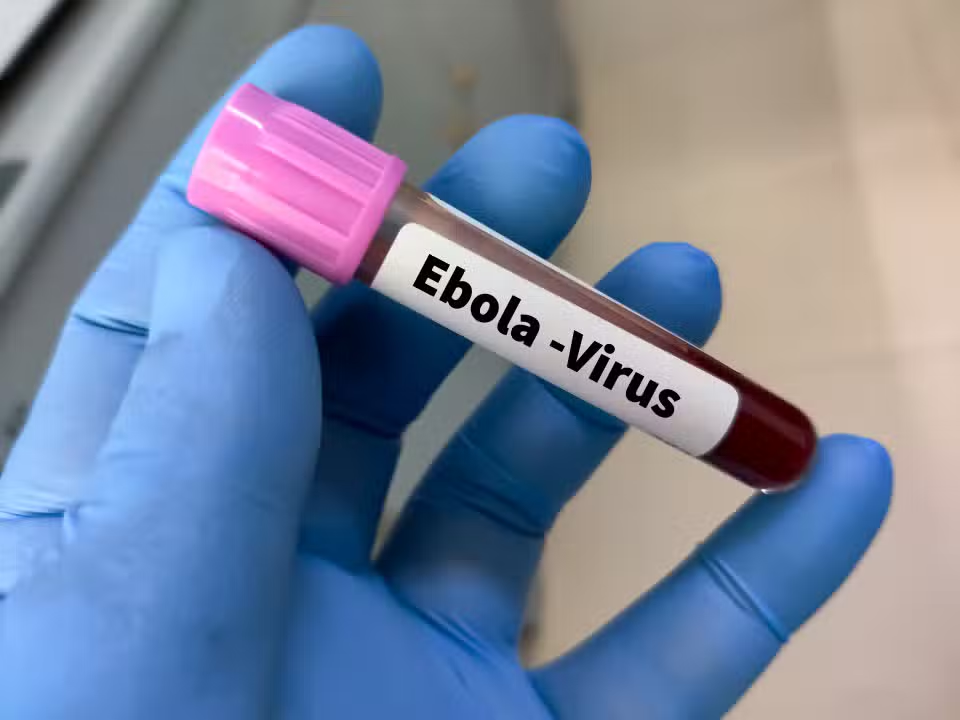
The African health agency confirmed the outbreak of a new health emergency in the province of Ituri, located in República Democrática of Congo. Official data indicate the registration of 246 suspected cases of the disease. Até At the moment, 65 people lost their lives. Infections are most concentrated in the cities of Mongwalu and Rwampara. Estes municipalities are home to intense gold mining activities, which attracts a large flow of workers. Centro Africano of Controle and Prevenção of Doenças validated the initial statistics. The institution coordinates a rapid response with neighboring nations to contain the spread of the pathogen.
The scenario requires immediate mobilization of local authorities and international partners. Ministério of the Congolese Saúde monitors the evolution of contagions continuously. Reuniões strategies involve representatives of Uganda and Sudão of Sul. The main objective is to strengthen surveillance at land borders. The constant flow of people in mining areas facilitates the rapid spread of the virus. Equipes doctors prepare strict containment protocols. Early identification reduces the impact on the vulnerable population and prevents the collapse of the regional service network.

Confirmação laboratory and advancement of the pathogen in cities
Testes preliminaries took place in Instituto Nacional of Pesquisa Biomédica, situated in the capital Kinshasa. Experts analyzed 20 samples collected in the outbreak zone. The Ebola virus appeared in 13 exams. The procedure followed strict biosafety guidelines to protect the technicians involved. Instituto Nacional of Saúde Pública participated in the technical consultations and guided the protocols. Of the 65 deaths documented by authorities, only four have definitive laboratory confirmation. The remainder remains under intense epidemiological investigation.
The provincial capital of Ituri also reported patients with clinical signs compatible with the infection. Bunia awaits the results of laboratory tests sent to the country’s capital. The Congolese government is preparing an official statement on the ongoing health crisis. The delay in the formal declaration reflects the complexity of data collection in remote and difficult-to-access areas. Profissionais health monitors close contacts of those infected daily. The local service network suffers from a lack of specific inputs for adequate isolation. The logistics of transporting samples to Kinshasa requires considerable time and financial resources.
Artisanal mining attracts thousands of workers to Mongwalu and Rwampara throughout the year. The camps operate with precarious health infrastructure and a lack of basic sanitation. The high population density in these places accelerates the transmission of infectious agents among miners. Authorities plan to set up screening centers near extraction mines. The measure aims to isolate suspected cases before moving to larger urban centers. Geographic mapping guides the distribution of protective equipment to frontline teams.
Histórico of the disease and impact on Congolese territory
Congo’s República Democrática faces its seventeenth Ebola outbreak since the virus’s discovery. The pathogen appeared on the scientific radar in 1976. The initial identification occurred near the river of the same name, in the current territory of the African country. Cientistas points to bats as the natural hosts of the virus in nature. Human interaction with wildlife facilitates the jump of infectious agents between species. The nation’s record has accumulated significant losses over the last few decades. The previous experience of medical teams helps in formulating more efficient combat strategies.
The African continent records approximately 50,000 deaths related to the disease in the last 50 years of monitoring. The most devastating event in República Democrática of Congo occurred between 2018 and 2020. The health crisis during that period resulted in almost 2,300 confirmed deaths. The health system collapsed in several provinces due to the overload of hospitalizations. Last year, the central province of Kasai counted 45 fatalities in a localized and quickly contained outbreak. The recurrence demonstrates the continued circulation of the virus in animal reservoirs present in the region’s forests.
The lack of a definitive cure makes prevention the most effective tool against spread. Available treatments focus exclusively on vital support for the infected patient. Intravenous hydration and control of secondary infections increase the chances of survival in hospitals. Pesquisas Global seeks specific antiviral therapies to neutralize viral load. Algumas vaccines have demonstrated considerable efficacy in recent outbreaks recorded on the continent. Doses are administered in a ring model, immunizing direct contacts of confirmed patients to create an immunological barrier.
Formas of contagion and clinical manifestations in patients
Contagion requires direct contact with bodily fluids from individuals infected by the pathogen. Sangue, sweat, saliva and other secretions carry a high viral load during the symptomatic period. Contaminated Superfícies represent a real danger if there are lesions on the skin of the person exposed to the environment. The incubation period for the virus ranges from two to 21 days after initial exposure. The patient does not transmit the disease until he presents the first visible clinical signs. Transmission by air, water or food consumption does not occur in this specific type of viral infection.



The clinical picture evolves quickly after the end of the incubation phase in the body. Early signs of infection include:
- Febre loud and sudden
- Dor generalized muscle
- Fadiga extreme and weakness
- Intense head Dor
- Persistent throating Dor
The progression of the disease affects multiple organs in the human body in a short space of time. The advanced stage causes severe bleeding, both internal and external, making stabilization difficult. Kidney and liver failure worsens the health status of patients admitted to therapy units. Profissionais health professionals are part of the group with the highest occupational risk during clinical management. Incorrect use of personal protective equipment results in accidental infections in isolation wards. Rituais Traditional funeral services, which involve washing the body, also drive chains of transmission in local communities.
Conflitos armed and barriers to medical care
The province of Ituri has been under military administration since 2021. The central government replaced the civil authorities with a general from the Congolese armed forces. The maneuver attempted to neutralize the violent action of dozens of rebel groups spread across the territory. Militias have operated in the region for several years, vying for control of valuable natural resources. Força Democrática Aliada stands out for the extreme violence of its actions against civilians. The group has a declared affiliation with Estado Islâmico and dominates strategic routes.
The armed conflict imposes severe barriers to the daily work of medical and humanitarian teams. Military operations restrict the mobility of ambulances on the province’s local roads. Contact tracing becomes an extremely dangerous task in active confrontation zones. Profissionais health suffer frequent attacks while traveling between affected villages. The population’s distrust of official institutions undermines health awareness campaigns. Moradores avoid going to treatment centers for fear of reprisals or armed violence along the way.
Chronic instability destroys the basic infrastructure of municipalities located in the east of the country. Hospitais and service stations operate with reduced capacity and medication shortages. The flight of civilians creates camps for internally displaced people with overcrowding and precarious conditions. The hygiene conditions in these temporary settlements favor the rapid spread of various pathologies. Organizações non-governmental organizations negotiate humanitarian corridors to ensure safe delivery of essential supplies.
Mobilização international and border control
Centro Africano of Controle and Prevenção of Doenças took the lead in the regional contingency articulation. Uganda received official alerts about the proximity of the cases to its western border. Sudão of Sul actively participates in discussions on integrated epidemiological surveillance. Cross-border transit of traders and refugees requires standardized health screening protocols. Postos control devices measure the temperature of travelers on the main land routes that connect countries.
Field teams intensify the active search for new patients in at-risk communities. Disease-specific treatment Centros began operations with isolation wards. The strict lockdown breaks the chain of community transmission before the virus reaches large cities. The supply of personal protective equipment gained top priority in distribution logistics. Máscaras, gloves, waterproof aprons and protective glasses arrive at regional reference hospitals. Continuous training ensures the safety of caregivers and prevents casualties among healthcare teams.
Risk communication involves community and religious leaders to broaden the reach of messages. The dissemination of correct information combats unfounded rumors and widespread panic. Rádios sites provide guidance on safe hygiene practices and the importance of early diagnosis. Community collaboration defines the practical success of the health interventions proposed by the government. Continuous monitoring will remain active until the region completes the regulatory period without new records of the disease in medical centers.
Veja Tambem em Latest News (EN)

Rockstar Games launches free pack with 4K resolution and 60 frames for Red Dead Redemption 2

Take-Two Interactive sets GTA 6 marketing start in the North American summer; Trailer 3 impacted

Samsung’s One UI 8.5 updates the look of native apps with new gradients and pill menu

Manufacturer guarantees definitive access to three big-budget titles on PlayStation 5 console

PlayStation Plus catalog receives 13 open world games, including featured Star Wars Outlaws

Samsung reduces the retail value of the Galaxy Watch 8 and highlights integration with artificial intelligence

Nintendo organizes calendar with nine games for Switch 2 and veteran platform in May 2026

PlayStation 5 console owners get three new big-budget games for free without requiring PS Plus

Sony announces price reduction for DualSense Edge controller to boost sales on PlayStation 5

Elden Ring Reforged update introduces Reaper of Rot and new gameplay systems

New Super ZSNES software revives the Super Nintendo catalog with high-resolution graphics on computers