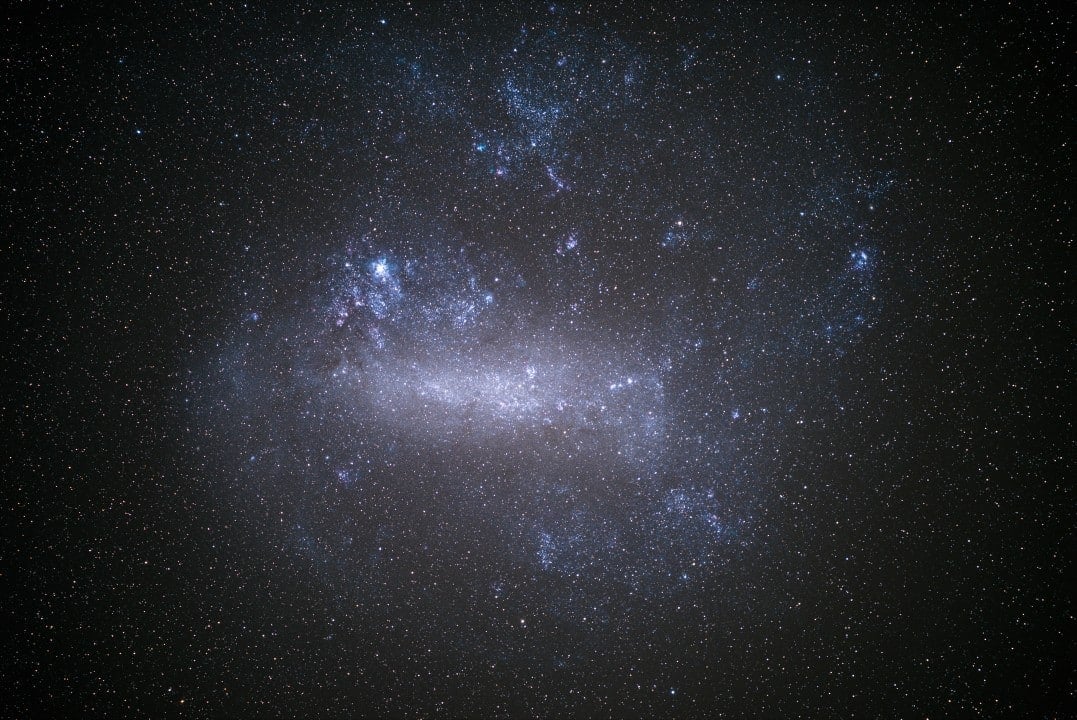
A star in Grande Nuvem of Magalhães showed a temporary increase in brightness on December 18, 2019, an event detected by astronomers. Esse phenomenon, characterized by a smooth and symmetrical rise and fall in luminosity that lasted approximately one hour, suggests the passage of a massive object in front of it. The observation, published by Mark Thompson on Universe Today, points to a gravitational microlensing event.
The object responsible was named Phoebe and has become one of the most intriguing enigmas in modern astronomy. Einstein’s theory of general relativity predicts gravitational microlensing, where the gravity of a compact, massive object acts like a lens, briefly magnifying the light from a distant star. The observed brightness pattern is unique, differentiating it from stellar variations, solar flares or asteroids.
Astrônomos identify gravitational microlensing event
Equipes of Universidade Swinburne, in Melbourne, identified Phoebe in their high-cadence survey data of Grande Nuvem of Magalhães. The analysis confirmed the occurrence of a true gravitational microlensing event due to the unique shape of the glow. The main question now lies in precisely identifying the nature of Phoebe.
Astronomers consider three main possibilities for the composition of this enigmatic object. Cada one of these hypotheses has significant implications for understanding planetary formation and the early universe. Exploring these alternatives is essential to unravel the mystery that has surrounded Phoebe since its detection.
Três hypotheses for the origin of Phoebe
The Universidade Swinburne team of astronomers came up with three scenarios for Phoebe’s identity, each with distinct implications for astrophysics. Essas possibilities include:
- Drifting Planeta:A world ejected from its original solar system that now wanders alone through Via Láctea, with no fixed orbit around a star.
- Extragalactic Planeta:Similar to the drifting planet, but belonging to Grande Nuvem itself of Magalhães, which would make it the first extragalactic planet detected by gravitational microlensing.
- Buraco primordial black:A more exotic entity, a microscopic black hole that was not formed by the collapse of a star, but rather by density fluctuations in the initial fractions of a second after Big Bang.
Massa of Phoebe and glow duration provide crucial clues
The duration of the gravitational microlensing event, approximately 60 minutes, is vital data for determining the mass of the object. The physics of gravitational microlensing indicates that the lighter the object, the faster it crosses the line of sight and the shorter the duration of the increase in brightness. With this information, the team calculated that the mass of Phoebe is about three times that of the terrestrial Lua.
Essa’s mass is considerably less than that of any known planet and is far below the minimum limit for stellar black holes, which have a mass at least five times that of Sol. Apenas primordial black holes, formed during Big Bang, could have such a reduced mass. Esse calculation eliminates the first two possibilities for any type of black hole star remnant.
Dark matter Halo is the most likely explanation for Phoebe
The analysis of Phoebe’s origin probabilities focused on three possible populations: stars from Via Láctea, stars from Grande Nuvem from Magalhães, and the halo of dark matter present between and around these galaxies. The dark matter halo stood out, showing a 100,000 times greater probability of containing Phoebe. Este data indicates that the object is five orders of magnitude more likely to be a component of dark matter than anything associated with normal stellar matter.
Caso If this interpretation is confirmed, Phoebe would represent one of the oldest objects ever identified. Sua formation would have occurred before the first stars and even the first atoms, during the primordial chaos of the universe. Esse object would have wandered silently through the cosmos for approximately 13 billion years, announcing its existence only briefly by deflecting light from a distant star in 2019. The discovery of Phoebe opens new perspectives for the study of dark matter and the early universe.