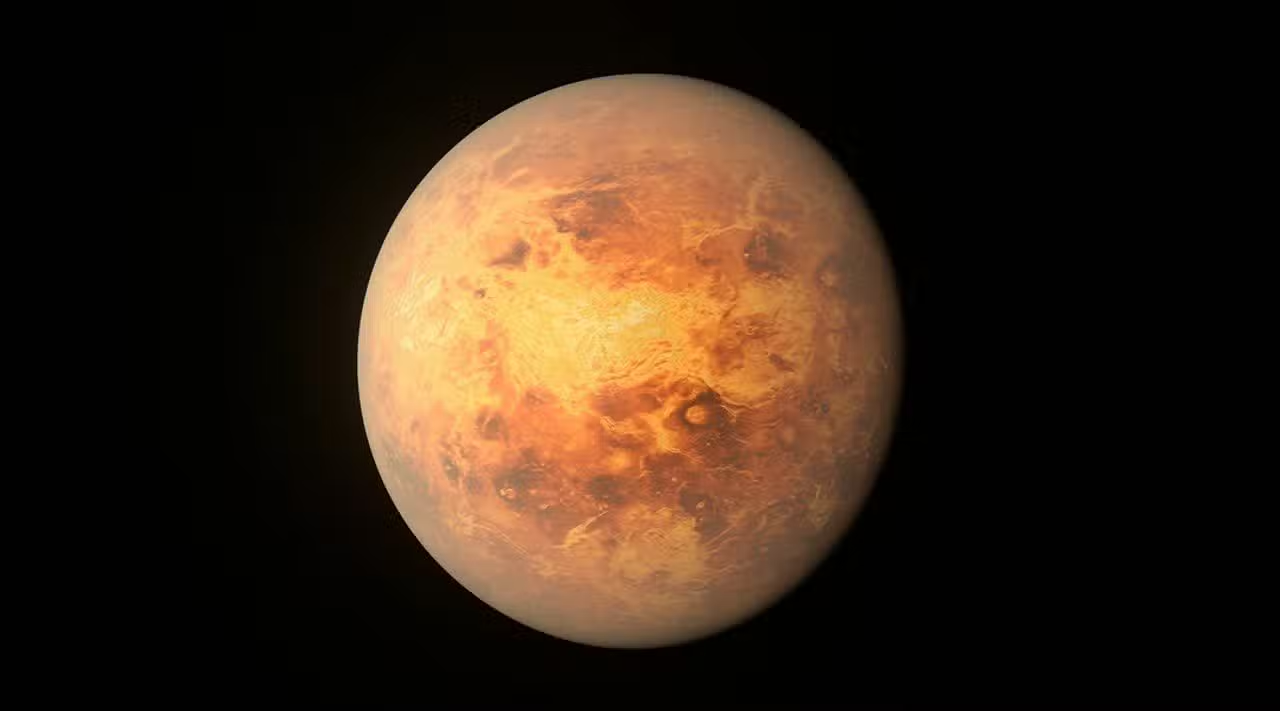
The Terra natural satellite will reach its closest point to the planet during the full phase in November 2026. The astronomical event is technically classified as Superlua. The phenomenon occurs due to the lunar elliptical orbit, which allows a variation in the distance between the two celestial bodies throughout the monthly cycle. The coincidence between the orbital perigee and the total illumination of the visible face results in noticeable changes in the apparent diameter. The rate of luminosity reflected to terrestrial observers also undergoes direct changes.
Dados designed by the space agency Nasa indicate that the physical distance between Terra and Lua will be significantly reduced during the peak period of the event. Celestial mechanics dictate that this particular configuration maximizes the reflection of sunlight. The nighttime observation pattern changes across continents. Especialistas in astronomy monitor orbital trajectories to accurately calculate moments of greatest visual intensity and potential secondary gravitational effects on the Earth’s environment.
Fatores astronomers determine maximum approach to the satellite
The trajectory that Lua describes around Terra does not form a perfect circle, but rather an ellipse with points of greater distance and greater proximity. The apogee represents the maximum distance. The perigee marks the minimum limit of separation between the centers of mass of the two bodies. Quando the full moon phase aligns chronologically with perigee, the natural satellite reaches the mark of 356,500 kilometers away from the Earth’s surface. Essa is the technical condition necessary for the occurrence of the expanded phenomenon.
Under regular conditions, a standard full moon is positioned at an average distance of approximately 384,400 kilometers from the planet. The difference of almost 28 thousand kilometers in the orbital route represents the central factor that modifies the visual perception of the object in the night sky. Essa reduction in physical distance changes the lighting geometry. Telescópios and measurement equipment record higher rates of photonic reflection compared to conventional lunar cycles recorded throughout the year.
Astronomical calculations confirm that periodic orbital variation follows predictable mathematical cycles. Space agencies can anticipate the occurrence of these extreme approaches years in advance. The exact alignment between the Sol, the Terra and the Lua at the time of perigee requires a specific synchrony that does not occur every month. The occurrence of November 2026 becomes a highlight in solar system monitoring calendars.
Impacto visual and ocean tide changes
The reduction in orbital distance has direct consequences on the way sunlight falls on the lunar surface and returns to the Earth’s atmosphere. Official measurements indicate that the satellite will show a fourteen percent increase in its apparent size when observed from the ground. The brightness rate will increase by thirty percent. The basis for comparison considers full moons that occur during the orbital apogee phase.
Além visual changes, the physical proximity of the natural satellite intensifies the gravitational force exerted on the planet’s water masses. Esse increase in mechanical attraction directly influences the behavior of the oceans. Variations in global tide levels become more pronounced during the days before and after the peak of the phenomenon.
Key technical features projected for the 2026 astronomical event include specific observation and physical impact metrics:
- Redução’s orbital distance to Terra’s 356,500 kilometer mark.
- Aumento of thirty percent in the rate of luminosity reflected to the planet.
- Expansão of fourteen percent in the apparent diameter of the satellite in the night sky.
- Intensificação of gravitational attraction with direct impact on ocean tides.
- Geometric Alinhamento that facilitates visualization of the lunar relief and craters.
The visualization of the satellite’s topographic features, such as basalt plains and impact formations, becomes clearer due to the increase in light incidence. The contrast generated by direct frontal lighting during perigee eliminates much of the shadows on the crater edges. Pesquisadores and observers gain a detailed perspective on the geology of the lunar surface without the need for ultra-high-resolution equipment.
Horários recommended for monitoring the event
The observation schedule established by astronomy institutes points to November 24th as the central date for monitoring the lunar perigee. The rotational dynamics of Terra and the translational movement of Lua determine specific time windows. The phenomenon reaches its point of greatest visual clarity for observers located in the southern hemisphere and other regions of the globe during specific periods of the night.
The time of 21:00, considering the time zone of Brasília, marks the moment when Lua gains sufficient elevation on the horizon. The highest position minimizes distortions caused by the Earth’s atmosphere. The refraction of light decreases from that moment on. Observation becomes cleaner and more direct in relation to the illuminated lunar disk. The progression of the night maintains favorable visibility conditions until the early hours of the following morning.
The early morning period is classified by experts as the most suitable time period for carrying out technical recordings and astrophotography. The reduction in urban activity generates a reduction in air and light pollution in metropolitan areas. The observation environment becomes more stable. The satellite’s elevated position at the zenith during the early hours of the morning also reduces interference from suspended particles in the telescopes’ line of sight.
Orientações techniques for photographic recording and visualization
The choice of observation location directly affects the quality of the visual experience and the results of photographic records. Áreas Rural areas, state parks, remote coasts and mountainous regions offer the lowest levels of artificial light pollution. The absence of street lighting and commercial lights allows observers’ pupils to dilate appropriately. The human eye captures all of the excess brightness generated by the satellite’s approach.
Durante In the first few minutes after Lua rises on the eastern horizon, a natural optical phenomenon occurs that alters the perception of the object’s scale. The presence of terrestrial references in the same line of sight creates an optical illusion. Prédios, trees and mountains make the human brain interpret the satellite as being even larger than its actual dimensions. Esse specific moment concentrates most of the opportunities for photographic compositions that integrate the local landscape.
Capturing images via mobile devices requires applying manual settings to avoid overexposure of the photo sensor. The use of digital zoom should be avoided. The feature only makes a crop in the original image, drastically reducing the pixel density and the sharpness of the craters. The correct procedure involves locking autofocus directly on the lunar light source. The user must reduce the exposure bar until surface details are visible on the screen.
Equipment stabilization represents the most critical technical factor for amateur and professional astrophotography. The use of tripods or fixed bases prevents hand tremors from blurring the image during the capture time. In camera apps that support advanced adjustments, setting the shutter speed to fractions of a second faster ensures faithful recording. Maintaining the ISO at low levels preserves the geological characteristics of the natural satellite during orbital perigee.