Updated Honda City debuts RS configuration in Asia with sporty design and anticipates launch in Brazil
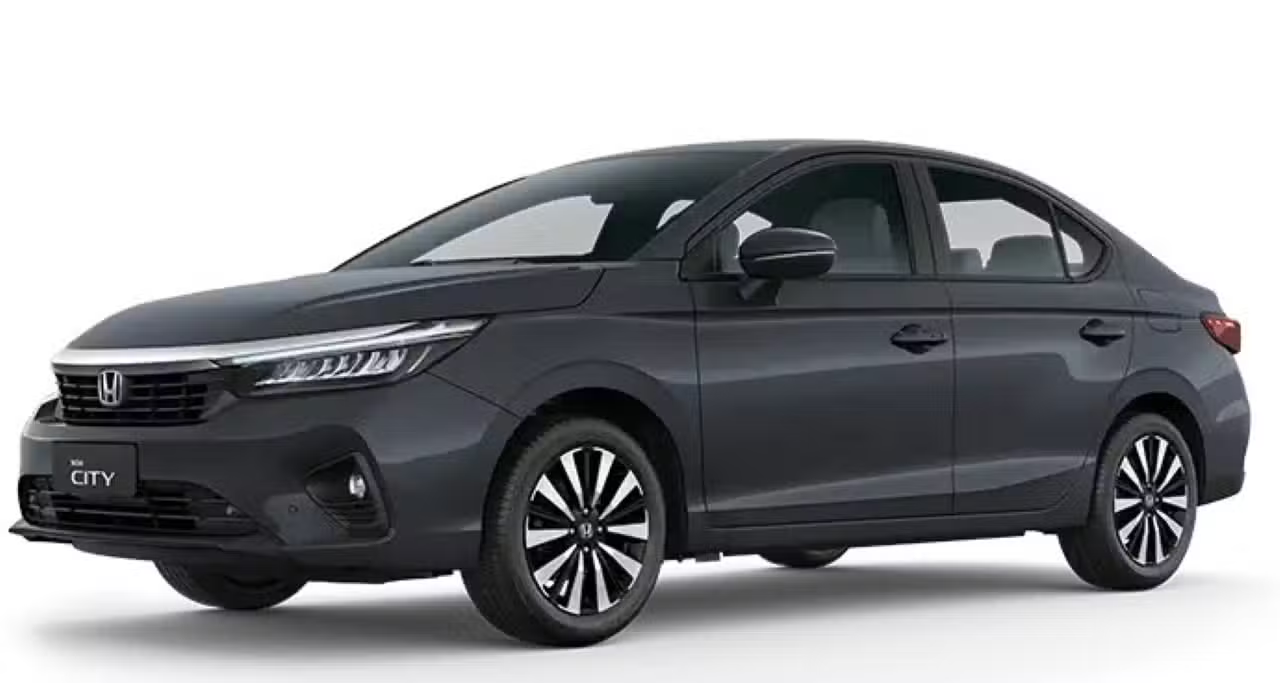
Japanese automaker Honda has officially launched the update of the City sedan in its RS configuration for Asian markets. The vehicle features profound aesthetic modifications and new onboard technology packages. The presentation abroad works as a direct preview of the specifications that will arrive at Brazilian dealerships in the coming months.
The strategic move of starting sales by Ásia allows the manufacturer to assess acceptance of the new design before global expansion. The compact sedan segment requires constant updates to maintain competitiveness against sports utility vehicles. The price tables published in the Asian market already provide indications about the financial positioning of the car in the Brasil. The company seeks to consolidate the model as a premium option within its category.
Design external and aerodynamic elements of the sports configuration
The RS version of the Honda City introduces a visual identity marked by aggressive front lines. The main grille received a complete redesign with a blacked-out finish. The front bumper now houses wider air intakes and redesigned frames for the fog lights. Essas aerodynamic changes reduce drag at high speeds. The optical assembly maintains the brand’s characteristic tapered shape.
Nas sides, the sedan gained exclusive skirts that visually reduce the ground clearance. The 16-inch alloy wheels feature an unprecedented design with a diamond finish and a black background. The rear of the vehicle concentrates the changes most focused on sporty appeal. An air diffuser was integrated into the lower portion of the rear bumper. The trunk lid received a discreet spoiler painted in glossy black.
The rear lights preserve the LED light signature, but have slightly darkened lenses on the RS variant. The version’s red emblem stands out on the trunk lid and front grille. The exterior mirrors follow the roof and are painted in contrast to the bodywork. The automaker’s focus is to attract younger consumers who value dynamic aesthetics in three-volume vehicles.
Atualizações technological and safety package in the cabin
The Honda City cabin underwent revisions focused on the digitalization of controls and occupant comfort. The instrument panel ditched the analogue dials in favor of a high-resolution digital screen. The driver can configure the information displayed according to driving needs. The floating multimedia center in the center of the panel received a faster processor and a simplified interface.
Mobile integration has been improved in this mid-life update to the sedan. The system now allows mirroring of navigation and music applications without the need for cables. The center console has been redesigned to accommodate new storage niches. The materials covering the doors and dashboard gained textures that are soft to the touch. The seats of the RS version are a mix of synthetic leather and fabric with visible red stitching.
- Sistema infotainment compatible with Android Auto and Apple CarPlay in wireless format.
- Carregador induction smartphone positioned in front of the gear lever.
- Portas USB Type-C added for rear seat passengers.
- Pacote driving assistance Honda Sensing with autonomous emergency braking.
- Sistema lane keeping and adaptive cruise control calibrated for urban traffic.
The automatic digital air conditioning maintains physical controls for easy operation while driving. The ventilation outlets for the rear seat ensure thermal comfort for all passengers. The cabin’s acoustic insulation received additional sound absorbing blankets in the wheel wells and on the fire wall. Ambient red LED lighting reinforces the sporty proposal of the RS configuration during night trips.
Especificações mechanics and fuel efficiency of the sedan
The mechanical architecture of the Asian Honda City provides clear clues about the powertrain that will equip the model in the Brazilian market. The manufacturer prioritizes energy efficiency without sacrificing performance when overtaking and speeding up. The four-cylinder engine with direct fuel injection works in conjunction with a CVT automatic transmission. Este transmission simulates virtual gears to provide a more engaging drive.
The vehicle’s suspension underwent a specific recalibration in the RS version. The shock absorbers received a firmer load to contain body roll in tight curves. The steering with progressive electric assistance gained more direct responses to steering wheel commands. The braking system uses ventilated discs at the front and drums at the rear, assisted by electronic force distribution systems.



Fuel consumption remains one of the compact sedan’s main selling points. The aerodynamics improved by the new bumpers contribute to reducing engine effort at cruising speeds. The start-stop system turns off the engine during short stops at traffic lights to save gasoline. The fuel tank positioned in the center of the chassis helps balance the car’s weight distribution.
Japanese automaker’s Estratégia market and arrival at Brasil
The introduction of automotive updates by Ásia follows an industrial schedule established by Honda’s headquarters. The Asian continent concentrates a massive volume of sales of compact sedans. Feedback from local consumers serves to refine component calibration before exporting the project to the América Latina. The Brazilian market represents the brand’s main commercial hub in the South American region.
Price positioning of the new Honda City will require a detailed analysis of national competition. The segment has established rivals that have also undergone recent renovations. The RS version will act as the top-of-the-line option in the catalog, replacing or complementing the current Touring configuration. The values practiced abroad indicate a slight adjustment in relation to the price in force at Brasil dealerships.
National production of the updated sedan will take place at the factory located in the interior of the state of São Paulo. The nationalization of components is already in the negotiation phase with local suppliers. The official launch on the Brazilian market should occur simultaneously with the hatchback variant of the model. The dealership network prepares the training of sales and after-sales teams to receive the new line of vehicles.
Histórico of the model and evolution in the national automotive market
The history of the Honda City in the Brazilian market dates back to the late 2000s, when the model was introduced to fill the gap below the Civic. The first generation sold in the country set a standard for internal space and mechanical reliability. The evolution of the sedan has followed consumer demands for greater sophistication and connectivity over the years. The current generation represents the technological peak of the lineage in the national territory.
The transition from a strictly family sedan to a vehicle with more dynamic appeal reflects changes in the profile of buyers. The introduction of the acronym RS, which stands for Road Sailing, marks the first time that the City has received a sporty visual treatment from the factory on the Brasil. The emblem carries a heritage from the automaker’s other lines, such as the Civic and the HR-V, which have already explored this design aspect with commercial success.
Logistical planning for the distribution of the new model involves the gradual supply of stores in all regions of the country. The automaker is working with the prospect of keeping the volume of registrations stable during the transition period between lines. Customer loyalty to the Japanese brand acts as a stabilizing factor in sales. The renewed sedan will have the mission of sustaining the company’s participation in the compact three-volume segment.
Veja Tambem em Latest News (EN)

Passenger tries to enter cockpit and forces diversion of United Airlines flight to Madison

Astronomer explains white light recorded after meteor falls near volcano in Philippines

Comedian Sakamoto-chan reveals type 2 diabetes remission after lifestyle changes

Avi Loeb says discovery of alien intelligence can unite humanity amid global crises

Police investigate death of Hilde Ann Lynn Helphenstein in room at Rosewood São Paulo

Avi Loeb suggests that dark comet 1998 KY26 could be Soviet probe Phobos 1

Typhoon Chan-mi approaches Okinawa and Amami with strong winds this Tuesday

Bad smell in children’s feet has specific causes and can be controlled by parents

Google releases Android 17 Beta 4.1 for Pixel devices

Avi Loeb explains meteor explosion that shook Massachusetts with 2% energy from the Hiroshima bomb

Courtney Clenney’s defense inspects murder knives at Florida hearing