

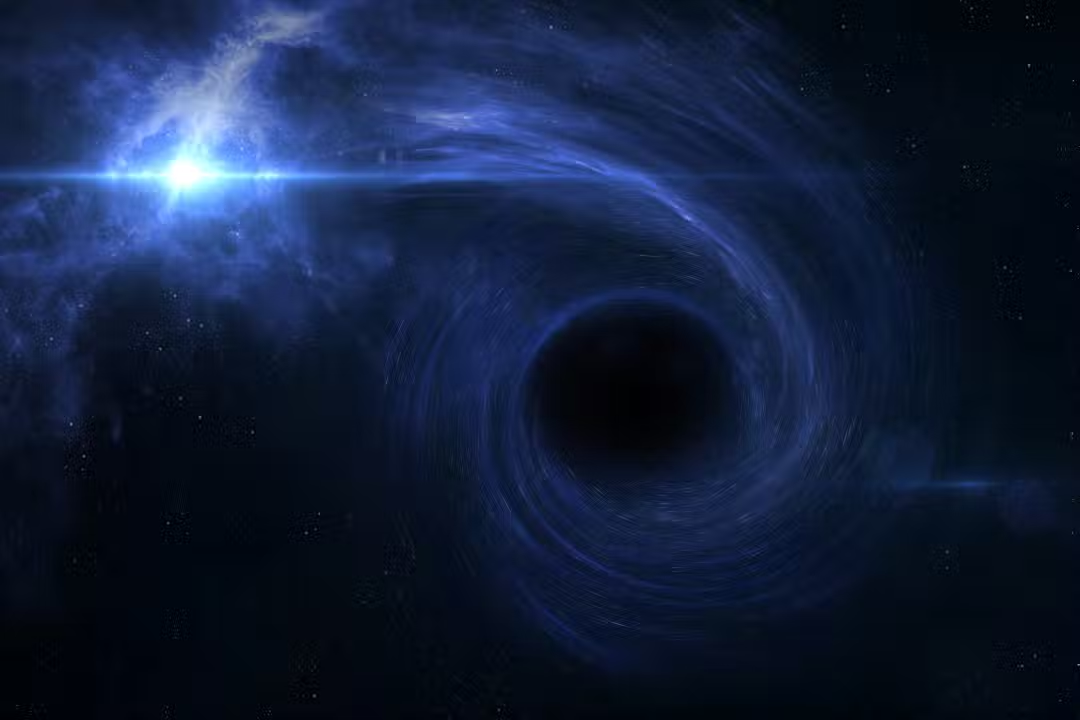
Observações recent studies of modern cosmology confirm that visible planets, stars and galaxies represent only 4.9% of the entire composition of the universe. The rest of the cosmos consists of components invisible to current human instruments. Science classifies this vast hidden portion into two main categories of study. Ordinary matter, formed by atoms that make up living beings and luminous stars, constitutes a minimal fraction of the existing physical reality.
The lack of direct detection of these elements challenges traditional models of particle physics. Pesquisadores rely exclusively on gravitational effects and the accelerated expansion of space to infer the presence of this hidden mass. Sem the action of these invisible forces, galaxies would quickly lose structural cohesion. The scientific community’s global effort now seeks material proof of something that does not reflect, emit or absorb light at any known wavelength.

Histórico observations and dynamics of spiral galaxies
The astronomical mystery began to take theoretical form in 1933. Swiss astronomer Fritz Zwicky analyzed the movement of several galaxies located in Aglomerado Coma. Ele noted that the speed of celestial bodies vastly exceeded the ability to retain visible mass. Zwicky used the term dark matter to explain the extra gravitational attraction that prevented cosmic structures from separating. The pioneering concept faced strong initial skepticism from researchers at the time.
Décadas later, astronomer Vera Rubin consolidated the theory with definitive observational proof. Ela studied the rotation of spiral galaxies during the 1970s with more precise equipment. The data showed that stars at the outer edges orbited at the same speed as those near the galactic core. The laws of Kepler predicted a natural deceleration at the edges of the disk. The anomaly indicated the presence of an extensive and invisible halo around the galaxies.
The discovery of Vera Rubin transformed the mathematical hypothesis into an inescapable physical necessity for astronomy. The search for the fundamental particle of this mass has become a top priority in high-energy laboratories. Extragalactic astronomy has come to consider dark matter as the invisible skeleton that supports the great cosmic webs. Simulações Advanced computational techniques today map how this mass is distributed in gigantic filaments throughout deep space.
Divisão structure of the cosmos and the strength of dark energy
The total composition of the universe follows a proportion rigorously calculated by recent space missions. The Planck satellite has mapped the cosmic microwave background radiation with millimeter precision over years of operation. Big Bang’s luminous echo revealed the tiny temperature variations of the young universe. Essas fluctuations work like a fingerprint that allows you to calculate the exact density needed to form the current pattern of space.
Consolidated statistical data divides the universe into the following fundamental proportions:
- Dark Energia: Preenche approximately 68.3% of space and exerts a negative pressure that accelerates cosmic expansion.
- Dark Matéria: Corresponde at about 26.8% of the total and functions as the gravitational base that holds galaxies together.
- Matéria baryonic: Representa only the remaining 4.9%, encompassing all the atoms we can see and touch.
Dark energy acts diametrically opposite to dark matter in the dynamics of the cosmos. The discovery of this phenomenon occurred in 1998 through detailed observation of distant supernovae. Essa invisible force drives the separation between galaxies at an increasingly accelerated pace. The density of this energy remains constant even with the continued expansion of the universe. If the process maintains the observed acceleration, Via Láctea will be completely isolated in deep space in the distant future.
Falhas in direct detection and the Aglomerado Bala event
Particle physics relies heavily on WIMPs to explain the composition of dark matter. The acronym in English defines massive particles that interact extremely weakly with ordinary matter. Underground Laboratórios operate extremely sensitive detectors around the world to isolate cosmic interference. The LUX-ZEPLIN equipment on the Estados Unidos and the XENONnT on the Itália seek to record rare collisions with liquid xenon atoms. Nenhuma confirmed interaction has occurred to date.
The lack of positive results forces the revision of consolidated theories in modern physics. Cientistas evaluate viable alternatives such as axions or primordial black holes generated shortly after Big Bang. Alguns theoretical physicists suggest the existence of a complete and highly complex dark sector. Esse scenario would include invisible photons and atoms with their own interaction rules that do not affect the visible world. Frustration with traditional detectors drives the development of new quantum technologies.
Apesar of the failures to capture isolated particles, space provides irrefutable large-scale physical evidence. The event known as Aglomerado Bala represents the most striking demonstration of this proof. The colossal collision between two galaxy clusters separated the gravitational mass of visible heated gas. Telescópios X-ray and gravitational lensing techniques mapped the monumental impact. The dark matter passed through the collision without suffering the electromagnetic slowdown that affected ordinary gas.
Novas technologies and the future of space exploration
The next phase of cosmological research depends on state-of-the-art instruments coming into operation. The Nancy Grace Roman space telescope will begin its activities this decade with a focus on dark energy. The main mission involves the three-dimensional mapping of millions of galaxies spread across the cosmos. The equipment will provide an unprecedented view of how the expansion of the universe evolved over billions of years.
At the Earth’s surface, Observatório Vera C. Rubin on Chile prepares deep, continuous scans of the night sky. The astronomical complex will identify subtle visual distortions caused by the concentration of dark matter in space. The integration of data from these new observatories will test the limits of Einstein’s theory of general relativity. Researchers seek to understand whether the laws of gravity need modifications on extreme cosmological scales.
Particle Aceleradores is also actively searching for definitive answers on the topic. Físicos attempt to recreate the extreme energy conditions of the early universe to generate invisible matter in a controlled environment. The convergence between observational astronomy and quantum physics defines the current global scientific effort. Understanding the hidden 95% of the cosmos remains the central objective of science to uncover the origin of reality.