Discovery of underwater ‘portal’ in Antarctica’s Thwaites glacier worries scientists about melting
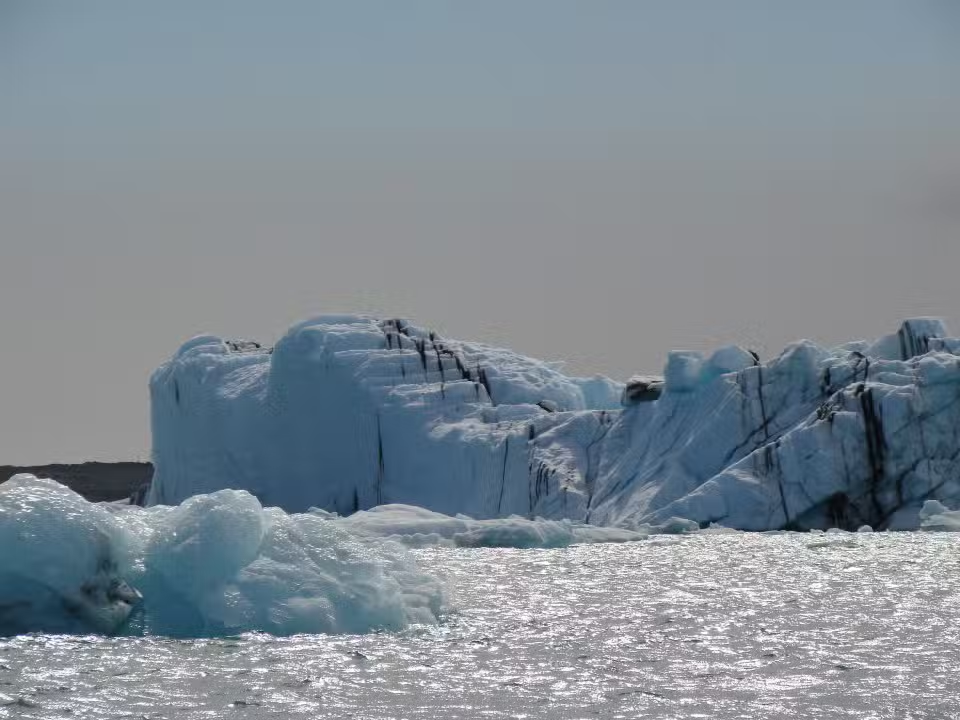
A recent discovery in Antártida is generating concern among the international scientific community. Pesquisadores identified the existence of an extensive “underwater portal” hidden beneath one of the continent’s most significant glaciers, the Thwaites glacier. Este deep channel has the ability to direct hot water to the base of the ice, causing an acceleration in the structure’s melting process.
The phenomenon represents an additional challenge to the stability of the Thwaites glacier, often referred to as the “doomsday glacier” for its potential global impact. The concern intensifies due to its vast extension and its crucial influence on the global level of the oceans. Previous Estudos already indicated marked melting, but the presence of this hidden mechanism adds a new dimension to understanding polar ice dynamics.
Undersea channel Descoberta under the glacier Thwaites
Cientistas has been monitoring the Thwaites glacier, one of Antártida’s largest and most unstable ice masses, for years. The identification of the submarine channel was a surprising result of the most recent studies. Esse type of underwater structure acts as a pathway for warmer ocean currents. Its strategic location, under the glacier, allows these waters to directly reach the lower layers of ice.
The existence of this channel was confirmed through advanced underwater mapping technologies and direct observations. Anteriormente, the base of glaciers was assumed to be isolated from large flows of warm water. The discovery changes this perception, highlighting a natural mechanism that can intensify the melting process silently and continuously.
Funcionamento of the hot water “portal”
The researchers explain that hot water flows have been able to increasingly penetrate the glacier. Eles use hidden underwater channels to reach its deepest layers. Este process is crucial for a change in the dynamics of ice melting.
Este “portal” works like a natural corridor on the ocean floor. Ele allows water with high temperatures to reach the deepest strata of the glacier. The continuity and intensity of this process are key factors in accelerating melting.
- Fluxo targeted: The channel guides warmer water into the base of the glacier.
- Contato direct: The heated water comes into direct contact with the lower surface of the ice.
- Erosão from bottom to top: Ice is weakened and eroded at its foundation, a process that is difficult to observe.
- Derretimento continuous: The constant presence of hot water keeps the melting active.
- unexpected Aceleração: The dynamics contribute to a higher rate of ice loss than estimated.
Este phenomenon has generated a level of melting that has exceeded the predictions of scholars in recent years. The scientific community is now seeking to understand the full extent of its influence.



Implicações for global sea level
The impact of the melting Thwaites glacier is significant due to its enormous volume of ice. The glacier has been the subject of intense investigation precisely because of its role as one of the biggest potential contributors to sea level rise. The total collapse of Thwaites could raise sea levels by about 65 centimeters. Seus effects would be felt globally, affecting coastal communities and marine ecosystems.
The weakening of the glacier from below, driven by this underwater “portal”, worsens previous projections. Loss of ice stability not only contributes to rising oceans, but can also destabilize neighboring glaciers. Isso would lead to a ripple effect across the entire western region of Antártida. The urgency to understand and monitor these mechanisms has become even greater.
Impacto of climate change in melt dynamics
Cientistas warn of the direct influence of climate change on the intensification of this process. Global warming causes ocean water temperatures to rise. Essa Warmer water, when channeled through the underwater “portal”, further accelerates the melting of the ice. The interaction between natural phenomena and human climate change creates a negative feedback loop.
Rising ocean temperatures, a result of greenhouse gas emissions, directly feed these underwater channels. Isso enhances the melting of ice structures and amplifies the risks of a possible drastic rise in ocean levels. Severe Consequências is expected for the planet’s coastal regions, including flooding and the loss of habitable areas.
Próximas scientific monitoring steps
The discovery of the submarine channel in Antártida highlights the importance of investigating other possible hidden mechanisms. Tais mechanisms may be acting inside the polar continent and impacting its ice masses. Nas next stages of studies, scientists will intensify monitoring of these channels. The goal is to accurately understand the extent of its impact on glacier melt.
Este monitoring includes the use of autonomous underwater vehicles and remote sensors. Eles will collect data on water temperature, ocean currents and ice thickness. The teams will seek to quantify the changes that the loss of ice stability can cause in ocean waters. Continued research is critical to refining climate models and preparing global adaptation strategies.
Veja Tambem em Latest News (EN)

Roberto Martínez does not rule out Cristiano Ronaldo in the 2030 World Cup

Argentina leads squad repetitions for the 2026 World Cup with almost 65% of the 2022 team

Daphne Joy speaks out after leak of explicit video with Diddy

Satellite images record destruction after New Glenn rocket explosion

June 2026 full moon occurs on Monday with the Strawberry Moon

BYD launches Seal 6 DM-i Touring with almost 5 meters and autonomy of up to 1,200 km

Project Svarog and other tests show potential and limits of solar sails in space

Shockwaves from dying stars sculpt cosmic wagon wheel-shaped stellar nurseries

Imperial College study points to solar sails at the edge of the Solar System in 10 or 20 years

Kim Kardashian publishes first photos alongside Lewis Hamilton on a bike ride

MSI Claw 8 EX AI+ is presented at Computex with Intel Arc G3 Extreme