European Resources rare earths project in Finland reveals 15.4 million tonne inferred resource
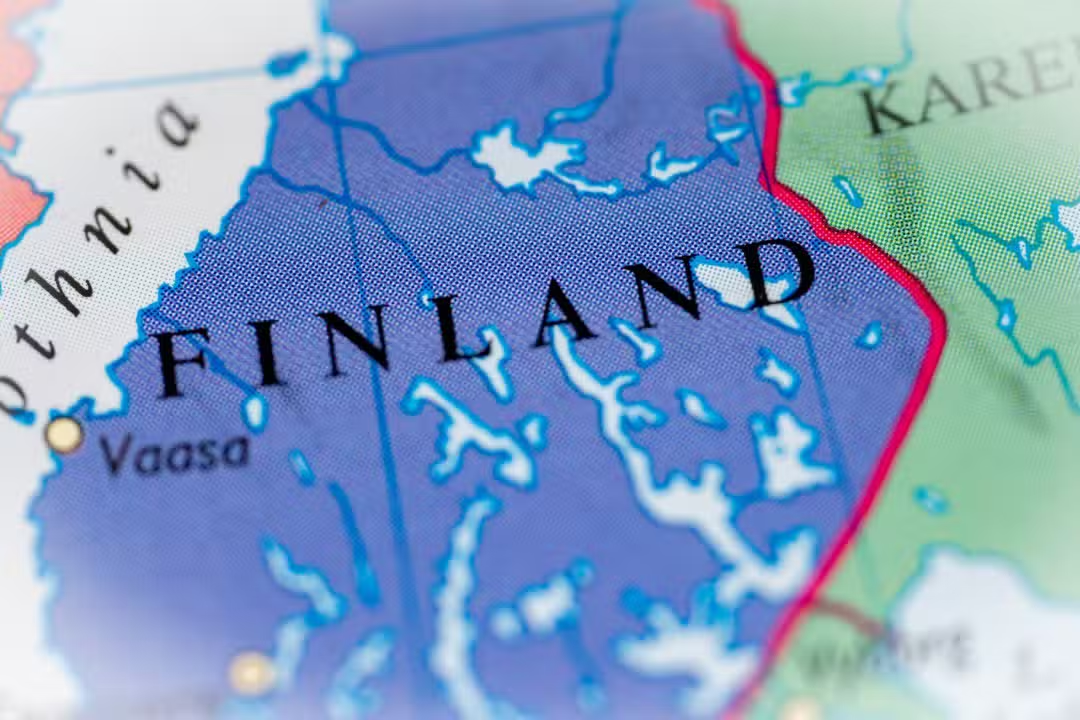
European Resources (ASX: ERE) advances exploration of a rare earths project at Finlândia, seeking to transform a former lead mine into a strategic source for Europa. With a current market capitalization of approximately A$7.6 million, the company controls the Korsnäs ETR project. Efforts focus on metallurgical studies and expansion of exploration to assess viability.
Este movement gains relevance in the European context of searching for alternatives to the rare earth supply chains currently dominated by China. The Korsnäs project, with an inferred resource already reported, presents itself as a potential element in the diversification of these sources. The narrative highlights the importance of distinguishing proven facts from market speculation.
Antiga Korsnäs mine reassessed for rare earths
The historic Korsnäs mine, located at Finlândia, which for decades was focused on lead production, is being revisited by European Resources. The rare earths present at the site were largely neglected during the previous period of operation. Agora, the company reports an inferred resource of 15.4 million tonnes grading 1.0% TREO (rare earth elements).
The distribution of paramagnetic neodymium (NdPr), crucial elements for modern technologies, reaches approximately 22.7% within this resource. Além from the main resource, European Resources identifies additional opportunities. Estas include the potential to use tailings and concentrate stocks already existing in the mine area, which can expand the scope of the project.
Finlândia offers strategic mining environment
Finlândia maintains its position as one of the most favorable mining jurisdictions globally, a crucial factor in the development of the Korsnäs project. The country provides robust infrastructure and consolidated expertise in licensing processes, which simplifies bureaucratic steps for mining projects. Talentos specialized technicians are readily available, offering skilled labor and local knowledge.
The project’s geographic location is strategic, providing proximity to subsequent mineral processing facilities. One example is the Neo Performance Materials refinery, located at Estônia, which can facilitate the refinement of rare earth concentrates. The combination of these factors reinforces the appeal of the Korsnäs project for diversifying the critical minerals supply chain for Europa. European legislation, such as Lei de Matérias-Primas Críticas, drives initiatives like this, seeking autonomy and security in the provision of essential resources.
Estudos metalworkers indicate promising viability
The metallurgy of the Korsnäs project demonstrates promising results, according to independent studies that provided data on mineral recovery. Diversas institutions participated in these in-depth analyzes of the mine material. GTK Mintec, ANSTO and Universidade of Oulu contributed significant investigations to understand the composition and characteristics of the ore.
PT Geoservices was also involved in the processes, reinforcing the scope and collaboration in the studies. Research suggests the existence of recoverable monazite-apatite mineralization, an important indicator for the efficient extraction of rare earths. Houve also indicates significant improvements in beneficiation methods. Estes avanços são cruciais para otimizar o processo de separação dos minerais.



- The preliminary results of the metallurgical studies are:
- Mineralização recoverable:Indícios of monazite-apatite recoverable in deposits.
- Melhorias in processing:Sugestões to optimize separation and concentration processes.
- Colaboração technique:Envolvimento of GTK Mintec, ANSTO, Universidade of Oulu and PT Geoservices.
- Recurso formal:Confirmação of the existence of an official inferred resource.
Ressalvas for investors in the potential of Korsnäs
Apesar of optimism, European Resources still needs formal economic validations for the Korsnäs project. Embora presentations analyzed by Rare Earth Exchanges™ highlight the “resource growth potential” and a “7 kilometer extension”, this information represents projections and not confirmed assets. Alvos Additional exploration and comparisons with large systems such as Halleck Creek on Wyoming should be interpreted as future possibilities rather than current guarantees.
The company has not yet made public a detailed feasibility study, full economic assessment or formal reserve estimate. Também does not have a published commercial development plan. Afirmações such as that there are “no warning signs” in metallurgy are considered management opinions. Tais statements do not constitute proof of future economic success, and investors should weigh the risk inherent in a project in the early stages of development.
Papel of Korsnäs in European Rare Earth Autonomy
The Korsnäs project, despite its initial stage, is part of Europa’s macro strategy to guarantee its autonomy in rare earths. União Europeia has growing demand for mines, mineral separation capacity and infrastructure for permanent magnet manufacturing. The region seeks scale to reduce dependence on external suppliers.
Embora The Korsnäs design alone will not challenge China’s supremacy in the global rare earths market, it represents an important step forward. Dezenas projects like this need to transition from the drilling phase to commercial production. Isso is critical for Europa to achieve its ambitions set by Lei of Matérias-Primas Críticas. With an estimated market value of A$5.4 million, European Resources exemplifies a junior exploration company. Ela carries both high risk and high return potential for investors who closely follow the sector. The interesting geology and strategic location are strong points. Economic viability remains the next big challenge.
Veja Tambem em Latest News (EN)

Passenger tries to enter cockpit and forces diversion of United Airlines flight to Madison
Astronomer explains white light recorded after meteor falls near volcano in Philippines

Comedian Sakamoto-chan reveals type 2 diabetes remission after lifestyle changes
Avi Loeb says discovery of alien intelligence can unite humanity amid global crises

Police investigate death of Hilde Ann Lynn Helphenstein in room at Rosewood São Paulo

Avi Loeb suggests that dark comet 1998 KY26 could be Soviet probe Phobos 1

Typhoon Chan-mi approaches Okinawa and Amami with strong winds this Tuesday

Bad smell in children’s feet has specific causes and can be controlled by parents

Google releases Android 17 Beta 4.1 for Pixel devices

Avi Loeb explains meteor explosion that shook Massachusetts with 2% energy from the Hiroshima bomb

Courtney Clenney’s defense inspects murder knives at Florida hearing