

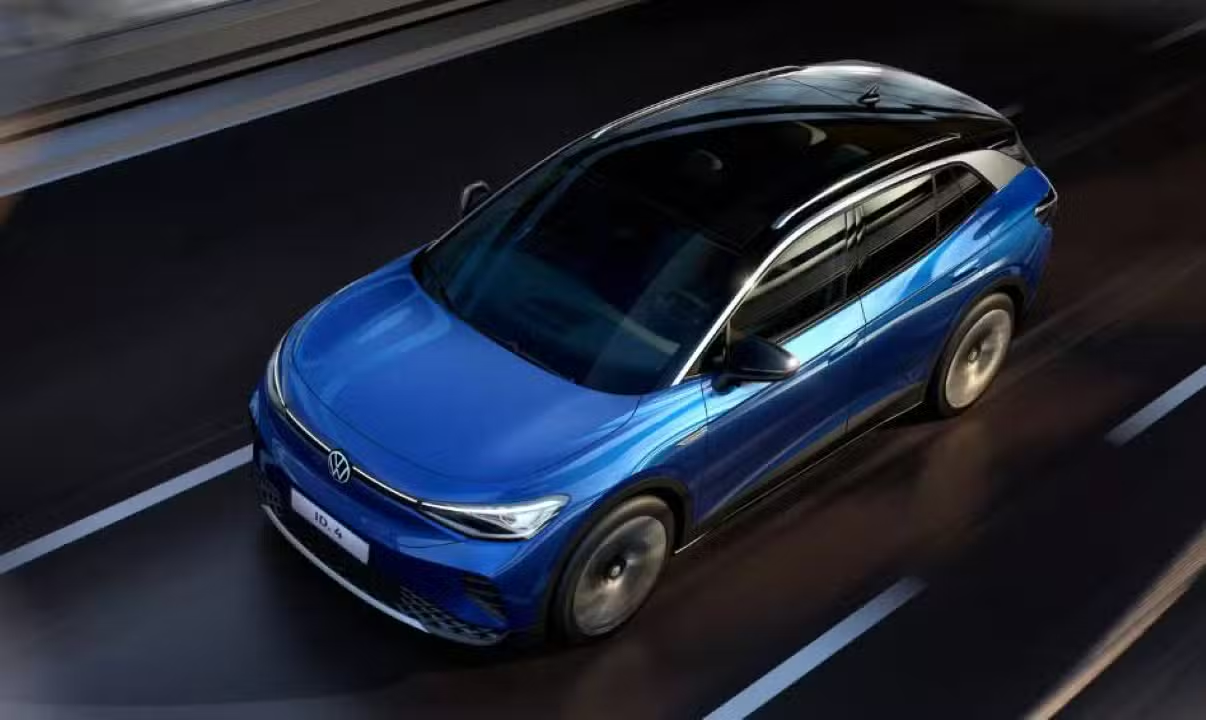
Used Um Volkswagen ID.4, purchased for a price below 20,000 dollars, is at the center of a major upgrade. The owner, Wes, of the Out of Spec Bits channel on YouTube, detailed his experience with the electric crossover after five months of intensive use. Ele has faced several technical problems and issues related to battery degradation, including a factory recall that directly affects the model.
The purchase was made at a time of rising gasoline prices, making pre-owned electric vehicles an attractive option on the market. The potential fuel savings are significant, especially for those who have access to cheap home charging. Este scenario underlines the relevance of Wes’s detailed analysis on vehicle acquisition and maintenance.
Aquisição strategic and initial value of ID.4
Last December, Wes purchased an Volkswagen ID.4 AWD Pro, model 2023. The vehicle was purchased for just US$19,300, a value considered highly advantageous for the used electric car segment. At the time of acquisition, the car’s odometer read approximately 46,000 miles, equivalent to approximately 74,000 kilometers. Este low price for an electric car with four-wheel drive and enough space for a family attracted attention on the used market. The EPA-estimated range for the new model was 255 miles, equivalent to about 250 miles on a full charge. The proposal was to offer a robust and affordable electric SUV, and the initial analysis indicated an exceptional and strategic purchase.
The decision to invest in a used electric car reflects a growing trend in the global automotive market. Consumidores seek more economical and sustainable alternatives to the high costs of fossil fuels. The affordability of the Wes ID.4 was a decisive factor for the acquisition, promising a good value for money.
Diagnóstico from failures and wear after 16,000 km
Após After five months of continuous use and covering around 16,000 kilometers with the vehicle, Wes identified some faults. The most significant problem is related to the car’s GPS antenna module. Este component cannot locate the vehicle with the necessary precision, causing problems in using the integrated navigation system. The inability to use the navigation system efficiently creates great frustration during travel.
Para bypass the GPS failure, the owner found temporary solutions that helped mitigate the problem. Remover and replacing a specific fuse restores normal system operation for a few days. Outra’s effective strategy has been to force the Android Auto to use the GPS signal from the driver’s smartphone rather than the car’s native system.
Além of the electronic issues, mechanical problems were observed in the vehicle. A small noise is audible at the front on the passenger side, the origin of which has not yet been fully clarified. The owner also noted the imminent need to change the rear tires, indicating accelerated wear.
- Problemas identified after purchase:
- Módulo of the GPS antenna showing failures in precise location.
- Presença of a small noise in the front passenger side.
- Pneus rear ends with accelerated wear, requiring replacement soon.
Rapid wear of the rear tires is a known feature of the Volkswagen ID.4, according to reports from other owners. Embora is a four-wheel drive model, its weight distribution is predominantly concentrated at the rear of the vehicle. Isso results in greater load and, consequently, greater wear on the rear tires compared to the front.
Disparidades on battery degradation and recall
The battery condition of Wes’s ID.4 revealed contradictory and potentially worrying data. At the time of purchase, an official report that accompanied the vehicle indicated a degradation of just 6% of the battery’s total capacity. Entretanto, five months later, analysis of data extracted directly from the vehicle’s OBD port presented a different scenario. The battery’s usable capacity was measured at approximately 65 kilowatt-hours, a value that suggests an actual degradation of about 15% of the original capacity. The significant difference between the reports raises questions about the accuracy of initial assessments and evolving battery health. Esta discrepancy has a direct and notable impact on the driver’s perceived range.
The car’s original range, when new, was 410 kilometers (255 miles) on a full charge, as estimated by the EPA. With the 15% degradation now noted, the current theoretical range would be around 350 kilometers (217 miles). Isso represents a significant reduction for longer trips and everyday use.
Adicionalmente, this specific Volkswagen ID.4 was included in a large-scale battery recall promoted by the automaker. The recall affects North American models that use cells manufactured by SK On. Esta preventive measure aims to correct potential internal failures in the vehicle’s energy system, ensuring the safety of occupants.
Medidas security information and reported incidents
The recall report imposes important restrictions on owners of affected vehicles to ensure safety. Recomenda battery charging is limited to 80% of its total capacity, avoiding full charges. Além Furthermore, the use of direct current (DC) fast chargers should be strictly avoided until the Volkswagen provides a definitive solution to the problem. Estas precautions are mandatory to prevent additional risks.
The need for the recall arose after four fires were recorded in batteries of ID.4 models in circulation. Esses incidents pose a serious risk to the safety of drivers and passengers. The urgency of the automaker’s action is evident given the critical nature of the reported failures.
Volkswagen proposed a comprehensive technological solution to mitigate the risks associated with batteries. Será installed self-discharge detection (SDD) software on all impacted vehicles. Este advanced program has the primary function of identifying battery modules that present defects or anomalies.
Caso the SDD software points out irregularities or defective modules during the analysis, these components will be replaced. The exchange will be carried out free of charge by Volkswagen, at no cost to the owners. Esta measure aims to restore the safety and full functionality of the vehicle, minimizing the risks of future incidents.
Percepção from the owner on the experience and value for money
Apesar faced all the technical issues, including battery degradation and the safety recall, Wes maintains a remarkably positive outlook on its acquisition. The owner of the ID.4 categorizes the car as “incredible for the price” paid. Essa evaluation reflects the balance between the challenges encountered in maintenance and the perceived cost-benefit of the purchase.
The combination of factors contributed significantly to this favorable perception. German engineering is widely recognized for the robustness and reliability of its vehicles, an aspect that Wes values. The production quality of the Volkswagen ID.4 is also highlighted as a strong point. However, the most determining factor in Wes’s satisfaction was the purchase price of US$19,300, which made the deal exceptionally attractive in the pre-owned electric vehicle market. Para the owner, the decision to buy a used electric car, despite the adversities, proved to be the right one. The savings generated by low charging costs at home complement the purchase price, partially offsetting the inconveniences faced.