Researchers capture unprecedented signal during supernova explosion and challenge models of stellar physics
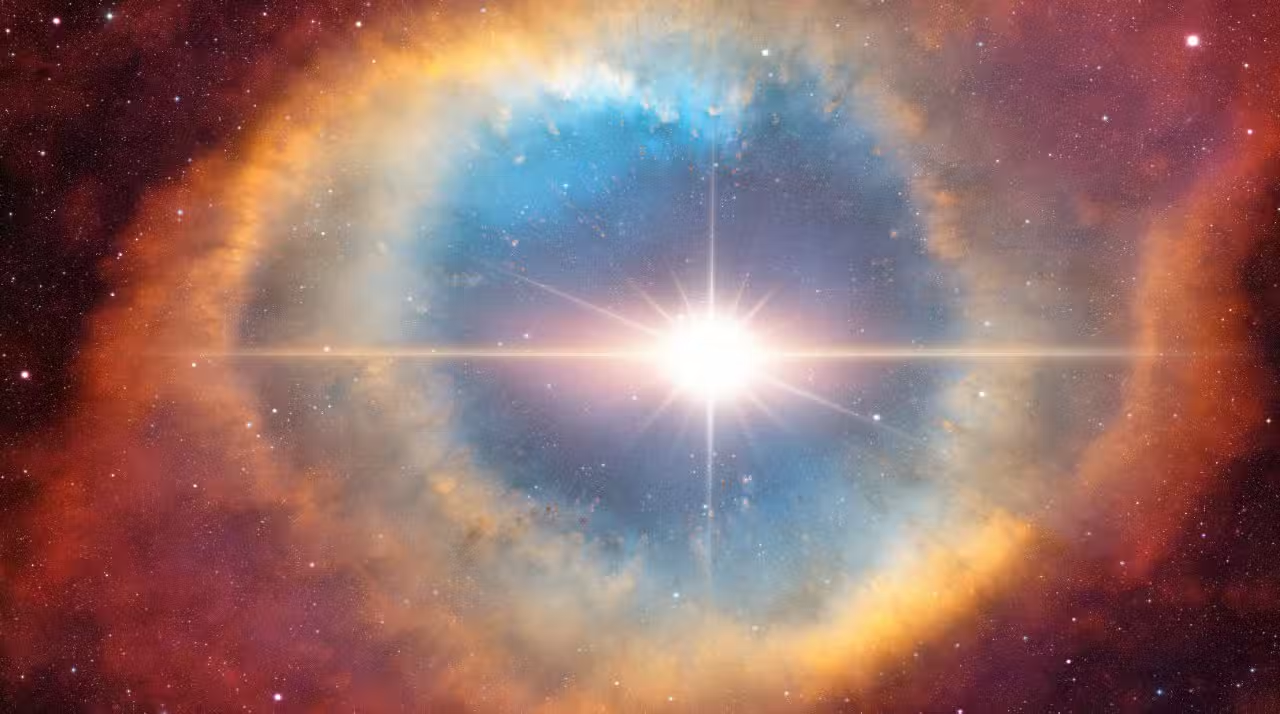
An international team of researchers has detected a novel signal pattern originating from a supernova explosion located millions of light years from Terra. The astronomical phenomenon generated emissions that resemble an acoustic pattern, captured using high-precision instruments aimed at observing deep space. The discovery provides direct and crucial data about the final moments of the lives of massive stars. Especialistas state that the anomaly demands an immediate revision of current physical models describing stellar collapse.
The unusual signal was isolated from a massive database of astronomical data, requiring advanced processing to confirm the integrity of the information. The frequency and continuous duration of the waves indicate an extreme level of instability in the star’s core moments before its total destruction. The event marks a turning point in modern astrophysics, as it exposes complex physical processes that occur during the death of giant celestial bodies. Analistas from the sector assess that understanding this mechanics can redefine knowledge about the evolution of the universe.
The collapse of the stellar core and the emission of gravitational waves
The dynamics of the explosion reveal that the gravitational force overcame the star’s internal pressure, resulting in a violent and instantaneous collapse. Esse process generates intense vibrations that travel through the fabric of spacetime, reaching Earth-based detectors after millions of years. The pattern identified by scientists shows a rapid increase in wave frequency, a behavior characteristic of extreme high-energy events. The precision of the data allows us to observe the exact transition between the original shape of the star and the residue left by the detonation.
Modelos Previous theorists did not predict the magnitude of the waves captured in this specific event. The release of energy during the collapse occurs in a fraction of a second, but carries detailed information about the density and rotation of the stellar core. Researchers use these metrics to calculate the mass ejected and the speed at which debris expands into outer space. Continuous analysis of these variables helps map the distribution of matter in neighboring galaxies.
The phenomenon also raises questions about the asymmetry of the explosion. A perfectly spherical detonation would not produce the type of signal detected by measuring equipment. The scientific team deduces that the collapse occurred irregularly, creating massive distortions that propagated through the vacuum. Essa irregularity provides clues about the star’s internal magnetic fields before its definitive demise.
The role of the Ligo and Virgo observatories in detecting the phenomenon
Confirmation of the event depended directly on the infrastructure of the Ligo observatories, located at Estados Unidos, and Virgo, located at Itália. Ambas facilities work together to triangulate the origin of gravitational waves with millimeter precision. The coordinated use of this global network of detectors eliminates false positives and ensures the accuracy of astronomical measurements. The laser interferometry technology used in these locations can measure variations smaller than the nucleus of an atom.
Multi-messenger astronomy stands out in this scenario of space discoveries. Essa approach combines gravitational wave data with observations of electromagnetic radiation such as X-rays and visible light, as well as particles such as neutrinos. The integration of these different sources of information creates a complete picture of the cosmic event. Cross-referencing allows scientists to confirm the exact location of the supernova and track the evolution of the stellar remnant over time.
The volume of data generated by these observations requires the use of supercomputers and artificial intelligence algorithms. The systems filter out the background noise of the universe and isolate the signals relevant to the study. Current processing capacity represents a technological leap compared to previous decades, enabling discoveries that were previously considered impossible. Collaboration between software engineers and astrophysicists becomes essential for the advancement of space science.
Formação of black holes and the creation of heavy chemical elements
The collapse of massive stars often results in the formation of black holes or neutron stars. The recent signal indicates that the remaining core reached a critical density shortly after the main explosion. The transition to a black hole occurs when matter collapses in on itself to a point of singularity, where the laws of classical physics no longer operate. Monitoring gravitational waves offers the only direct window to observe this exact instant of transformation.



Supernovae function as the universe’s main furnaces for the synthesis of heavy chemical elements. The extreme heat and pressure generated during detonation force atoms to fuse, producing metals such as gold, platinum and uranium. Esses materials are later ejected into space and end up composing new generations of stars, planets and life forms. Signal analysis helps quantify the rate of production of these elements in the observed event.
The dispersion of matter throughout the cosmos occurs at speeds that reach a significant fraction of the speed of light. The collision of this debris with interstellar gas generates wave fronts that heat the surrounding material, emitting radiation that can be seen by optical and radio telescopes. Tracking these shock fronts provides information about the density of the interstellar medium in the supernova host galaxy.
Próximos international team steps and protocol update
Diante the complexity of the data obtained, the international scientific community initiated a review of its analysis protocols. The team responsible for the discovery defined a series of priority actions for the coming months, aiming to improve the ability to detect similar events. The objective is to establish a new monitoring standard that can anticipate the capture of high-frequency signals.
The guidelines established by the researchers include hardware and software updates at the world’s main research centers. The work schedule requires the cooperation of government agencies and academic institutions to ensure funding and execution of tasks. The measures adopted seek to optimize the response time between initial detection and the activation of auxiliary telescopes.
The action plan focuses on specific areas of observational and theoretical astrophysics for the next years of operation:
- Desenvolvimento of new algorithms to filter noise in high-frequency gravitational waves.
- Criação of advanced three-dimensional simulations of fluid dynamics during stellar collapse.
- Ajuste in early warning systems to coordinate telescopes around the planet in real time.
- Mapeamento deep-sky continuum to identify terminal-stage supermassive stars.
Implementation of these technical improvements must occur before the start of the next cycle of global detector observations. The expectation is that the new equipment configuration will allow the capture of dozens of cosmic events per year with the same level of detail. The continued advancement of scientific instrumentation ensures that humanity expands its understanding of the fundamental forces that govern the cosmos.
The detailed study of the death of stars remains one of the most dynamic fields of space research in 2026. The fusion of data from photons, neutrinos and gravitational waves cements multimessenger astronomy as the definitive tool for exploring the universe. The research teams’ commitment to sharing information and improving methodologies ensures that each new signal detected contributes to the construction of a more accurate and comprehensive cosmological model.
Veja Tambem em Latest News (EN)

Passenger tries to enter cockpit and forces diversion of United Airlines flight to Madison
Astronomer explains white light recorded after meteor falls near volcano in Philippines

Comedian Sakamoto-chan reveals type 2 diabetes remission after lifestyle changes

Avi Loeb says discovery of alien intelligence can unite humanity amid global crises

Police investigate death of Hilde Ann Lynn Helphenstein in room at Rosewood São Paulo

Avi Loeb suggests that dark comet 1998 KY26 could be Soviet probe Phobos 1
Typhoon Chan-mi approaches Okinawa and Amami with strong winds this Tuesday

Bad smell in children’s feet has specific causes and can be controlled by parents

Google releases Android 17 Beta 4.1 for Pixel devices

Avi Loeb explains meteor explosion that shook Massachusetts with 2% energy from the Hiroshima bomb

Courtney Clenney’s defense inspects murder knives at Florida hearing