

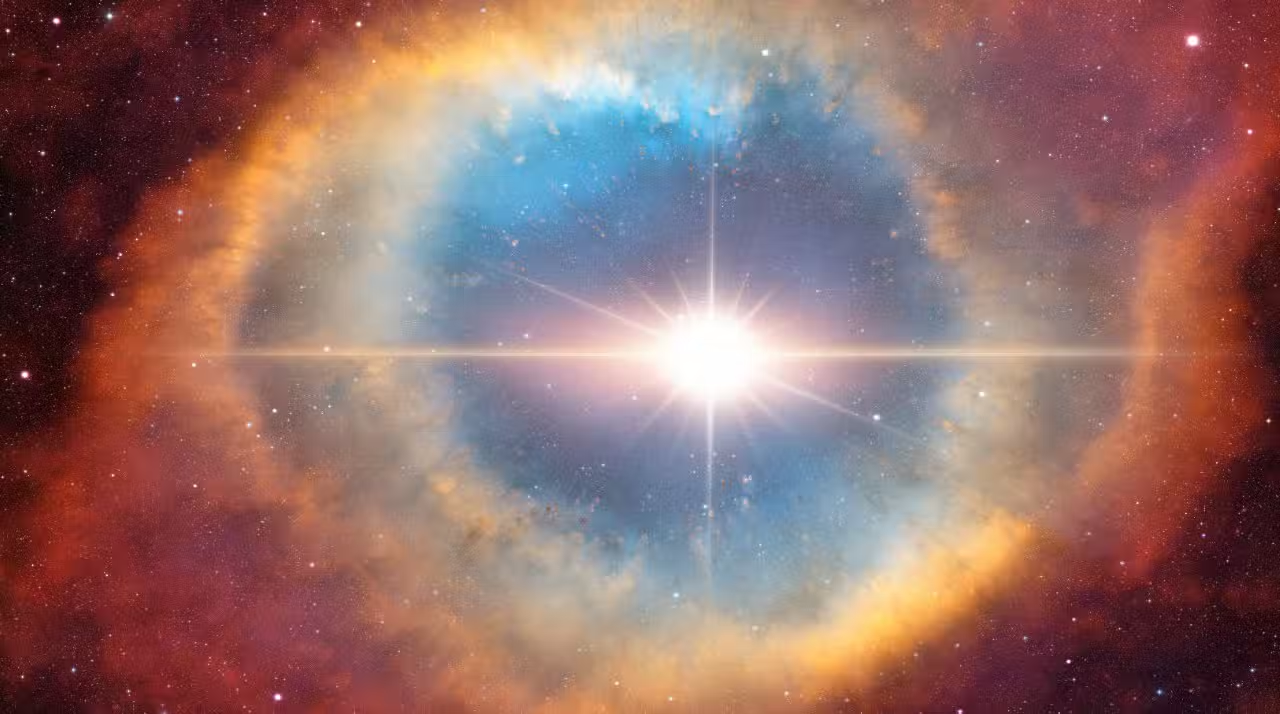
Simulações 3D performed by Japanese scientists showed the role of shock waves coming from late-life stars in the formation of peculiar structures in stellar nurseries. Essas configurations resemble giant wagon wheels, with filaments extending like spokes from a dense core. The process helps explain how gas organizes itself to give rise to new stars in Via Láctea.
Pesquisadores of Universidade of Kyushu and Universidade of Nagoya led the work. Eles used a supercomputer to recreate the conditions inside giant molecular clouds.
Simulações recreates interaction between gravity and shockwaves
Scientists have built a virtual molecular cloud with magnetic fields. Gravity first distorted these fields into an hourglass shape. Then, a simulated shock wave, similar to those generated by supernova remnants, passed through the structure.
The impact created oblique shocks at different angles. Essas regions amplified parts of the magnetic field and opened preferential channels for gas flow. Over time, the material became concentrated into elongated filaments that converge toward the center.
- The shock wave encountered curved magnetic fields at varying angles
- Choques obliques formed pathways for dense gas
- Filamentos stretched out like spokes from a wheel
- Central Núcleo became denser with the accumulation of material
- Low-density Gás between the spokes remained almost motionless
Essa dynamics occur over millions of years and result in systems known as Hub-Filament Systems (HFS).
Shingo Nozaki details the mechanism of star formation
Shingo Nozaki, lead author of the study and Kyushu’s doctoral student at Universidade, explained that stars are born in the coldest, densest parts of molecular clouds. Nessas regions, the gas collapses under its own gravity.
Muitos stellar nurseries display narrow filaments that funnel material into the core. Entender the origin of these filaments is essential to understanding how gas accumulates and forms stars. Simulations show that external shock waves play a central role in this process.
The ATERUI III supercomputer, dedicated to astronomy, allowed magnetohydrodynamic modeling to be performed at high precision. The results reproduced patterns observed by telescopes in several regions of Via Láctea.
Gás flows rapidly through the filaments
Nas simulations, dense gas moves along the filaments toward the center. Sua speed increases as it approaches the core. Já the less dense material between the spokes remains practically stationary.
Esse behavior explains why only a small fraction of the total gas in molecular clouds ends up turning into stars. Most remain dispersed or do not reach the critical density for collapse.
Researchers observed that the interaction between gravity, magnetic fields and shock waves creates a cosmic cycle. Explosões of dying stars help shape the environments where new stars are born.
Estudo advances understanding of difficult-to-observe processes
Observar directly forming these real-time systems is complicated due to the time and distance scales involved. Simulations offer a way to study these phenomena in detail.
Future Trabalhos plans to test different cloud configurations and shock wave intensities. Scientists want to understand why filament patterns vary in different regions of the galaxy.
The article was published on March 18 in the journal The Astrophysical Journal Letters.
Implicações for studying star formation in the galaxy
The discoveries connect the death of massive stars to the creation of new ones. Ondas shock and stellar winds from supernovae act as triggers that reorganize the gas into ordered structures.
Astrônomos have already identified several examples of these central-core filament systems in infrared and radio observations. Simulations now provide a plausible physical model for its origin.
The work reinforces the importance of computational simulations to complement data from telescopes such as the Herschel and Spitzer. Juntos, they help put together the puzzle of stellar evolution in Via Láctea.