

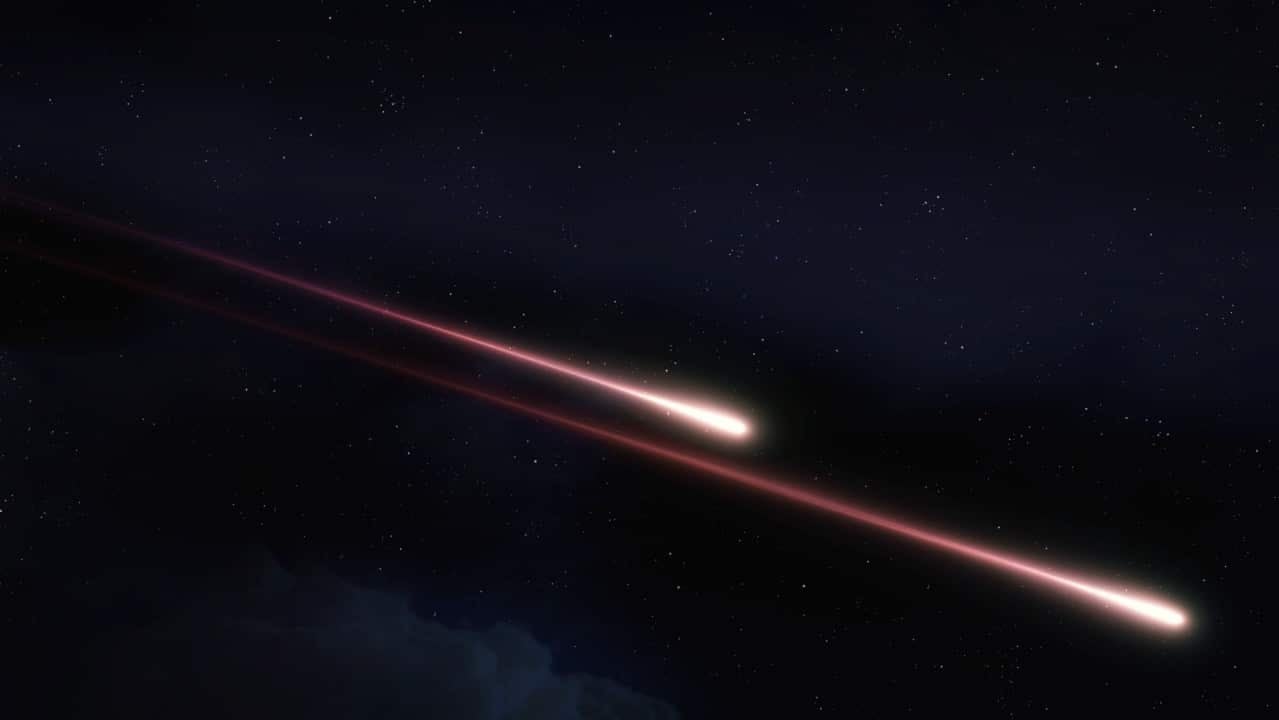
Avi Loeb and his postdoc Richard Cloete have identified a new interstellar meteor candidate in the CNEOS fireball database. The event, called Polar-IM, took place on April 1, 2026 at 02:13:14 UTC. The detection took place at an altitude of 90.5 kilometers over Oceano Atlântico Sul, east of Argentina.
The object’s speed clearly exceeded Sistema Solar’s escape limit. Calculations indicate statistical confidence greater than 99.9997% that it is an interstellar body. The analysis used an uncertainty model calibrated on data after 2018.
Polar-IM Detection Detalhes
The detection point is at latitude -41.9° and longitude -54.7°. The sensors recorded a geocentric velocity vector with a strong polar component of 59.8 km/s. Essa measured far exceeds the local escape velocity of Sistema Solar, which is 42.14 km/s.
- Final polar velocity Componente: +47.09 km/s
- Velocidade total heliocentric: 51.73 km/s
- Excesso heliocentric speed: 30.00 km/s
- Ângulo tilt: 89.4 degrees
The impact energy was modest, equivalent to 0.086 kilotons of TNT. The object had an estimated mass of around 150 kilograms and a diameter of approximately half a meter.
Trajectory Analysis Metodologia
Loeb and Cloete transformed the reported velocity vector into inertial geocentric state. Eles applied two-body hyperbolic model to consider the gravitational acceleration of Terra. Depois, added the heliocentric velocity of Terra obtained from JPL Horizons.
The team propagated measurement uncertainties across one million Monte-Carlo realizations. Nenhuma of them resulted in bound heliocentric orbit. The margin-to-dispersion ratio reached 12.82 sigma. Isso reinforces interstellar classification.
The high polar component minimizes corrections required by Terra’s axial tilt of 23.4 degrees relative to the orbital plane. Essa feature facilitated the initial completion of Loeb when querying the database.
Comparação with other interstellar candidates
Polar-IM stands out as the most robust candidate registered in the CNEOS catalog to date. Previous Eventos, such as the 2014 meteor known as IM1, have generated discussions about material recovery. In the case of Polar-IM, the high altitude and low energy complicate searches for fragments.
The object likely broke up in the upper atmosphere. Qualquer remaining material would require accurate calculation of the drop ellipse to assess search feasibility. Diferente of IM1, there are no immediate plans for an oceanographic expedition.
Outros telescopic interstellar objects, such as 1I/’Oumuamua and 2I/Borisov, confirm that larger bodies transit the inner Sistema Solar. Modelos populations predict many smaller objects on the meter scale that only reveal themselves as fireballs when entering the Earth’s atmosphere.
Próximos recommended steps
The current priority is higher fidelity reconstruction of the trajectory. The researchers suggest four main actions:
- Testes Uncertainty Inflation and Tail Sampling for Speed Errors
- Integração reverse trajectory with detailed model Terra-Moon-Sun
- Refinamento of input velocity vector
- Modelagem of atmospheric entry, fragmentation and wind drift if warranted
Observações independent of ground-based optics, infrasound, seismic, satellites or regional fireball networks on April 1, 2026 could validate the measurements. Qualquer additional data would help confirm the interstellar origin.
Contexto of interstellar meteors
Meteoros interstellar represents material coming from other stellar systems. Sua detection by networks such as CNEOS allows direct study without relying solely on telescopic observations. The Polar-IM reinforces the idea that small objects enter the Sistema Solar more frequently than previously imagined.
Avi Loeb has led similar efforts in the past. Sua team seeks evidence that expands knowledge about the composition and dynamics of these cosmic visitors. The current work was completed within days of initial identification in the database.
The complete article with detailed analysis is available for scientific consultation. Ele includes all Monte-Carlo calculations and simulations that support the conclusions presented.