

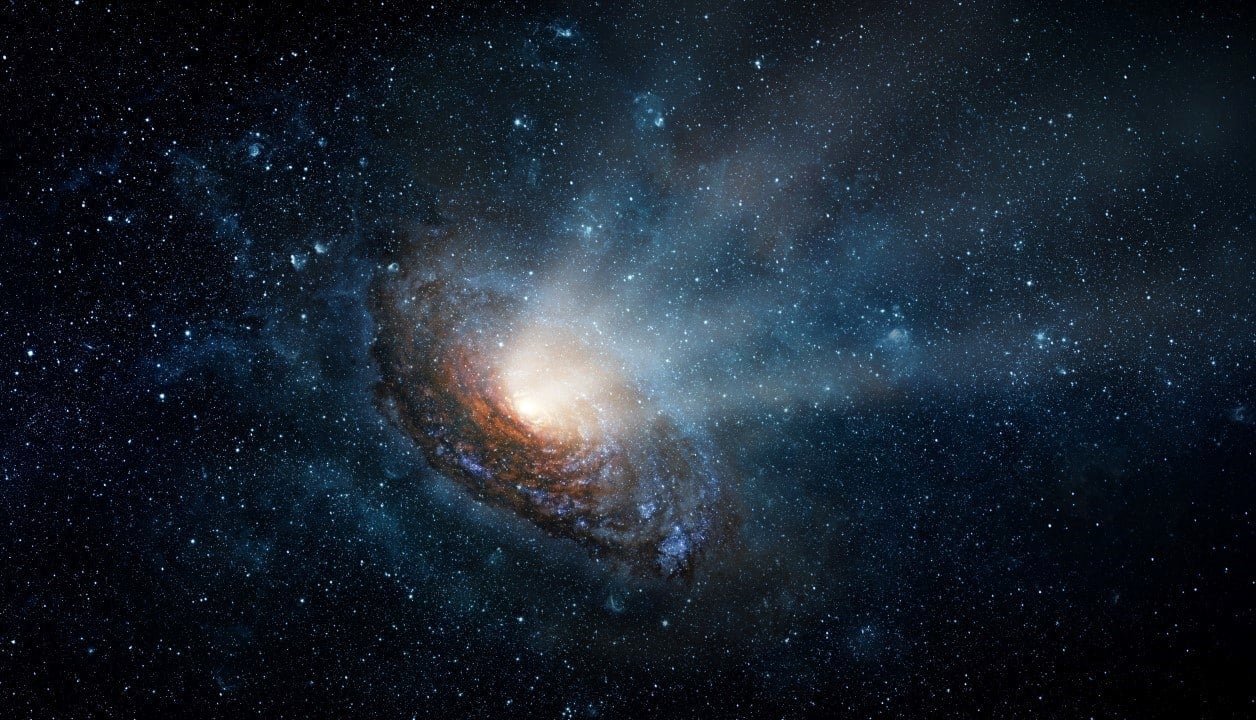
Telescópio Espacial James Webb has identified the most distant dormant black hole ever recorded by astronomers. The massive object is at the center of the galaxy MRG-M0138, located more than 10 billion light-years from our planet. The observation allowed scientists to directly measure the mass of an inactive cosmic structure at such a remote period in the history of the universe.
Research published in the scientific journal Science details the use of natural gravitational lensing to magnify the image of the distant galaxy. The method made it possible to precisely track the movement of stars orbiting the central region. The adaptation of this technique provides unprecedented data on the formation of these objects and the influence they exerted on galaxies in the young universe.
Gravitational Lente enables unprecedented observation in deep space
The measurement required the use of a physical phenomenon predicted by the theory of general relativity. A cluster of galaxies positioned in the foreground acted as a giant cosmic magnifying glass. The immense gravity of this cluster bent the light coming from MRG-M0138, creating multiple images and magnifying the original brightness by approximately 30 times.
Sem this natural magnification, the equipment would not be able to resolve the necessary details in the central region of the target galaxy. Gravitational lensing allowed infrared sensors to capture subtle differences in speed between stars. The stars closest to the center move differently from those located at the edges of the system.
Richard Ellis, researcher at University College London and senior author of the study, evaluated the visual impact of the discovery. The clarity provided by modern instruments combined with the rare cosmic alignment facilitates the mapping work. The specific spatial configuration serves as an essential resource for the study of very distant and ancient structures.
Ausência light emission requires new measurement approach
The black hole located in MRG-M0138 is in a state of dormancy. Esta condition means that there is no matter or gas falling toward the event horizon at the current time. The lack of friction and material heating makes the object invisible at all wavelengths of the electromagnetic spectrum.
Pesquisadores led by Andrew Newman, from the institution Carnegie Science, needed to adapt calculation methodologies. The team applied a stellar dynamic analysis system normally used only in galaxies close to Via Láctea. Tracking the orbits of neighboring stars revealed the gravitational pull exerted by the dark center.
The successful application of this technique sets new benchmarks for observational astrophysics.
- The galaxy MRG-M0138 appears magnified by natural gravitational lensing.
- Estrelas orbit the central black hole with speeds measurable by sensors.
- Massa determined by high-precision stellar dynamic analysis.
- Técnica now viable for objects located in the early universe.
Final calculations indicated that the black hole has a mass equivalent to about 6 billion times that of Sol. The number impresses experts because it is a structure formed when the universe was only around 3 billion years old. The approach bypasses the technical barrier of directly observing celestial bodies that do not emit radiation.
Interrupção in star formation marks the galaxy’s past
The analysis of MRG-M0138 revealed peculiar characteristics about the system’s evolution. The data show clear signs that the process of new star formation stopped abruptly in the distant past. The stars present in the galaxy are old and there is no evidence of active stellar nurseries in the observed region.
Scientists suspect that the galaxy hosted an extremely active quasar in its early stages of development. The energy released by this phenomenon would have violently expelled the reserves of cold gas necessary for the creation of new stars. The process exhausted the available fuel, depriving the black hole of matter and leaving the galaxy in a state of calm.
Andrew Newman highlighted the differences in evolutionary rhythm found in deep space. In other early galaxies mapped by the telescope, star formation ceased at much later periods. Direct comparison between these systems helps to build a more accurate model of the different development paths of cosmic structures.
Futuras space missions should expand catalog of discoveries
The current detection reinforces the fundamental role of supermassive black holes in regulating the galactic life cycle. The episode of intense activity in MRG-M0138 accelerated the end of the star creation phase, transforming it into an early inactive galaxy. The study offers concrete clues about the formation of so-called dead galaxies early in the history of the universe.
Equipes international astronomy scientists plan to expand the data sample with new targeted observations. The focus of the next campaigns is on other galaxies affected by gravitational lensing that present similar interruptions in star formation. Current theoretical models will undergo updates to incorporate these dynamic measurements into large-scale evolution simulations.
Continuing technological advancement promises to accelerate the pace of discovery over the next decade. Futuras observations conducted by new generation equipment, such as the Euclid and Nancy Grace Roman space telescopes, should identify dozens of galaxies magnified by cosmic lenses. The successfully tested stellar dynamic measurement technique opens a definitive window into understanding the invisible giants that inhabit the far reaches of space.