
NASA questions Viking results about possible life on Mars

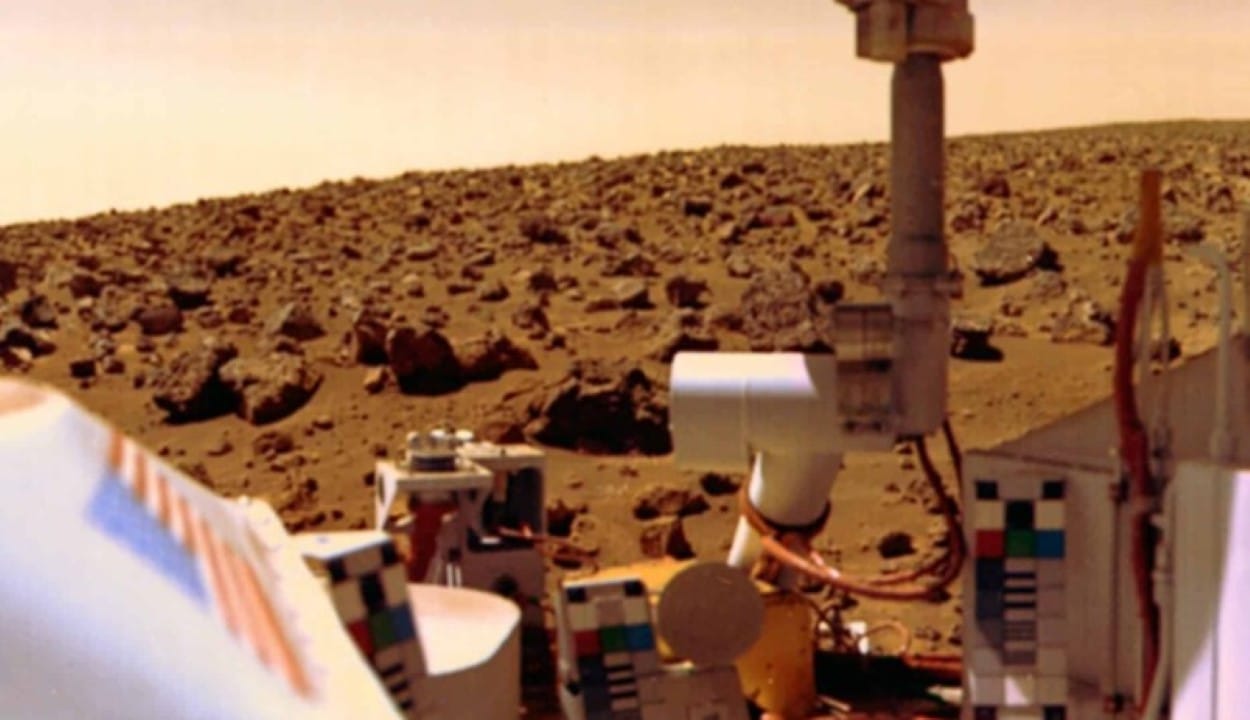
The Viking 1 probe landed on Mars on July 20, 1976 and carried out experiments to look for signs of biological activity in the planet’s soil. Labeled Release, one of the main tests, recorded the emission of radioactively labeled carbon gas after adding nutrients to the samples. Similar results appeared on Viking 2, which arrived in September of the same year.
Scientists interpreted the data as possible evidence of microbial metabolism. Other experiments, however, did not detect organic matter, which led to the official conclusion of the absence of life. The debate is now resurfacing with new analyses.
Labeled Release experiment showed consistent reaction
The test injected a nutrient solution with carbon-14 into the Martian regolith and monitored the release of 14CO₂. Both probes recorded emission peaks that repeated in cycles.
The response decreased after heating the samples, a behavior similar to that of terrestrial microorganisms. Gilbert Levin, the experiment’s main investigator, defended the biological hypothesis until the end of his life. The scientific community, however, prioritized chemical explanations based on the absence of organic compounds detected by another instrument.
Martian soil contains perchlorates, oxidizing substances that can mimic biological reactions. This discovery, made decades later, reinforced initial skepticism. Still, debate persists over whether the results were discarded prematurely.
- Viking 1 landed on Chryse Planitia
- Viking 2 landed on Utopia Planitia
- Labeled Release worked on both missions
- Other tests: Pyrolytic Release and Gas Exchange
- Gas Chromatograph-Mass Spectrometer found no organics
Avi Loeb criticizes conservative approach to astrobiology
The Harvard University astrophysicist published a recent text comparing the case to false negatives in science. He argues that risk aversion led the community to ignore intriguing early signs.
Loeb cites his own experience with the interstellar object Oumuamua, initially rejected as a possible technosignature. In the article, he argues that disruptive ideas deserve careful investigation rather than outright rejection.
The lack of repetition of the Labelled Release experiment in later missions reinforces the point. No probe sent after 1976 attempted to exactly reproduce the active metabolism test.
Steven Benner prepares book about Viking’s 50th anniversary
Astrobiologist Steven Benner launches the book “Meet the Neighbors” in July 2026, which revisits Viking data. He questions the official interpretation and defends new analyses. Benner has published articles on the topic since 2000.
The date marks the anniversary of the missions. The 400-page work must provide technical arguments about why the experiment may have captured microbial life.
Experts highlight that the Gas Chromatograph-Mass Spectrometer had sensitivity limitations. Traces of organic compounds later detected on Mars fuel the discussion about whether low-density microorganisms escaped initial detection.
Why NASA hasn’t repeated the test in half a century
Subsequent missions prioritized searches for ancient water, geology and atmosphere. None repeated the exact Labelled Release protocol, considered risky due to ambiguous results.
Critics see this as a missed opportunity. Repeating the experiment with modern technology could clarify whether the signal was biological or purely chemical.
Current investment in astrobiology, including rovers like Perseverance, collect samples for return to Earth. These materials could allow for more accurate testing in terrestrial laboratories.
Challenges in detecting microbial life on Mars
The Martian environment is hostile, with intense radiation, extreme temperatures and oxidizing soil. Any organism would need specific adaptations.
New missions plan to drill deeper, where conditions may be more stable. More sensitive instruments look for biomarkers that Viking’s equipment could not identify.
The discussion goes beyond Viking. She touches on scientific methodology itself and the balance between healthy skepticism and openness to new evidence.
Loeb’s article concludes that curiosity and humility are essential. Without new data, the mystery of the 1976 results remains open.





