
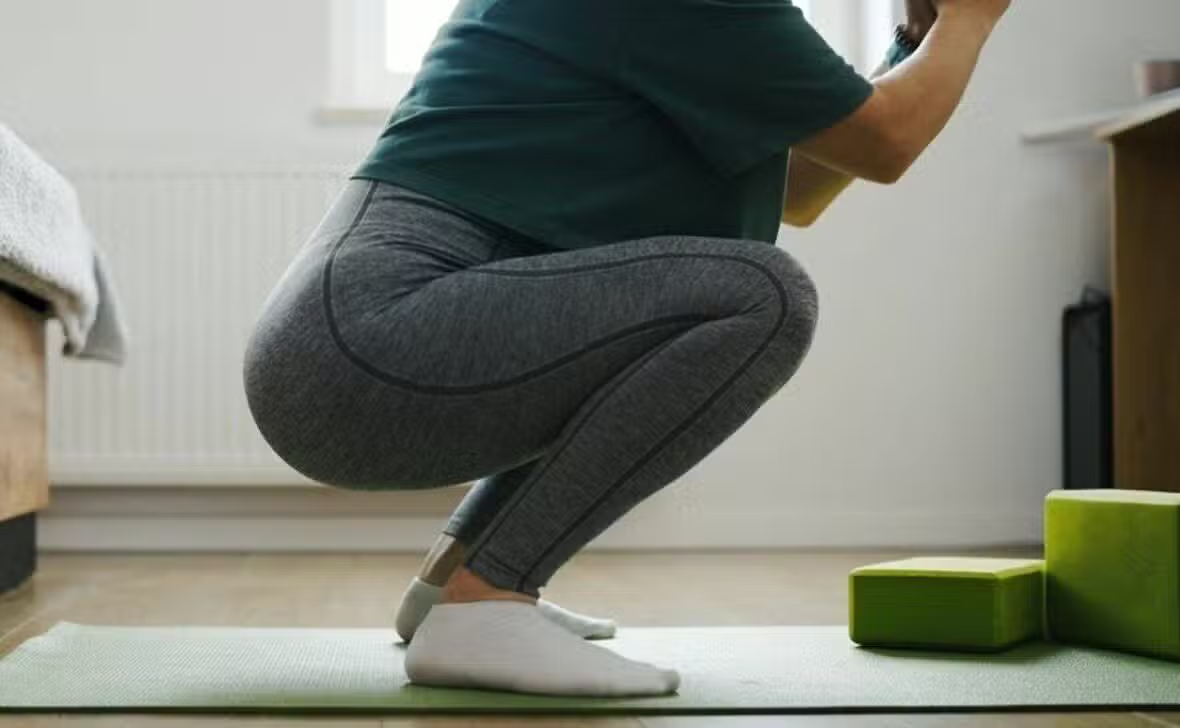
In several Asian countries, including China and Japan, the squatting position is an integral part of people’s daily routine. Individuals comfortably maintain this posture with heels firmly on the floor while waiting for transportation, interacting with friends, or even during meals.
Often, videos of tourists trying to replicate this type of squat go viral on social media, showing many of them losing their balance, falling backwards or to the sides, or needing external support to remain standing. Body movement experts emphasize that the growing interest in this position is intrinsically linked to a broader health issue: the relevance of preserving mobility as we age.
This raises a crucial question: why do some people perform deep squats with ease, while others find it difficult to even maintain themselves in that position?
The importance of deep squats for daily well-being and longevity
The squat is universally recognized as one of the cornerstones of human movement. “It’s practically impossible to live a day without performing some form of squats,” explains Christopher Powers, a professor at the University of Southern California, in the United States, whose research focuses on the relationship between movement patterns and knee injuries. He points out that this action is present in tasks such as sitting down, getting out of vehicles, using the bathroom or simply reaching for an object on the floor.
Although the conventional squat is widely known in training environments, where you bend your knees until your thighs are parallel to the ground, there is a deeper variation. The full squat, often called “Asian”, is distinguished by bringing the body to maximum flexion of the knees, which remain pointed outwards, with the feet slightly apart, the trunk aligned and the back of the thighs resting on the calves.
Matt Hsu, American trainer and founder of Upright Health, which specializes in mobility and strength, has achieved millions of views with his deep squat videos, but points out that the term “Asian” can be a misnomer. “People from Africa, Slavic countries and Eastern Europe claim this position as their own”, comments Hsu, emphasizing that “in fact, this squat is a universal heritage”.
The squatting posture also has historical relevance in Brazil. The literary classic “Os Sertões”, by Euclides da Cunha, published in 1902, illustrates squatting as a deep-rooted habit among the inhabitants of the backlands. The author describes that, when stopping for any simple reason – whether to prepare a cigarette or to talk –, the countryman “squats down”, remaining for a considerable time in unstable balance, with the weight of his body on his heels and resting on his toes, in a pose that is both peculiar and captivating.
Physiotherapists point out that the full squat demands broad mobility in the hips, knees and ankles, activating a greater number of muscle groups compared to the more superficial version. Research suggests that this range of movement contributes to increased flexibility, relief from low back pain and the maintenance of autonomy in daily activities throughout life.
Factors that lead to loss of the ability to squat deeply in adulthood
Children often assume this posture innately, with apparent ease. This ability is due, in part, to the greater malleability of the joints and the distinctions in body proportions compared to adults. However, anatomical changes are not the only cause for the progressive loss of the ability to perform a deep squat in adulthood.
Mostly sedentary lifestyle habits, with the predominant use of chairs and elevated toilets, result in few opportunities for most adults to squat deeply in their daily lives, leading, over time, to a decrease in mobility and physical strength. “What is not used is lost,” warns Powers, from the University of Southern California, about mobility.
Cultural habits that favor deep squats in some societies
Such transformations in living standards are less pronounced in certain regions of Asia, such as Japan, where routine actions, such as meals in restaurants, still require a squatting posture. “You have to go in, remove your shoes, squat down to the mat and only then sit down to eat,” details Hsu, from Upright Health.
Even the most elementary tasks of daily life directly depend on hip and leg strength. Hsu adds that “in certain Asian locations, there are still toilets that require a squatting posture, and daily use of this type of installation ensures that the ability to squat is maintained.” In a 40-minute interview with the BBC, Hsu demonstrated the deep squat position for long periods, with few interruptions.
For him, the relevance of such movements was particularly highlighted by a personal experience of his family. “My father fell and needed an ambulance to be rescued from the sidewalk, as he was no longer able to get up on his own”, he reports, highlighting the importance of mobility to prevent accidents and preserve autonomy, a crucial point for health in old age.
Despite his Asian heritage, Hsu reveals that he lost the ability to squat deeply in his 20s, following prolonged periods of sedentary lifestyle while recovering from sports injuries. “I couldn’t even touch my ankles, my body was so stiff,” he recalls. He needed new training to regain movement, stating that the ability to perform a deep squat is, like any other physical skill, capable of being learned.
Safe practices to develop the full squat
For those interested in learning the deep squat, Hsu advises caution not to overload the body. “It is inadvisable to try to descend quickly to the ground, as this could lead to injuries”, warns the expert. Hsu suggests a gradual progression, using supports such as chairs or benches, and only descending to a comfortable point. “With a few daily repetitions over a period of weeks, you will notice an improvement, gaining confidence to move forward with each attempt,” he predicts.
The process of relearning the deep squat, however, presents greater challenges as age advances. “As we age, there is reduced mobility in the joints, spine, hips and, notably, the ankles,” explains Powers of the University of Southern California, adding that “this further restricts the ability to perform this specific type of squat.”
Researchers confirm that squats, at any depth, provide benefits. However, Powers cautions that deep squats should not be viewed as a goal applicable to everyone, especially for individuals with preexisting knee, hip, or back pain. In clinical contexts, squat exercises are usually personalized, taking into account each patient’s body type, health history, injuries and individual goals.
“Although many claim there is a perfect way to perform the movement, the reality is different”, declares Powers, highlighting that “each individual has their own particularities”. Individuals with longer femurs, restricted ankle mobility, or variations in hip structure may face greater challenges maintaining balance and achieving a deeper squat, regardless of their fitness level. For some physical therapists, the true goal lies not in bringing the hips closer to the ground, but rather in ensuring the ability for independent movement throughout life.
Currently, science still lacks conclusive studies that attest to the long-term effects and benefits of daily and prolonged deep squat practice. Hsu clarifies that his goal is not perfection, but rather the reacquisition of a movement that the contemporary way of life may have suppressed over time. “My own experience teaches me that it is essential to have control over the body, to be able to stand up and face the force of gravity independently”, he concludes.