
NASA records formation in Echus Chasma with possible giant 4 km waterfall on Mars

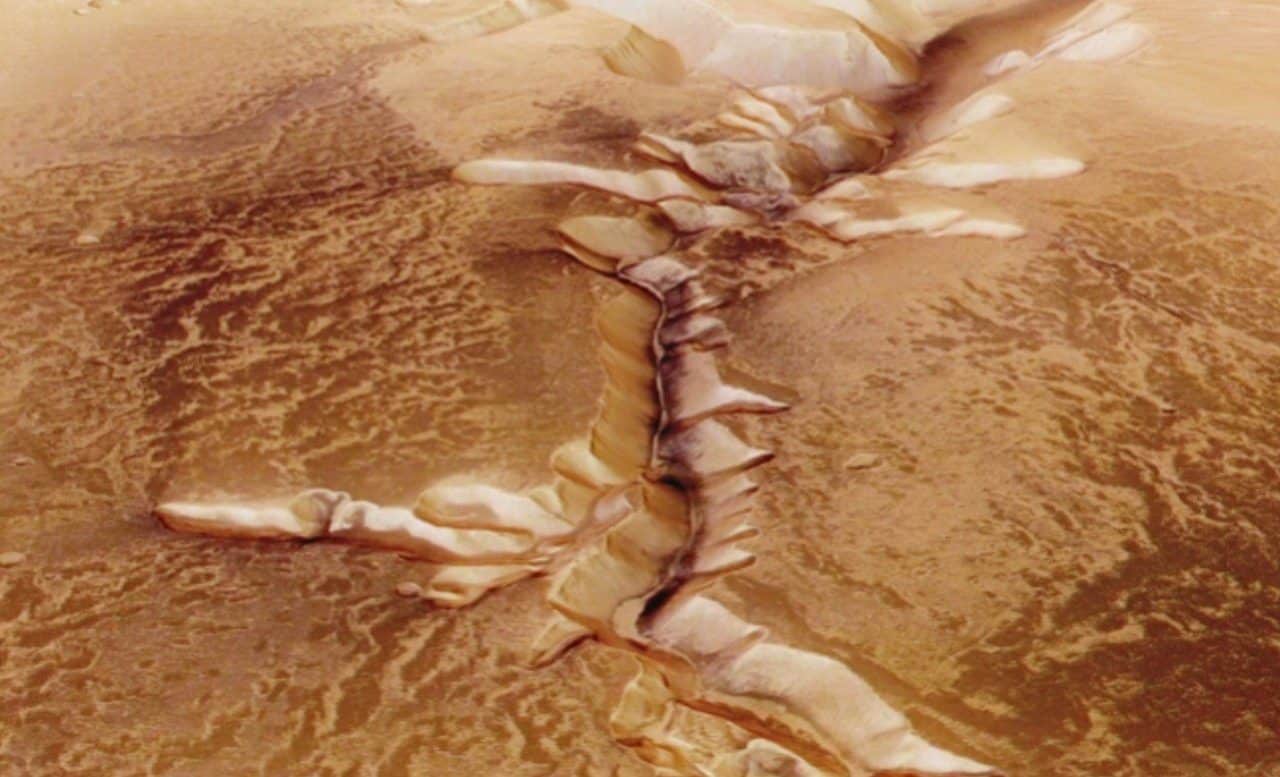
An impressive formation on Mars, compared to a giant waterfall by NASA, reignites discussions about the geological past of the Red Planet. Although the image is striking, the structure does not represent an active waterfall today, but rather an area of walls in Echus Chasma. With a difference in level of approximately 4,000 meters, the Martian landscape bears traces that may have been shaped by the action of ancient water, lava flows or a combination of both.
Scientific interest in the formation of Echus Chasma
The highlight of this remarkable Martian formation arises from the comparison between Echus Chasma and terrestrial waterfalls, with the 4 km drop in level surpassing the largest known on our planet. However, it is essential to interpret the idea of ”waterfall” as a reconstruction of Mars’ past geology, and not as a current scene.
Currently, Mars has a cold, arid environment with an extremely rarefied atmosphere. Therefore, the theory does not suggest free-falling water today, but rather a remote period in which intense currents would have carved vast canyons, valleys and giant walls on the Martian surface.
NASA observations in the Echus Chasma Valley
The space agency NASA released an image that highlights the imposing cliffs that delimit Echus Chasma. The explanation provided by the agency points out that the wall, with a height of around 4 km, may have been carved by water or lava throughout its history.
The most relevant points about this training include:
- Echus Chasma is located on Mars, in the northern portion of the gigantic Valles Marineris complex.
- The area features cliffs with an altitude difference approaching 4,000 meters.
- The hypothesis of a waterfall refers to flows that occurred in ancient eras, without indicating the presence of falling water today.
- NASA itself considers that water or lava are the most likely erosive agents for its formation.
- This region is connected to Kasei Valles, a colossal system of Martian canals.
The existence of an active waterfall on Mars today
It is crucial to clarify that an active waterfall, in the terrestrial sense, does not exist on Mars. What remains is a singularly preserved landscape, made up of cliffs, canals and a smoothed valley bed, with marks that indicate a past of powerful flows. Water, if it was a factor in this process, disappeared from the surface countless millennia ago.
Some aspects are essential to correctly interpret the headline:
- The photograph shows the Martian relief, not the movement of water.
- The measurement of 4,000 meters refers to the total difference in level of the wall.
- The theory involves events that occurred in the very distant past, possibly billions of years ago.
- Erosion may have been the result of water action, lava action, or a combination of both processes.
- The area maintains its importance for the study of the wettest period in the history of Mars.
The relevance of Echus Chasma to understanding Martian hydrology
The Jet Propulsion Laboratory (JPL/NASA) describes Echus Chasma as an area approximately 4 km deep and the source of the Kasei Valles system. This detail is significant, as Kasei Valles stretches thousands of kilometers across the planet.
If, in fact, water flowed over these walls, it would have been part of a hydrological system of gigantic proportions. This offers an explanation for how ancient flows were able to create such extensive channels on a planet that today appears almost completely dry.
For an insight into one of the most impressive landscapes ever documented outside of Earth, the BBC Earth Science channel, with its vast community of subscribers, presents content about Echus Chasma, on Mars, a site associated with an ancient megawaterfall that may have had falls of up to four kilometers.
Theories about the formation of four thousand meter walls on Mars
Caution is still needed when determining the exact cause. The European Space Agency (ESA) suggests that enormous volumes of water may have flowed from these cliffs in times past, but also notes that the valley floor was later flooded with basaltic lava.
Certain clues help to distinguish between hypotheses and evidence:
- 4 km wall:The high altitude would allow for a colossal fall into the past. The size of the area justifies its comparison with a waterfall on an extreme scale, and should be interpreted as a characteristic of the relief.
- Connected channels:Deep valleys establish a connection between the plateau and the Kasei Valles system. The geometric structure is consistent with ancient erosion processes, suggesting comparison of orbital images for analysis.
- Very smooth floor:The base of the valley appears to have been covered at a subsequent period. It is possible that basaltic lava obscured part of the previous geological marks, necessitating the separation of the geological phases.
- Title with current water:Headlines that insinuate the existence of a working waterfall today. This creates a distorted representation of the discovery and an inaccurate image of Mars, requiring context correction.
The size of the Martian formation in relation to the waterfalls on Earth
Salto Ángel, in Venezuela, is widely recognized as the largest waterfall on the planet, with a drop of less than a thousand meters. In contrast, the drop in level at Echus Chasma is about four times greater than this land mark.
However, this comparison has its limitations. On Earth, a waterfall can be observed as a water flow in constant activity. On Mars, the “waterfall” is a reading of an ancestral relief. What really surprises is not a curtain of water present, but the magnitude of a scenario that would have been capable of housing a waterfall of gigantic proportions.
The revelations of the Mars landscape about its geological trajectory
Analysis of this landscape reveals that Mars had much more dynamic processes than its current appearance suggests. Groundwater, large surface runoffs, intense erosion and volcanic activity may have alternated in the complex formation of Echus Chasma.
Mars’ “giant waterfall” has less value as a frozen visual spectacle and more as a valuable scientific clue. On its 4,000-meter walls, the red planet preserves a fundamental question: to what extent did water shape its surface before almost completely disappearing?





