
Mysterious predator: Hairy toadfish expands jaws 12 times to swallow prey and uses bait fin


With an expression that evokes a bitter mood and an appearance as if it has had a challenging day, the furry toadfish sports impressive jaws capable of expanding up to twelve times their usual size. This characteristic allows it to devour considerably large prey, highlighting it as one of the competitors for the title of most agile hunter in the aquatic kingdom. Their tactic includes luring victims with a fin disguised as a worm.
Despite being considered one of the most peculiar underwater creatures in terms of appearance, the hairy toadfish does not literally live up to its name. He is, in fact, a fish, not an amphibian, in addition to not having hair on his body structure.
Known scientifically as *Antennarius striatus*, or striated toadfish, this ocean dweller has an enigmatic appearance, resembling a sphere full of spines. However, its strange physical conformation is not the only peculiarity that distinguishes it.
Discover sixteen of the most unique and exotic species in the oceans
Enter the marine universe to discover the fascinating life forms that reside in the depths of the oceans.
Distinctive features of the striated toadfish, known as hairy
The hairy toadfish has specialized fins that have been adapted to serve as attractants, functioning as bait for its prey.
Hairy Toadfish Definition and Habitat
*Antennarius striatus* is a type of carnivorous fish that inhabits high-temperature ocean waters. Its body is covered in spiny projections that resemble a tangle of shaggy hair.
Six dangerous marine species that use extreme camouflage
The danger of these underwater creatures lies, in large part, in their remarkable ability to completely blend in with their deep-sea environment, becoming almost invisible.
The hairy toadfish’s camouflage is extraordinary, allowing it to change its color to mimic its surroundings. Interestingly, this species does not move by swimming.
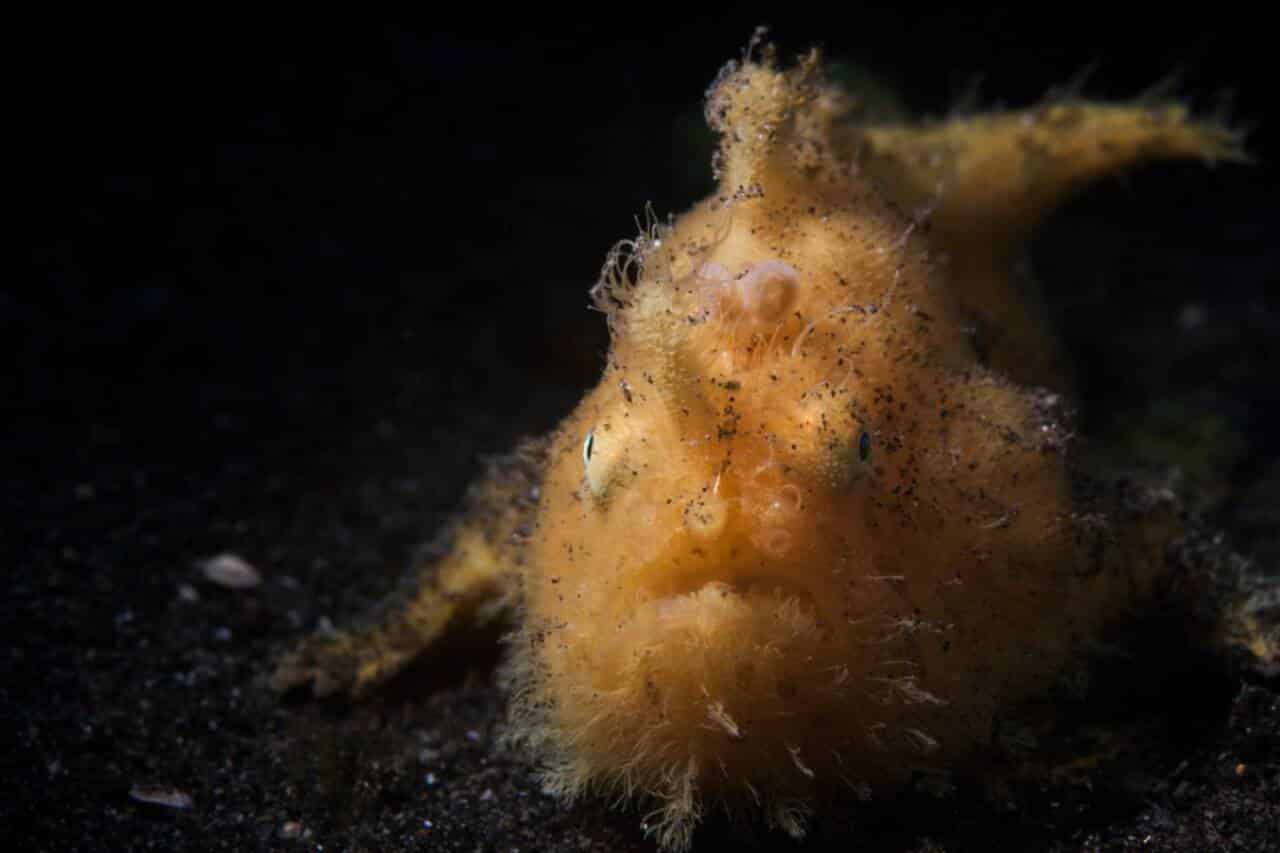
The dimensions and physical characteristics of the hairy toadfish
This fish can reach a length of up to 23 centimeters and weigh approximately 33 grams. It has a rounded body shape, with soft skin covered in spines. Although it is relatively small, it is an extremely skilled predator, with a wide mouth capable of swallowing prey of similar size to itself.
Eight aquatic predators with effective hunting tactics
The creature does not have traditional gills, but remains submerged for most of its existence.
The intriguing morphology and expression of the hairy toadfish
With a peculiar physiognomy, the hairy toadfish often displays a grumpy appearance due to its upturned mouth, which can be protracted or expanded. Its body, including its stomach, is also extensible and covered with spines that give the impression of a wavy, tangled head of hair, despite not having real hair.
One of its most notable features is a modified and flexible backbone, which functions as a kind of biological “fishing rod”, resembling a small worm. This structure is ideal for attracting prey. Furthermore, it usually has stripes or striated marks on its body, which can change, as well as its color, to improve camouflage in the environment.
This animal also has the ability to imitate other species, such as sea anemones, to scare away predators. The furry toadfish’s color-changing process can take a few weeks to complete.
The hairy toadfish’s voracious diet
The hairy toadfish devours just about anything its remarkable jaws can grab. It is a voracious and carnivorous predator, feeding on crustaceans and other fish, including specimens of a size comparable to its own. There are also records that the hairy toadfish practices cannibalism, consuming individuals of its own species.
Hairy Toadfish Hunting and Camouflage Strategies
Their hunting is remarkably effective, using two distinct approaches. The furry toadfish’s camouflage ability allows it to remain motionless, mimicking a piece of coral or algae, waiting for a fish or crustacean to pass nearby so it can be quickly captured.
Another tactic is to attract prey by waving its elongated adapted dorsal fin, which resembles a worm, arousing the curiosity of other fish. As victims approach, the furry toadfish grabs them with its powerful jaws. If the fin bait has no effect, it moves stealthily to shorten the distance to the prey.
When the prey is at a distance equivalent to the length of its body, the hairy toadfish can propel itself and swallow it whole by extending and lowering its jaw. They are incredibly fast, inhaling prey in just six milliseconds – an attack speed that confers a significant evolutionary advantage, ensuring success in capturing agile prey. Instead of teeth for chewing, they have small protuberances on the roof of their mouth, used only to retain prey.
Geographic distribution and threats to the hairy toadfish habitat
The hairy toadfish inhabits both shallow, sandy areas, with rocks and coral reefs, and deeper water regions. It is found in the Indo-Pacific and Eastern Atlantic areas. However, its habitat is under threat due to warming ocean temperatures, which affects the dispersal and color of corals, essential components of its ecosystem.
The peculiar locomotion of the hairy toadfish at the bottom of the sea
Although they move little, hairy toadfish demonstrate an impressive ability to propel themselves quickly across the ocean floor using their vast mouths and gills, similar to a jet propulsion system. Furthermore, they have wide, articulated fins that they use to move along the bottom, instead of swimming, as their fins are not adapted for this. It can be said, therefore, that they “walk” along the bottom of the ocean.
The reproductive cycle of the hairy toadfish
In general, hairy toadfish are solitary creatures and tend to avoid other members of the species, except during the mating period. When the female is ready to reproduce, she and the male rise to the surface, where the female releases her eggs into a gelatinous structure that resembles a raft, and the male fertilizes them. After a few days, the eggs usually sink to the ocean floor, at which point the embryos are ready to hatch.





