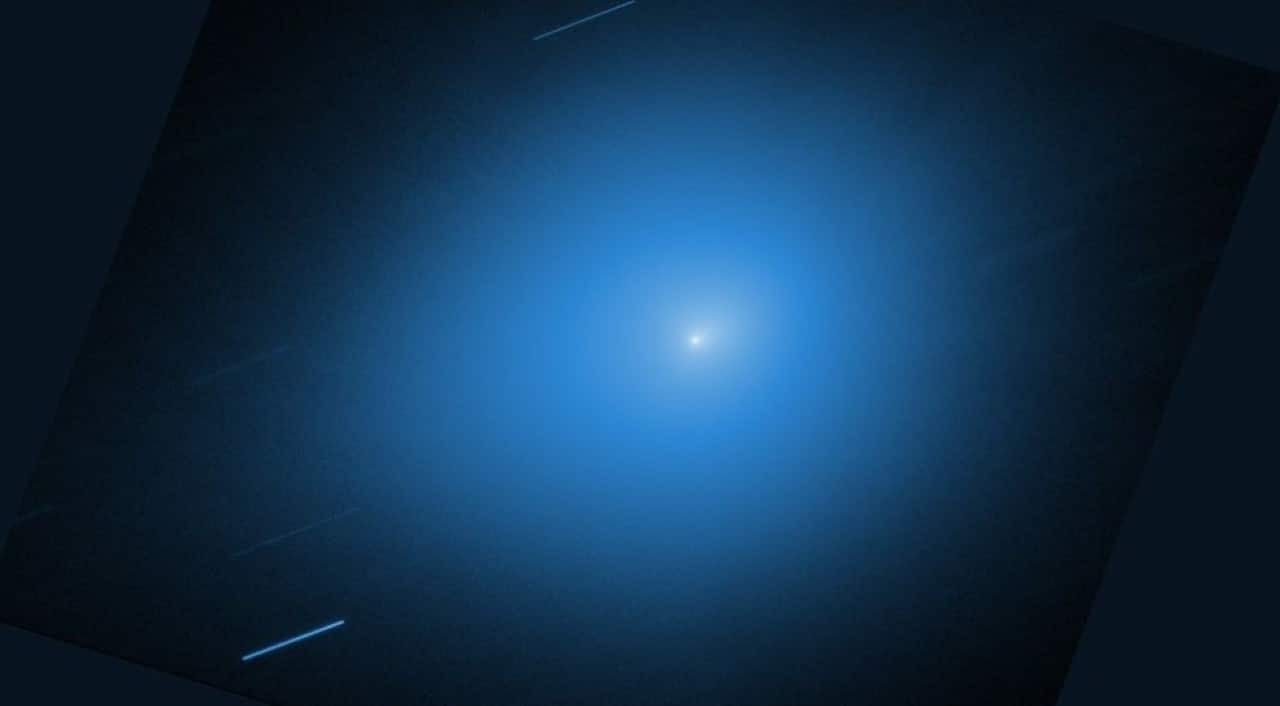
An extensive scientific investigation has just concluded that the celestial body 3I/ATLAS, recognized as the third visitor from outside our star system, does not carry any type of alien equipment. Detailed monitoring took place using the antennas of the Allen Telescope Array complex, located in North American territory, shortly after the identification of the star in July 2025.
The complete scan report made the pages of the prestigious scientific magazine The Astronomical Journal and attests to the total absence of artificial emissions. With this confirmation, the astronomical community reinforces the thesis that the space visitor has a strictly geological nature, presenting dynamics very similar to those of a common comet.
What makes visitors from other star systems so fascinating
Historically, modern science had only managed to record the passage of two space rocks from deep space: the enigmatic 1I/’Oumuamua and the comet 2I/Borisov.
The rarity of these events turns each approach into a golden opportunity, as these masses formed around suns completely different from ours. When they cross our cosmic neighborhood, they deliver physical samples and unprecedented data to scientists about how planets are born in distant galaxies.
Although the appearance and trajectory indicate natural formation processes, the simple presence of an outsider body immediately triggers the SETI Institute’s protocols. The researchers’ logic is clear: If an advanced civilization sent a disguised probe or mechanical device through the cosmos, terrestrial equipment could pick up radio frequency leaks.
Reasoning acts as a mirror for our own spatial ambitions. Scientist Sofia Sheikh, who led the survey, explained to the SciTechDaily portal that the Voyager spacecraft, launched by Earth decades ago, will inevitably take on the role of alien anomalies when they invade the orbit of other stars in the future.
How Radio Telescopes Scanned Space Rock
To ensure an in-depth analysis, the experts kept the sensors pointed at 3I/ATLAS for a period of more than seven uninterrupted hours. All of the work depended on the infrastructure of the Hat Creek Radio Observatory, an antenna complex initially funded by Microsoft co-founder Paul Allen and installed in the mountains of Northern California.
The tracking calibrated the instruments to listen specifically to the spectrum ranging from 1 to 9 gigahertz. This frequency window is considered the gold standard in the search for intelligence, as it houses extremely narrow radio waves that the laws of physics cannot produce spontaneously in the vacuum of space.
The initial capture was surprising due to its volume, recording an impressive 74 million pulses within this restricted range. However, the overwhelming majority of this cosmic noise was nothing more than electromagnetic pollution generated by our own telecommunications.
To clean the data and isolate the real anomalies, astronomers applied a rigorous exclusion process in sequential steps:
- They ran powerful algorithms capable of separating terrestrial electronic waste from space transmissions.
- They crossed the remaining sounds with the exact route the visitor was taking.
- They isolated only those emissions that appeared to emanate directly from the geometric trajectory of the rock.
The Data Verdict and Eliminating False Positives
The mathematical funnel reduced the mountain of data to around 200 alerts that required extra attention from experts. However, close manual inspection of each of these spikes proved that they were all reflections from commercial satellites or radio transmissions bounced off the atmosphere.
The final assessment showed zero detections of technosignatures coming from the celestial body within the spectrum heard. In the language of astrophysics, a technosignature encompasses any trademark that betrays the engineering of a civilization, from industrial lasers to intentional radio transmissions.
The study served to establish an impressive sensitivity limit for terrestrial equipment. The listening accuracy was so high that scientists can safely say that there is no transmitter operating between 10 and 110 watts attached to the visitor.
To put it into perspective, this voltage is equivalent to the energy consumption of a bright light bulb or a small appliance. This proves that modern telescopes can catch even the weakest and most rudimentary equipment wandering in the pitch black of space.
The mission’s legacy for future space encounters
Radio silence does not represent a failure for alien hunters, but rather a methodological advance. Detailed mapping helps create a catalog of how dead rocks behave, making it easier to identify real anomalies when the next outsider crosses our path.
Researcher Valeria Garcia Lopez, who co-authored the project, highlighted that the exercise validated Earth’s instruments. According to her, the scan proved that humanity already has the necessary infrastructure to intercept a message, if it really exists.
The astronomy team’s reaction time broke internal mobilization records. The antennas began recording data less than 24 hours after the global discovery alert, showing that observatories are on high alert for fleeting events.
The balance of the operation reinforces that the passage of exotic stones through our cosmic backyard functions as a free astrophysics laboratory. Each new visitor delivers crucial pieces about the chemistry of other galaxies and keeps alive the hope that, one day, radars will pick up an undeniable signal of companionship in the universe.