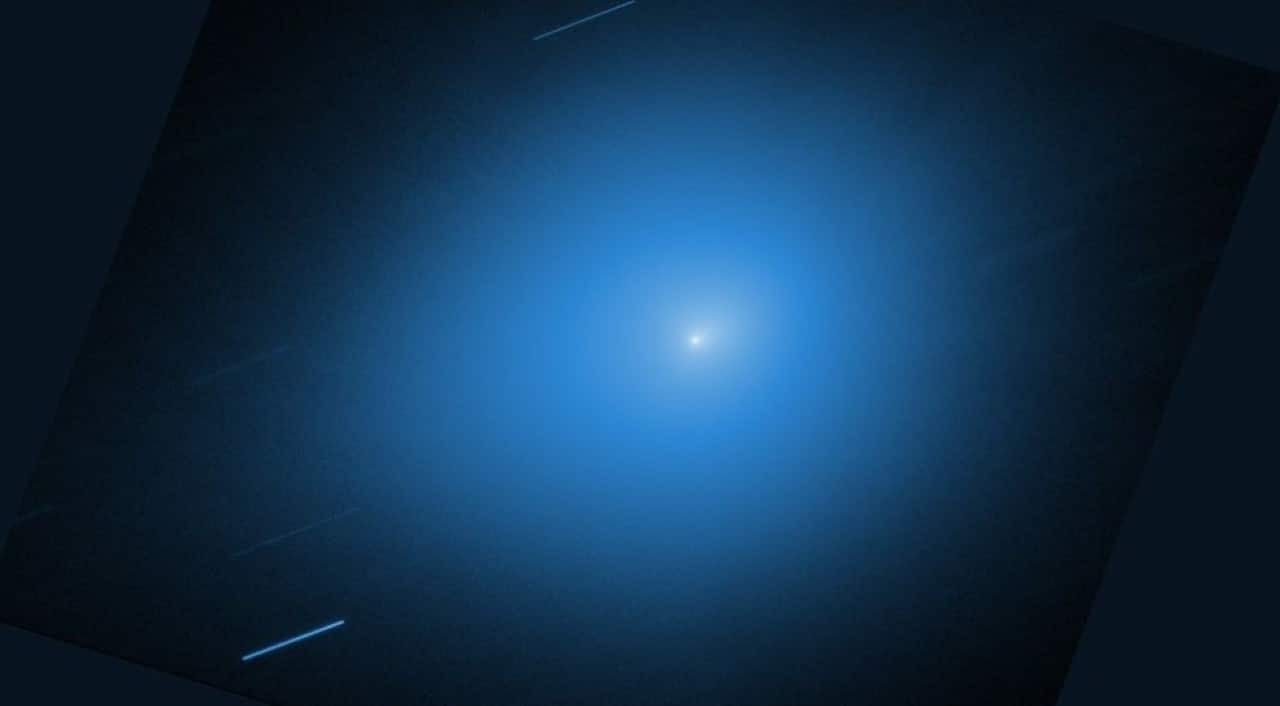
Researchers have completed the analysis to identify signs of alien technology in 3I/ATLAS, the third interstellar object ever confirmed to cross the Solar System. The scan was conducted with radio telescopes from the Allen Telescope Array, located in the United States, following the discovery of the celestial body in July 2025.
The results of the investigation, detailed in an article published in The Astronomical Journal, did not point to any evidence of extraterrestrial technology. This outcome consolidates the current understanding that 3I/ATLAS behaves like a natural object, similar to a comet.
The peculiarity of objects that travel between stars
Before 3I/ATLAS, astronomers had identified and confirmed only two other objects of interstellar origin: 1I/’Oumuamua and 2I/Borisov.
These celestial bodies are of great importance because they originated in orbit around other distant stars. As they pass through our Solar System, they provide valuable and direct information about the formation of planetary systems in regions beyond our own.
Even with characteristics that suggest a natural formation, visitors like these arouse the interest of SETI. This is due to the possibility that any interstellar object, if it were artificial, could emit technological signals that could be detected.
This perspective also extends to humanity itself. “At some point, our own Voyager probes will become extraterrestrial artifacts in other star systems,” noted Sofia Sheikh, lead author of the study, in a statement to SciTechDaily.
The SETI methodology in the search for evidence of technology
The research team dedicated more than seven hours to observing 3I/ATLAS using the Allen Telescope Array. The antenna array operates at the Hat Creek Radio Observatory, located in northern California, USA.
Scientists focused monitoring on frequencies ranging from 1 to 9 gigahertz. This range is crucial for tracking narrowband radio signals, which have no known natural origin in the universe.
During the observation campaign, almost 74 million signals in this category were identified. Although the initial list seems vast, a significant part of these emissions has been attributed to human-made interference.
The team then applied filters to exclude signals clearly associated with terrestrial technologies. It then selected only those emissions that were compatible with the trajectory of 3I/ATLAS’s movement through space.
The final result of the analysis and what was detected
After the rigorous filtering process, approximately 200 potential candidates for artificial signals remained under analysis. A subsequent, more in-depth check revealed that all of these signals originated from Earth or orbiting satellites.
Thus, 3I/ATLAS did not present any technosignatures in the frequencies that were analyzed by the researchers. The term technosignature refers to any observable sign that suggests the presence of technology, such as artificial transmission.
The search also established a significant technical parameter. The data made it possible to rule out the existence of radio transmitters with powers greater than something between 10 and 110 W in the vicinity of the interstellar object.
This power range is comparable to the power consumption of common household appliances, demonstrating the ability of current technology to test very subtle emissions scenarios.
The importance of continuing the search, even without finding signs
The absence of technological signals does not end the interest of the scientific community, as the results obtained are fundamental. They contribute to mapping the natural behavior of interstellar objects and improve strategies for future investigations.
“The findings on 3I/ATLAS illustrate the real feasibility of detecting a signal with the technological capabilities we currently have,” said Valeria Garcia Lopez, who is also a co-author of the study.
The agility in the response was another notable point. The observations began less than a day after the announcement of the discovery of the object, demonstrating the readiness to analyze cosmic events of great rarity.
In this way, each new interstellar object that visits our system provides a valuable opportunity to study matter formed in other planetary systems and drives the continued search for technology outside our planet.