
Scientists discover large amounts of methanol on comet 3I/ATLAS, indicating rare and distinct stellar origin

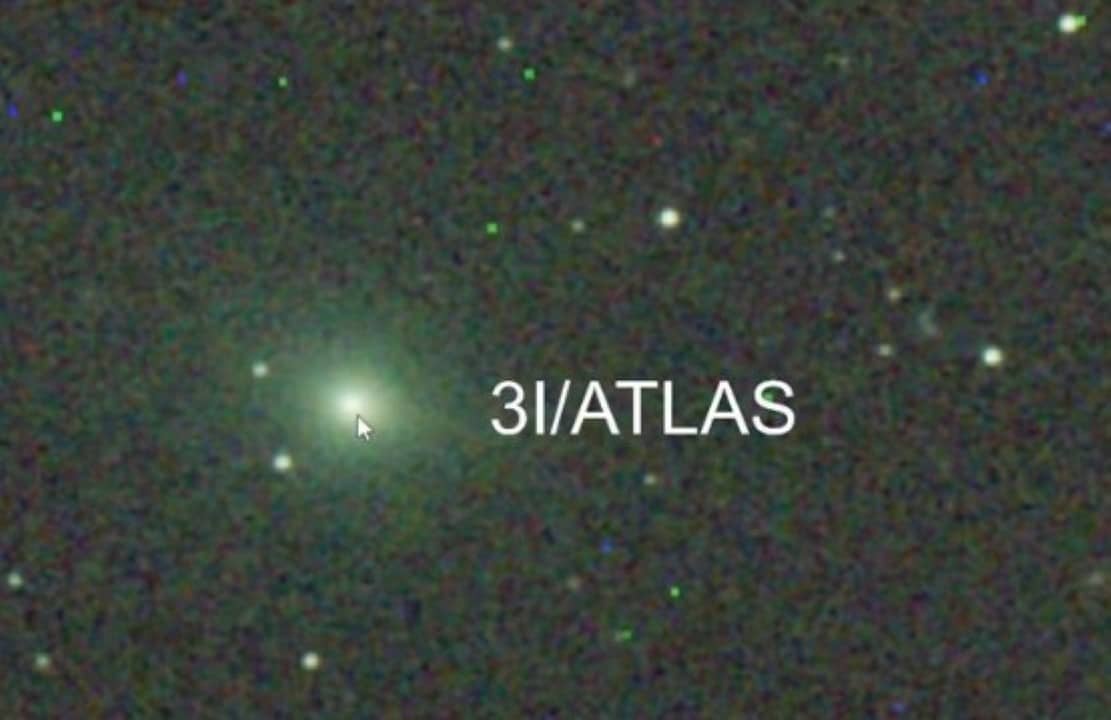
Astronomers have identified methanol in high proportions in the interstellar comet 3I/ATLAS, the third object confirmed to come from outside the Solar System, according to recent observations. The analysis shows that organic alcohol is released both from the nucleus and from icy grains present in the coma, forming a unique chemical signature of a distant and little-known cosmic environment.
Comet 3I/ATLAS revealed a surprising chemical composition during its passage through the Solar System, captured by astronomers using the ALMA observatory in Chile. This cosmic visitor, which is the third object to be confirmed from outside our stellar neighborhood, demonstrated a high concentration of methanol, a type of organic alcohol.
The discovery, which gained relevance in June 2026, is a fundamental step for scientists seeking to understand the materials that formed in other stellar systems. The measurements were taken while the comet received heat from the Sun, a process that caused gases and dust to be released around its nucleus, allowing researchers to map its chemical composition in space.
Comet 3I/ATLAS has a different chemical composition among interstellar objects
The trajectory of 3I/ATLAS is remarkable because interstellar objects are extremely uncommon among the celestial bodies observed crossing the Solar System. Before him, only 1I/’Oumuamua and 2I/Borisov had their origins confirmed as external visitors, each exhibiting distinct characteristics and behaviors.
This new comet, however, adds a unique element to that short list. While Borisov demonstrated similarities with the usual comets of the Solar System, 3I/ATLAS stood out for its richness in methanol, suggesting that its formation occurred under chemical conditions different from those found in our space region.
The ALMA observatory reveals a high concentration of methanol on the comet
Observations made by the Atacama Large Millimeter/submillimeter Array, known as ALMA, have detected evidence of methanol and hydrogen cyanide in the coma of comet 3I/ATLAS. These molecules produce specific marks at submillimeter wavelengths, enabling researchers to analyze their relative quantities.
The most striking fact was the large amount of methanol compared to hydrogen cyanide. This discrepancy placed the comet among the most methanol-rich objects ever studied, even in relation to several comets that formed close to the Sun.
Understand the meaning of methanol in the spatial context
When scientists refer to “alcohol” in 3I/ATLAS, they are not talking about a drink or something similar to what is understood in everyday life. The chemical compound identified is methanol, a simple organic molecule often found in studies of cometary chemistry and vital for understanding cold environments where planets form.
This category of molecule can appear on the surface of dust grains in extremely cold areas of space, where chemical reactions transform basic materials into more complex compounds. In this way, methanol serves as a valuable indicator of the physical and chemical conditions present at the comet’s birthplace.
Methanol is released from the nucleus and also from grains frozen in the coma
One of the most relevant points of the discovery is that the methanol from 3I/ATLAS does not appear to be released exclusively from the comet’s solid nucleus. Analysis indicates that part of this material is also emanating from frozen grains suspended in the coma, the cloud of gas and dust that surrounds the comet when it is heated by the Sun.
This phenomenon is called prolonged outgassing, in which ice particles suspended around the nucleus release molecules as they absorb solar heat. This means that the coma does not just act as a passive layer, but as an active source of gas, expanding the chemical trail that can be observed.
Hydrogen cyanide has a distinct release pattern
Unlike methanol, which was found in both the core and icy grains, hydrogen cyanide exhibited more direct behavior. Observations suggest that this compound was released predominantly from the nucleus of 3I/ATLAS, a pattern more common in comets observed within the Solar System.
The difference in release between the two molecules is significant, as it demonstrates that not all compounds react in the same way to heating. The comet appears to have different layers of chemical information, with substances responding in varying ways to the Sun’s heat during its journey through the inner region of the Solar System.
James Webb Telescope had already identified unusual features in 3I/ATLAS
Before the recent emphasis on methanol, observations made in conjunction with the James Webb Space Telescope had already revealed that 3I/ATLAS had a unique coma in other respects. The object showed important signs of carbon dioxide, supporting the idea that its composition does not perfectly align with known patterns.
With the new ALMA data, the picture has become even more intriguing. Two distinct instruments now indicate that this interstellar visitor has unusual chemistry, not just for a single molecule, but for a set of properties that make simple comparisons with comets from our own system difficult.
The chemical signature of comet 3I/ATLAS and its implications for distant stellar systems
The chemical composition of 3I/ATLAS can function as an indirect analysis of a cosmic environment that scientists will never be able to visit directly. Because the comet originated outside the Solar System, its frozen elements preserve crucial data about the temperature, radiation, dust and chemical composition of the protoplanetary disk where it formed.
Although it is not yet possible to precisely identify which stellar system produced the object, the analysis allows us to infer that the excess methanol suggests a different chemical history. This may be linked to cooler regions or atypical formation conditions compared to many comets in our own star system.
The importance of 3I/ATLAS in understanding interstellar objects
The 3I/ATLAS study has a special weight due to the small number of interstellar objects confirmed to date. With only three known cases, each new piece of information changes the way astronomers interpret the variety of celestial bodies that form around other stars.
‘Oumuamua raised questions for not exhibiting a typical coma, Borisov showed behavior closer to that expected for a comet, and now 3I/ATLAS expands the scenario with its methanol-rich chemistry. This string of discoveries indicates that interstellar visitors may be much more diverse than initially imagined.





