
Study of the interstellar comet 3I/ATLAS serves as a time capsule to understand the formation of the Milky Way and ancient systems

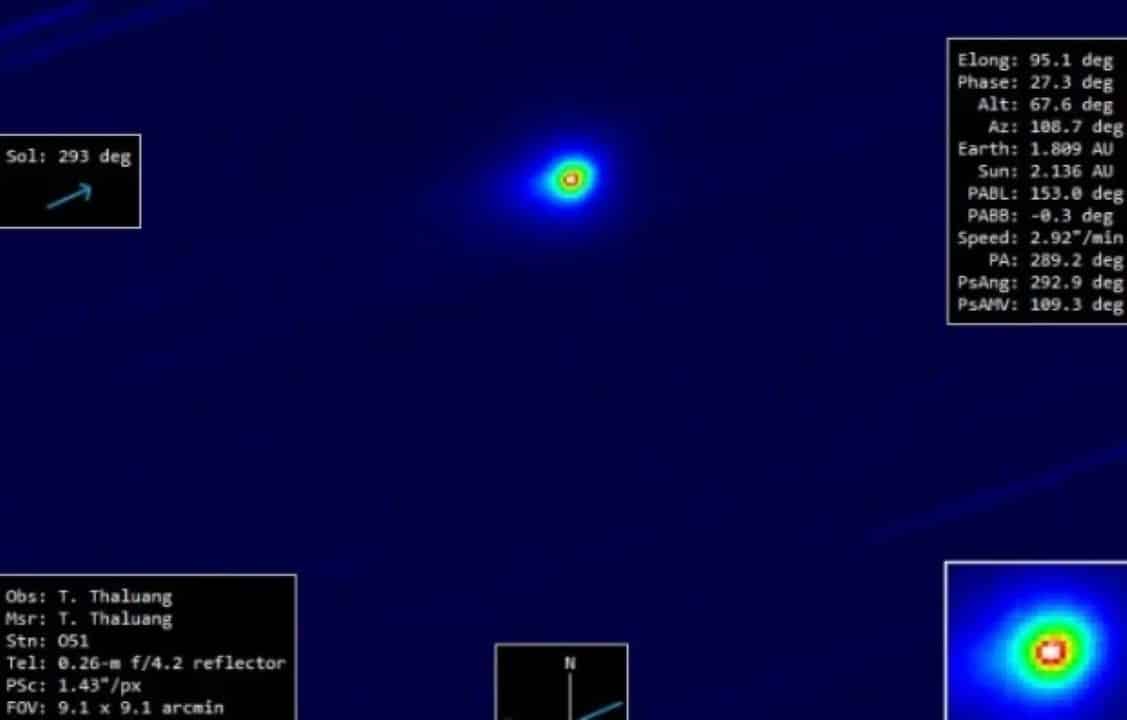
New discoveries about the composition of the interstellar comet 3I/ATLAS are providing unprecedented insight into conditions in the early Milky Way. Recent observations have revealed that this celestial object, the third of its kind to cross our solar system, is a “time capsule” that could rewrite understanding of the formation of distant planets. The research deepens knowledge about stellar environments outside our cosmic neighborhood.
3I/ATLAS, first identified in July and which began moving away from our solar system in December, stands out for its origin in a location different from our own planetary cradle. Details of its composition have recently been published, highlighting its importance for astronomy.
Unraveling the unique composition of comet 3I/ATLAS
The investigation of the internal structure of comet 3I/ATLAS, conducted with the aid of the Atacama Large Millimeter/submillimeter Array (ALMA) radio telescope in Chile, brought remarkable revelations. It was the first time that deuterium, an isotope of hydrogen, was detected in an interstellar object, opening new doors for science.
Luis Eduardo Salazar Manzano, lead author of the study, detailed the importance of deuterium. The element is generally found in the water of comets in the solar system and in Earth’s oceans, in the form of semi-heavy water (HDO). However, the abundance of deuterium in 3I/ATLAS exceeds the value present in Earth’s oceans by more than 40 times and more than 30 times that found in comets in our own system. This disproportion suggests extraordinarily cold formation conditions.
A window into the Milky Way’s distant past
The high concentration of deuterated water in the comet points to a formation environment with temperatures below 30 Kelvin (equivalent to -243.14 degrees Celsius). This extreme temperature indicates that the 3I/ATLAS home planetary system was significantly cooler than our solar system during its early stages. Such conditions are ideal for deuterium enrichment, which occurs in icy molecular clouds in interstellar space, generally around the same time that stellar systems form.
The comet is estimated to be up to 11 billion years old, making it considerably older than the Sun and our solar system, which are around 4.5 billion years old. The water trapped within it probably formed even before its host star. It is believed that 3I/ATLAS was born from a protoplanetary disk of gas and dust, where planets are also generated, and spent most of its existence in the outer regions of that disk, preserving its abundance of deuterated water.
The observing power of the ALMA telescope
The ALMA telescope was essential for these analyses, as its ability to point at the Sun at a closer angle than optical telescopes is a differentiator. It detects low-energy radio waves, as opposed to visible light or heat, which could damage optical instruments like those on the James Webb Space Telescope. The team used ALMA to observe the comet as it approached 203 million kilometers from the Sun. This proximity allowed the comet’s ice to sublime, transforming into gas detectable by solar heat.
Although the team expected to find ordinary water (H2O), it was not detected with the necessary sensitivity. The big surprise was the clear detection of deuterated water. “This immediately told us that 3I/ATLAS was a truly unusual object,” said Salazar Manzano. The discovery highlights the uniqueness of this comet and ALMA’s ability to reveal subtle chemical characteristics of celestial objects.
Implications and the future of interstellar object research
The information obtained with 3I/ATLAS is crucial for understanding how planets form in other systems and how the Milky Way evolved. Even without being able to determine the exact planetary system from which the comet originated, the celestial body offers valuable clues about hidden aspects of our universe.
The arrival of new instruments, such as the Vera C. Rubin Observatory in Chile, promises to revolutionize the detection of interstellar objects. With more sightings, it will be possible to determine whether the high abundance of deuterated water in 3I/ATLAS is an anomaly or a common feature among comets outside our system. Dr. Theodore Kareta, an astrophysicist who studied the comet, points out that the presence of deuterium is like a “fingerprint”, revealing the comet’s original composition and the conditions of the galaxy more than 10 billion years ago.
He emphasizes that understanding interstellar comets is critical to understanding the change in planet formation over galactic time. They allow astronomers “to look into the past to find out if the planets ‘out there’ look like the ones we have at home”, concludes the expert.





