

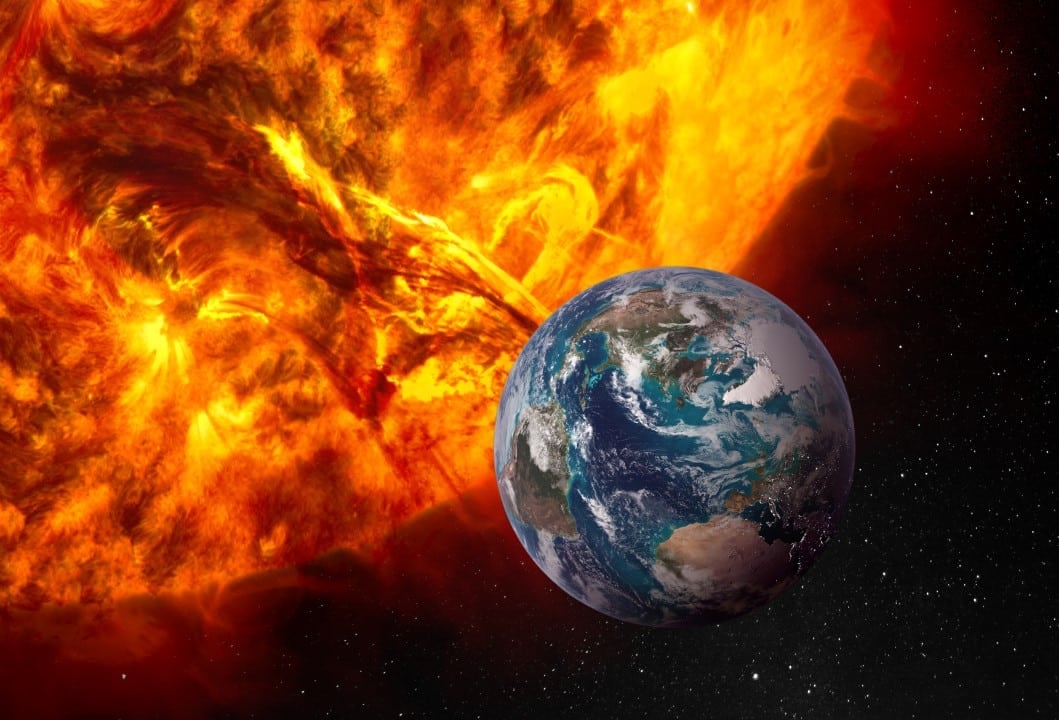
Scientists have presented a new perspective on Earth’s ultimate fate, challenging the common belief that the planet will inevitably be swallowed by the Sun. A recent study indicates that, at the end of its stellar life, our star may not completely consume our world, as previously imagined.
The research suggests that a set of astrophysical factors, mainly the loss of mass from the Sun, could cause the Earth’s orbit to expand enough to avoid total destruction. This scenario resets projections billions of years into the future of the solar system, offering an intriguing look at what might happen to our cosmic home.
Understanding the threat of the Sun’s transformation into a red giant
The Sun, currently classified as a yellow dwarf star, is approximately halfway through its existence, about 4.6 billion years old. In the distant future, approximately 5 billion years from now, it will exhaust its hydrogen fuel in its core and begin a transition to a red giant phase.
During this phase, the Sun will undergo a drastic expansion in size, swallowing the closest planets, such as Mercury and Venus. Earth, in many previous models, was often projected to meet a similar fate, being absorbed into the star’s extended atmosphere.
More on this story: Scientific Estimates Reveal the Sun’s Remaining Billions of Years and Earth’s Fate
The Escape Mechanism: How Earth Can Expand Its Orbit
The recent study introduces a theory crucial to Earth’s possible survival. It postulates that the Sun will lose a significant amount of its mass before reaching its full red giant phase. This loss of mass, driven by intense stellar winds, would decrease the Sun’s gravitational pull on the planets.
As solar gravity decreases, Earth’s orbit would gradually expand, moving the planet far enough away that it is not fully immersed in the Sun’s extended atmosphere. This phenomenon of orbital expansion is the main proposed mechanism for Earth’s “escape,” allowing the planet to persist, albeit in unrecognizable form.
Comparing projections: new perspectives on the solar system
Previous astrophysical models, which did not consider solar mass loss to this degree or with this specificity, often predicted that the Earth would be within the Sun’s expansion zone. This would result in its vaporization or total incorporation, with no chance of survival.
The fundamental difference in the new research lies in the detailed quantification of solar mass loss and the precise impact this would have on Earth’s orbit. The most recent projections suggest a tenuous balance where the Sun’s diminished gravitational pull allows Earth to migrate to an orbit further away and safer from complete immersion.
The habitability of the planet long before the extreme solar event
It is essential to understand that, even if Earth manages to escape being physically swallowed by the Sun, the planet will become uninhabitable long before this final event. It is estimated that in about a billion years, the gradual increase in solar luminosity will have already caused the evaporation of the oceans.
Learn more: Updated research indicates Earth may escape the fiery end caused by the death of the Sun
Rising temperatures will turn Earth into a scorching desert, eliminating any complex life form. Therefore, the question of habitability is dissociated from the eventual physical submersion by the Sun, focusing on much more immediate conditions for life.
The importance of this research for the study of exoplanets
This study has significant implications not only for understanding our own solar system, but also for analyzing exoplanets orbiting dying stars. Observations of stars that are at the end of their lives and their planetary systems can gain new light with the application of these models.
Scientists continue to refine simulations and collect data from other Sun-like stars, searching for analogs that could confirm or adjust predictions for the distant future of Earth and other worlds, improving our understanding of stellar and planetary cycles.
Projected chronology for the future of the Sun and Earth
The journey of the Sun and Earth over the next billion years involves a series of cosmic transformations that will shape the destiny of our system.
On the same topic: Earth moves further away from the Sun this Monday, but without influence on the weather seasons
- Here are the key projected milestones:
- In 1 billion years:The Sun’s luminosity increases by about 10%, causing the Earth to overheat, the oceans to evaporate, and the end of multicellular life.
- In 3.5 billion years:The Earth’s surface will become so hot that it will resemble Venus, with oceans completely vaporized and rocks melting.
- In 5 billion years:The Sun begins to expand, becoming a red giant. Mercury and Venus are likely swallowed by the expanding star.
- Between 7 and 8 billion years:The Sun reaches its peak as a red giant, but due to significant mass loss, Earth’s orbit may have expanded enough to avoid total absorption, although the planet is completely transformed and uninhabitable.
- In 8 billion years:The Sun shrinks to a white dwarf, a small, dense remnant of its former self. What’s left of Earth will continue to orbit this dead star in the cold of space.
The continuous search for answers about the final destination
There are still many uncertainties about the exact fate of the Earth and the entire solar system. Computer simulations are powerful tools, but they depend on a complete understanding of stellar processes and gravitational interactions over cosmic eons.
New astronomical observations and advances in astrophysics will continue to advance our knowledge, offering a window into the cosmic events that, although distant in time, define the history and future of our universe.