Updated research indicates Earth may escape the fiery end caused by the death of the Sun


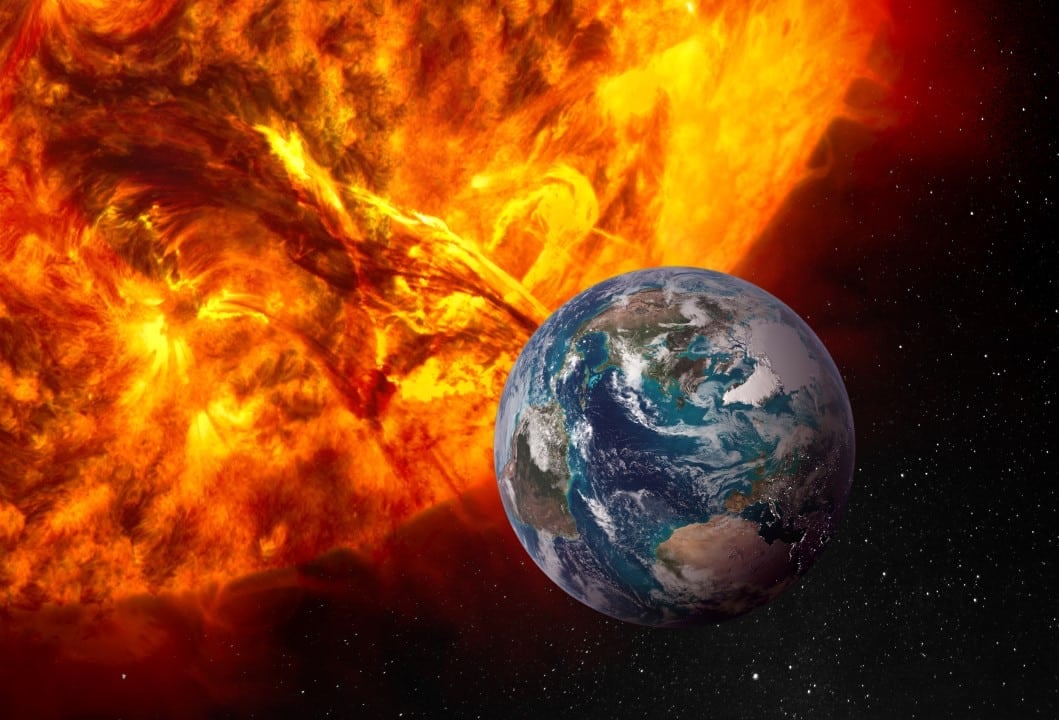
For many decades, scientists have debated the fate of the Earth in relation to the life of the Sun. It was expected that when the main star in our system exhausted its hydrogen fuel in approximately 5 billion years, it would expand to become a red giant, an immense celestial body capable of swallowing Mercury and Venus, and, according to several studies, the Earth itself.
However, new scientific surveys indicate that our planet has a greater probability of surviving this catastrophic scenario than previously imagined. Through improved models that simulate how aging stars interact with their planetary systems, researchers found that the gravitational forces that would pull the Earth toward the expanding Sun are less intense than previous predictions. This factor would give the planet more time to drift away as the dying Sun ejects its outer layers into space, potentially avoiding being entirely engulfed.
Despite the new perspective, the discovery does not guarantee terrestrial survival. Scientists explain that the main uncertainty now lies in the amount of mass that the Sun will lose in its final stages of evolution, and no longer in the intensity with which the expanding star pulls the planets closer, which represents a crucial change in understanding the process.
“The biggest doubt no longer comes from tidal calculations, but rather from the amount of mass that the Sun will emit in the future”, declared Mats Esseldeurs, lead author of the study from the Institute of Astronomy at KU Leuven, in Belgium. He added that “observations of giant Sun-like stars currently suggest Earth’s survival, but we need more precise observational data before we can know for sure.”
When stars similar to the Sun consume hydrogen from their cores and transform into red giants, a cosmic dispute begins. On the one hand, expanding tidal forces pull the planets inward; on the other, the loss of stellar mass pushes them outward. This interaction will define whether nearby worlds will be consumed or preserved.
This complex dynamic of attraction and repulsion occurs in two distinct phases. As the Sun expands, tidal gravitational forces act as a subtle brake, gradually decreasing Earth’s orbital energy and pulling the planet closer. Simultaneously, the dying star expels enormous volumes of gas through powerful stellar winds, eventually losing about half its mass. According to NASA, as it becomes less dense, the Sun’s gravitational pull weakens, propelling the planets that survive into wider orbits, which can even double their original distance from the star.
“The future of the Earth depends on a delicate balance between these two effects”, said Esseldeurs in his statement. “If tidal interactions predominate, the Earth will be swallowed up. If mass loss is preponderant, the Earth will escape to a more distant orbit.”
Previous research has reached different conclusions because it approached these competing processes in different ways, argue Esseldeurs and his team. Many of these studies completely ignored tidal interactions, while others relied on simplified methods developed decades ago that estimated a significantly greater internal attractive force.
Instead of using these old formulas, the new survey applies updated tidal force calculations. These new methods are based on the internal structure and ongoing dynamics of aging stars, which the team says has allowed accurate accounting of both tidal friction and the variation of stellar winds. The scientists then tested the results against a range of possible mass loss rates for the Sun’s final giant phase.
The most recent data suggests that, even with the internal gravitational pull attenuated, Mercury and Venus will not be able to avoid the Sun’s expansion and will invariably be absorbed. However, Earth and Mars will safely move through the two giant phases, allowing our planet to ultimately settle into a more spacious orbit around the white dwarf remnant that the Sun will leave behind, the study concluded.