
Harry Kane and Bellingham carry England’s attack at the 2026 World Cup

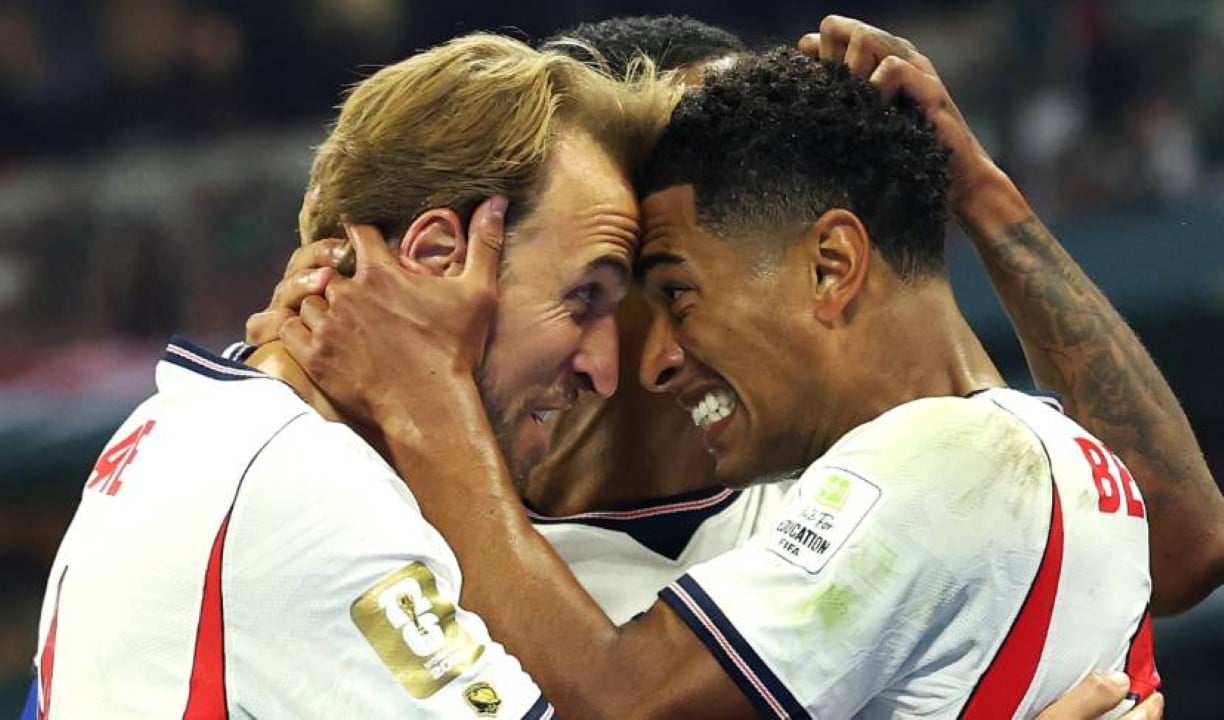
On an electrifying night of football in Mexico City, Jude Bellingham was responsible for opening the scoring for England against Mexico, at the emblematic Azteca Stadium. After the goal, the talented midfielder celebrated effusively with Harry Kane, and the pair were the last to leave the party area on the pitch, prolonging the recognition of the passionate English fans present in force in the stands. This scene, along with the moments in which the team sings “Wonderwall” with the fans after the matches, promises to become a memorable milestone in England’s campaign in the 2026 World Cup.
The two strikers played a decisive role in England’s narrow 3-2 victory in the round of 16. Captain Harry Kane, with his keen vision of the game, provided the assist for Real Madrid’s Jude Bellingham’s second goal, shortly after the first, silencing the local fans. Then, the experienced Harry Kane, even with the team playing with ten men after the expulsion of Jarell Quansah and Mexico pressing in search of an equalizer, demonstrated his known coolness by converting a penalty with precision, securing the decisive goal. England’s progression to the quarter-finals reinforces that the team’s fate in the tournament is closely linked to the performance and influence of Kane and Bellingham in each match.
The next big challenge will be against Erling Haaland’s Norway, in a long-awaited clash for Thomas Tuchel’s team, scheduled for next Saturday in Miami. Given the evident centrality of these athletes, the question arises about the real extent of England’s dependence on this duo of talents to achieve its World Cup ambitions.
The strategic dependence of the English team on its main attackers
The answer to the question of dependence is direct and clear: immense. Together, Harry Kane and Jude Bellingham have been responsible for ten of the eleven goals England have scored so far in this edition of the World Cup, with the remaining goal coming from Marcus Rashford, who came on as a substitute in the 4-2 victory over Croatia in the opening match. Thus, with six goals from Kane and four from Bellingham, the duo makes a significant contribution of 90.9% of the team’s total goals, a rate that surpasses that of any other team still in the competition.
France, for example, considered one of the favorites, occupies second place in this regard with 78.6%, with Kylian Mbappé (seven goals) and Ousmane Dembélé (four goals) scoring eleven of the team’s fourteen goals. Expected goals (xG) analysis also corroborates this centrality, revealing that Kane is responsible for 34.6% of England’s total, while Bellingham adds 20.3%. Combined, they represent more than half of the team’s offensive potential, reaching 54.9% of the overall xG, in addition to contributing significantly to shots, with Kane accounting for 23.8% of shots (31.3% on target) and Bellingham with 28.1% of shots.
However, this is not an unprecedented situation in England’s history in major competitions, where the dependence on two strikers for most goals has been observed on other occasions. At the 1990 World Cup, for example, Gary Lineker and David Platt scored 87.5% of England’s eight goals, with four and three tries respectively. Six years later, in the European Championship, the duo Alan Shearer (five goals) and Teddy Sheringham (two goals) repeated a similar pattern of concentration, scoring seven of the team’s eight goals. In both editions, the team’s progress was interrupted in the semi-finals, with defeats by penalties to Germany, serving as a crucial warning for the current generation: an excessive dependence on a few talents, although effective, can find a limit in decisive moments of major tournaments.
On the other hand, there is a perspective that takes a different look at England’s dependence on Harry Kane and Jude Bellingham. Unlike Argentina, which concentrates 70% of its goals on Lionel Messi, and Norway, with Erling Haaland scoring 63.6%, the English attack distributes its load between a pair of similar impact. This distribution can be a strategic advantage in terms of unpredictability for opponents and team resilience.
The strong connection between Harry Kane and Jude Bellingham
Although Real Madrid midfielder Jude Bellingham is almost a decade younger than Harry Kane, he already has six years of international experience. Kane, a Bayern Munich striker, made his debut for England eleven years ago, making a combined 172 appearances for the national team. It is precisely this vast experience, combined with their recognition as football superstars, that has positioned them as influential members of the English team’s leadership group, with experience in crucial matches and at major European clubs.
In the locker room environment, the duo is also very active and engaged. Harry Kane shows great appreciation for Bellingham’s contribution to the leadership group, while Bellingham, in turn, recognizes the constant public support that Kane always offers him. This strong connection between them is reinforced by the way they replicate each other’s celebrations, as seen recently against Mexico, where they both posed with open arms to the fans, a gesture that has become a Bellingham trademark.
Fundamentally, on the field of play, the duo’s synchrony is remarkable. Bellingham’s intelligent positioning creates more space for Harry Kane to exploit, and the English captain demonstrates his generosity by generating scoring chances for his teammate, as was clearly evident in the match against Mexico, consolidating the partnership as a key part of England’s success.





