
Scientists capture unprecedented details of a black hole’s event horizon

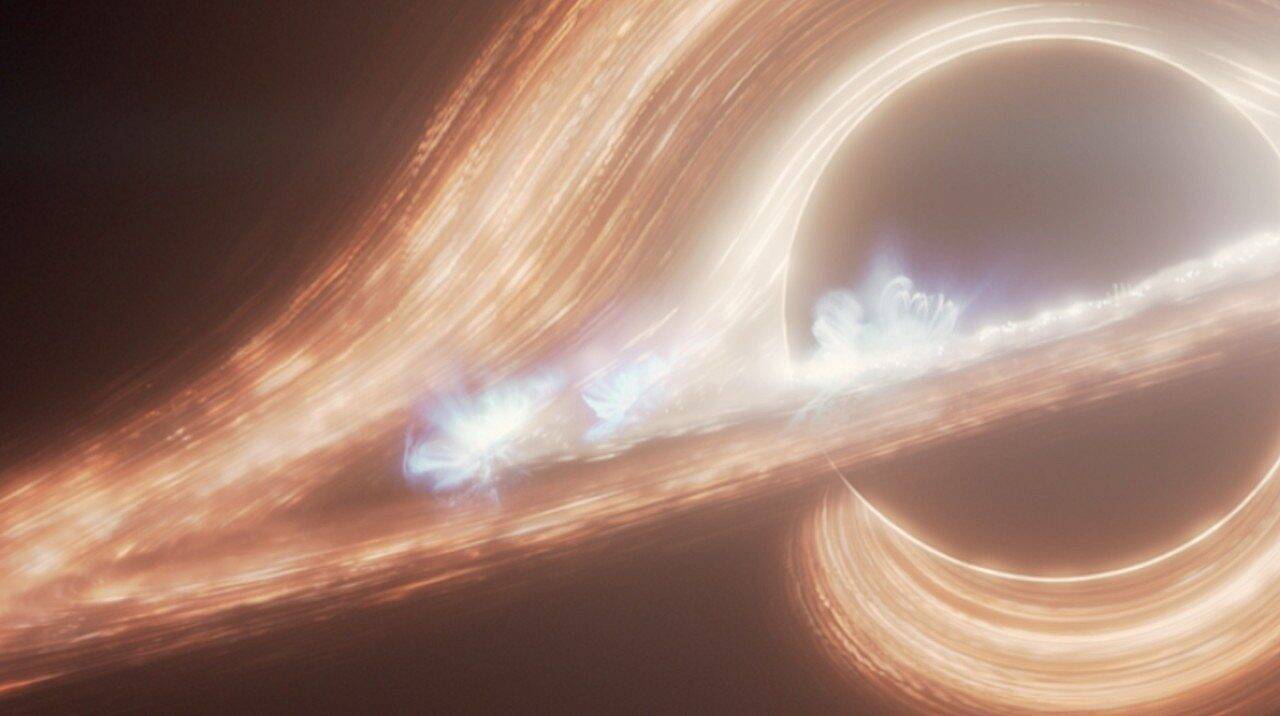
Researchers have detected evidence that the gravitational waves generated by the colossal black hole merger contain traces of the very edge of the newly formed black hole. If validated by future observations, this discovery could offer an innovative approach to investigating phenomena that occur in the vicinity of a black hole, without the need to observe it directly, a region notoriously inaccessible because it is the point of no return, from where not even light can escape.
In a recent survey, experts examined a strong incident of gravitational waves, named GW250114. They were able to identify a “direct wave”, a subtle component in the total gravitational wave signal, previously predicted theoretically, but never before verified in real data. This signal suggests the existence of information coming from an area extremely close to the black hole’s boundary line, the event horizon, the barrier beyond which absolutely nothing, including light, can escape.
The results of the research, published on June 24 in the renowned journal Nature, indicate that gravitational wave observatories may, in the future, enable astronomers to investigate regions that have remained inaccessible since the formulation of black holes by Albert Einstein’s theory of general relativity.
Scientists can hear the boundary of a newly formed black hole
Although scientists have already captured images of luminous material around supermassive black holes and recorded countless mergers of these objects using gravitational waves, directly studying the event horizon itself remains a considerable challenge.
Unlike ordinary light, gravitational waves consist of small distortions in the fabric of space-time, caused by the acceleration of massive bodies. They cross the cosmos virtually uninterrupted, carrying data about extremely violent cosmic events that would otherwise remain undetected.
According to Sizheng Ma, co-author of the research and postdoctoral researcher at the Perimeter Institute for Theoretical Physics, in Canada, the detection of the new signal provides a rare glimpse of the events that immediately follow the collision of two black holes.
“When two black holes come together, they cause a violent jolt in space-time itself,” said Ma. “For a brief instant, the region adjacent to the horizon of the newly created black hole is swept by turbulent, ephemeral motion.”
Ma clarified that the direct wave corresponds to the portion of the gravitational signal generated near the horizon, carrying with it the mark of this movement that propagates through space.
“That’s exactly why it’s so captivating,” he explained. “It can allow us to ‘feel’ what happens near the horizon, an area that remains invisible to light.”
Details of the black hole collision that generated the signal
The research team focused on event GW250114, a black hole merger identified on January 14, 2025 by the two Laser Interferometer Gravitational-Wave Observatory (LIGO) detectors located in Hanford, Washington, and Livingston, Louisiana.
“Our previous theoretical research anticipated that black hole mergers should generate a direct wave signal coming from the near-horizon region,” said Ma. “The big question was whether this phenomenon could actually be detected in real data.”
Incident GW250114, in turn, offered ideal conditions to verify this prediction.
“It was sufficiently intense, sharp and aligned with the theoretical scenario in which this signal should be discernible”, commented the researcher.
To identify this hard-to-notice feature, the researchers first isolated the best-understood part of the gravitational signal, which emanates from the newly formed black hole as it stabilizes after the merger. Then, the remaining data was analyzed to see if it was merely noise from the detectors or if it contained a genuine physical signal.
“What we found was truly remarkable,” reported Ma. “The remaining signal followed the rhythm and fading pattern expected for a wave originating in the region very close to the horizon of the final black hole.”
The team of scientists concluded that the residual signal aligns with the predicted behavior of a direct wave, as established by previous theoretical studies.

Opening a new door to understanding extreme gravity
The researchers stressed that their findings do not reveal what exists inside a black hole. Instead, they offer a new observational tool for investigating the area immediately outside the event horizon.
“The gravitational wave records appear to bear an imprint of the extreme neighborhood of the newly formed black hole’s event horizon — the renowned point of no return,” Ma said.
He clarified that the measurements are compatible with the idea that spacetime near the horizon is rapidly dragged by the rotating black hole, while the signal attenuates due to the intense gravitational field.
“For us, the exciting message is that gravitational waves can provide us with a new way to probe the edge of a black hole, using hard observational data,” Ma said.
Ma considers that the method could eventually be useful for exploring concepts such as quantum gravity — which seeks to harmonize Einstein’s theory of gravity with quantum mechanics — or the black hole information paradox, the ancient mystery about whether or not information falls into a black hole. However, it is not yet possible to test these questions directly.
“If quantum effects, or any deviation from the standard black hole model, leave a measurable signature there, then direct waves could, in principle, help us identify them in the future,” he explained.
The need for more data and future observations
The researchers warned that the discovery relies on a single gravitational wave event. Although GW250114 provided exceptionally favorable conditions, more robust proof will only be achieved if similar patterns are identified in several other black hole mergers.
“There are two primary directions,” said Ma. “The first lies in theory.”
Current models capture the essential physics but are still simplified, and more reliable descriptions of black hole mergers will be indispensable.
“The second is observation,” added the scientist. “This finding comes from a uniquely powerful and defined event, so the strongest confirmation would come from detecting the same type of pattern in other black hole mergers.”
As gravitational wave observatories continue their improvement and detect an increasing number of mergers, researchers hope to determine whether direct waves are a universal feature of black hole collisions.
“If the pattern manifests itself repeatedly in the way anticipated by general relativity,” said Ma, “the direct waves could become a new way to probe the horizons of black holes or their vicinity, and to test Einstein’s theory in one of the most extreme environments in the universe.”
If future observations confirm the team’s conclusions, scientists may have finally achieved something sought for decades: a direct observation path to the very edge of a black hole.





