
Study in European caves reveals complex cultural interaction between Neanderthals and modern humans


Previous genetic research confirmed interbreeding between Homo sapiens and Neanderthals, but the true extent of these relationships during the Stone Age, tens of thousands of years ago, remained uncertain.
Now, new discoveries at a Turkish archaeological site indicate that these two human groups not only lived side by side, but also possibly shared cultural customs, including instrument making and shellfish collecting.
Professor Ismail Baykara, leader of the study published in the journal PNAS, stated that the results suggest an exchange that went beyond the mere occupation of the same physical space by Neanderthals and Homo sapiens.
Baykara explained that, although it is not possible to prove direct contact, the continuity in production techniques, hunting strategies and the use of shells as adornments reinforces the idea of constant interaction and transmission of cultural knowledge between species over millennia.
Located in southern Turkey, the Üçağızlı II cave has long been a site of archaeological interest, but detailed explorations at the site, as reported by archeology professor Ismail Baykara, from the University of Gaziantep, only began in 2020.
Fossil finds, such as four teeth and a jaw fragment, indicate that Neanderthals inhabited the cave between 77,000 and 59,000 years ago. Later, Homo sapiens occupied the same refuge, as revealed by sediment layers, between 59 thousand and 47 thousand years ago.
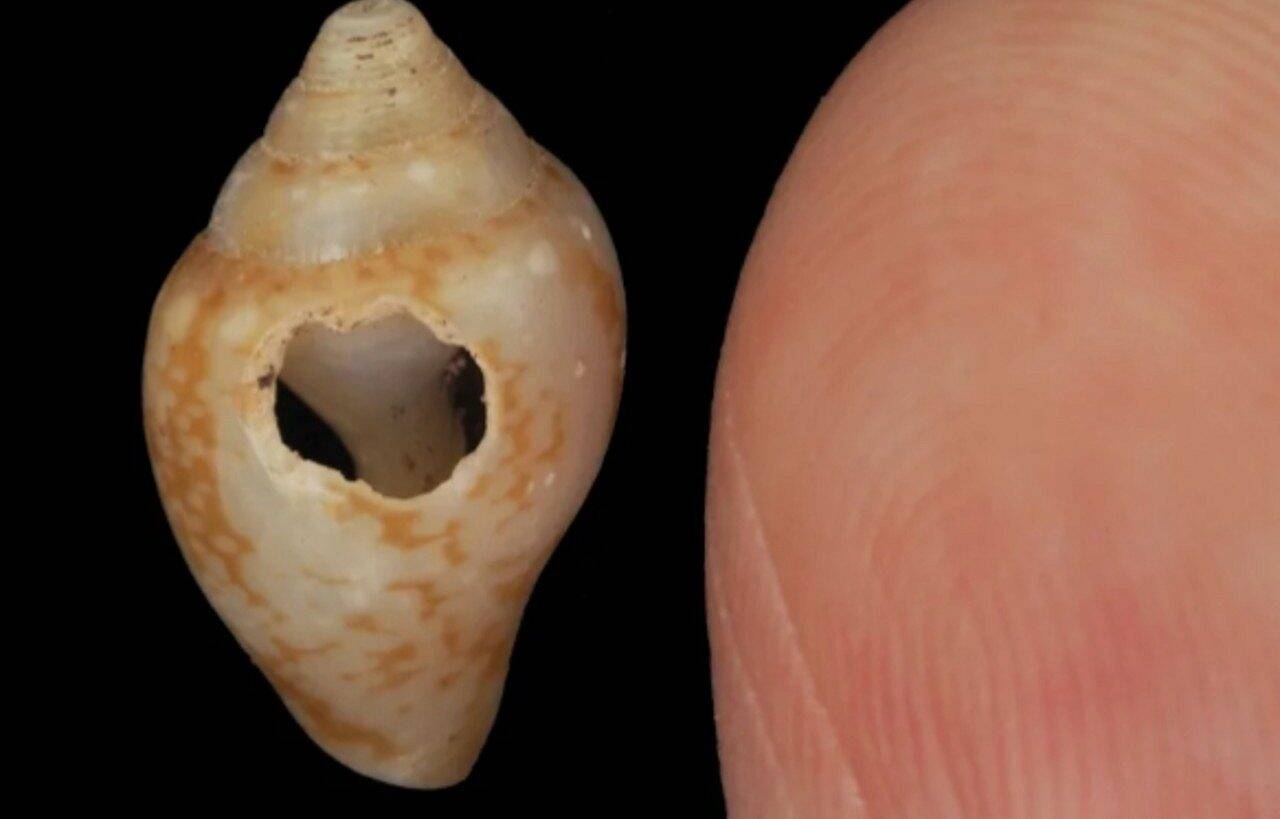
During these occupations, both species made flint tools following the Musteriense pattern, a style named after an archaeological site in France. Both groups also hunted similar animals such as wild goats, deer and wild boar. The research team was surprised by the presence of seashellsColumbella rustica, molluscs too small to eat, found in both Neanderthal and Homo sapiens layers.
Some of the shellsC. rusticathey had perforations, suggesting that they were used as adornment. Scholars have defined them as “manuports”, or items intentionally transported by humans from their place of origin. Although this shell was traditionally associated only with Homo sapiens, scientists now think that Neanderthals also valued it.
Naoki Morimoto, one of the co-authors and a researcher at Kyoto University in Japan, explained that Neanderthals sought and transported these specific shells from the coastal region of the Mediterranean, even though there were other options. Identical behavior was recorded among Homo sapiens who occupied the same cave.
Understanding ancient population movements out of the African continent
The site of Üçağızlı II is considered one of the few archaeological records of a crucial, but little explored, stage of human evolution.
Around 60,000 years ago, a great migration took Homo sapiens beyond Africa, colonizing several parts of the world, although some groups had already ventured out before. Experts believe that, during this expansion, there were interbreeding and interactions between modern humans and Neanderthals in regions that today make up Turkey.
This hypothesis, however, is mostly based on population models and genetic data. Direct archaeological evidence about this crucial period in the Levant (which includes the Middle East and Turkey) is scarce and fragmentary. The study in question was unable to determine whether the Homo sapiens in the cave were part of the main migratory wave or were descendants of previous populations.
Ludovic Slimak, an archaeologist at the French National Center for Scientific Research (CNRS) and author of the work “The Last Neanderthal: How Humans Die”, classified the cave as “an extremely important discovery”. He argues that the finding indicates that the arrival of Homo sapiens did not mean the simple replacement of Neanderthals by a naturally more advanced civilization, questioning previous historical interpretations.
In an emailed analysis, Slimak stressed that the most relevant point is not merely the use of tools or the collection of similar shells by both species.
He stressed, instead, that in the period of Homo sapiens occupation, what stands out is the way in which modern humans apparently adapted to an already established and local Mousterian tradition, in striking contrast to other sites where Homo sapiens introduced completely new technologies, as was the case at the Mandrin Cave in France.
Specialist Slimak drew attention to the difference between the Üçağızlı II site and the Mandrin Cave, in southern France, a place he excavated himself and where Neanderthals and Homo sapiens also lived in the same period.
In Mandrin Cave, Homo sapiens, who inhabited the site at the same time as those found in the Turkish cave, used very different stone tools, perhaps even with bow and arrow technology. These artifacts were much more advanced than the more rustic Mousterian instruments identified in the Neanderthal layers of Mandrin and those of both species at Üçağızlı II.
“The two archaeological sites tell different stories”, explained Slimak. “Together, they paint a much more complex picture, revealing diverse populations of Homo sapiens, varied cultural routes and, possibly, multiple phases of growth, exchange, regression and replacement of groups.”
Professor Baykara emphasized that more archaeological evidence is needed to confirm whether the Üçağızlı II cave case is an isolated event or part of a more widespread behavior.
“This unique situation shows that culture is not just a biological reflection, but is also shaped by regional specificities, allowing similar cultural practices to persist among different species for a long period,” concluded Baykara.





