
Chinese probe captures detailed image of Earth’s minimoon asteroid

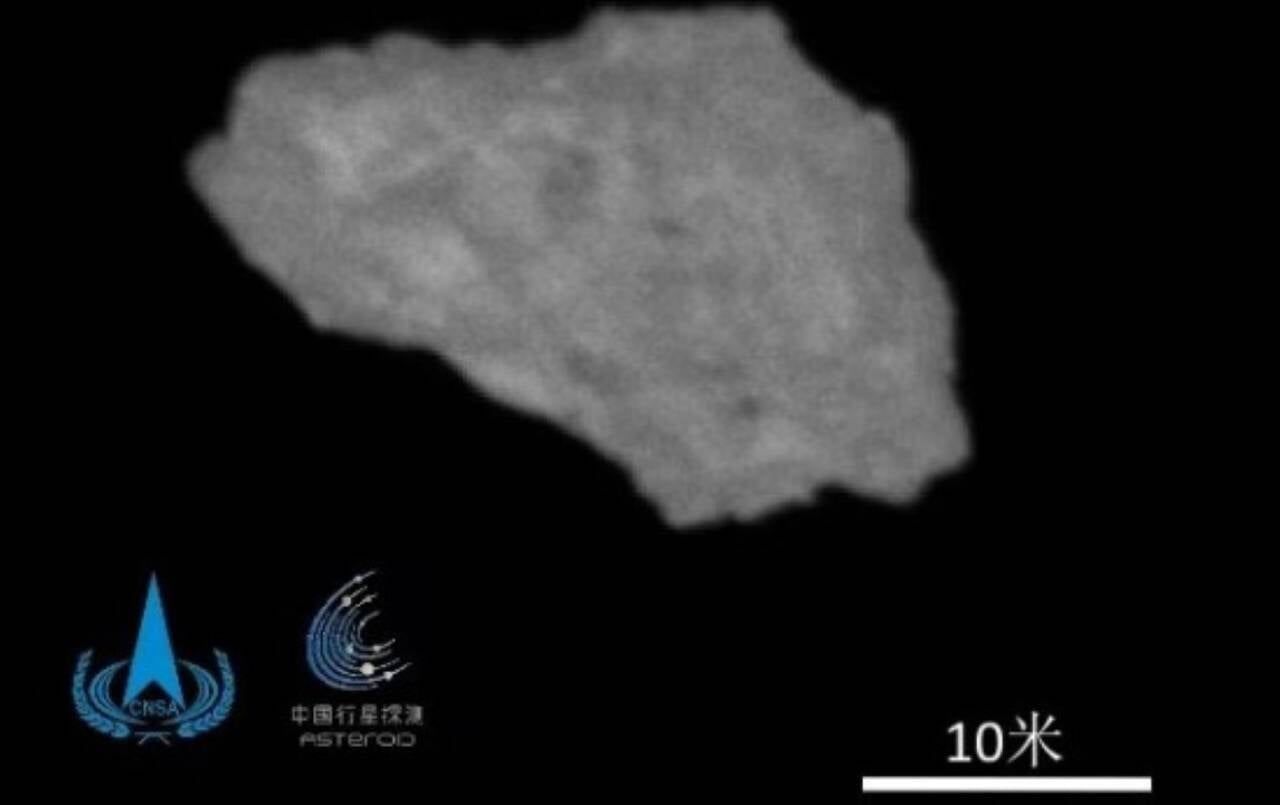
The Chinese government has revealed the first close-up photograph of Kamo’oalewa, a smaller asteroid popularly described as a “mini moon” that follows Earth’s orbit.
The unprecedented image was captured by the Tianwen-2 probe, after a journey of approximately 400 days that took it close to the celestial body.
The photographic record took place on July 2, when the spacecraft was approximately 20 kilometers from the asteroid, also designated as 2016 HO3.
The photograph details a space rock with reduced dimensions and an irregular contour, standing out against the dark vastness of the cosmos.
Despite being called a “mini moon”, Kamo’oalewa does not constitute a second natural satellite on Earth nor is it linked to the Earth in the same way as our Moon.
How the Kamo’oalewa asteroid differs from a natural satellite
A natural satellite, or moon, is a naturally formed celestial body that orbits a planet, with Earth’s Moon being the best-known example. Kamo’oalewa, however, orbits around the Sun, maintaining a trajectory that keeps it relatively close to our planet.
Due to this orbital pattern, the asteroid appears to follow the Earth when observed from here, being classified as a quasi-satellite or quasi-moon.
Identified in 2016, Kamo’oalewa has a diameter of just a few tens of meters. Researchers are investigating the possibility that it is a piece of the Moon, expelled into space after colliding with another celestial body, although this origin has not yet been fully confirmed, which highlights the importance of collecting samples to reveal its true nature.
The planning and objectives of the Tianwen-2 mission
Launched in May 2025, Tianwen-2 traveled approximately 1 billion kilometers to finally reach the asteroid.
In the approach process, the spacecraft demonstrated remarkable precision, reducing the margin of error in locating the object from hundreds to a few kilometers, according to information from the China National Space Administration (CNSA), an engineering feat crucial to the success of the collection phase.
From this moment on, the instruments on board the probe will intensify observation, seeking details about the shape, composition and internal structure of the rocky body.
The data collected will be essential for planning the next phase of the mission, which consists of collecting samples.
The intention of the Chinese mission is to collect fragments from Kamo’oalewa’s surface and transport them to Earth by the end of 2027. This material will be valuable for scientists to understand not only the specific origin of the asteroid, but also to reveal aspects of the formation and evolution of the Solar System in its early stages.
Tianwen-2 represents China’s first venture dedicated to collecting samples from an asteroid. After returning the material to Earth, the probe will continue its journey to 311P/PanSTARRS, an object located in the asteroid belt between the planets Mars and Jupiter.





