
New study reveals our planet must escape destruction during the Sun’s final phase


A recent scientific survey has transformed academic understanding of the fate of the globe in the distant future. Data published in the scientific journal Astronomy & Astrophysics indicate that our world will not necessarily be swallowed by the system’s central star, contradicting decades of pessimistic predictions. The researchers used state-of-the-art simulations to recalculate the collision path that was previously taken for granted by the astronomical community. The current distance of 150 million kilometers between the Earth’s surface and the solar corona will undergo drastic changes, but these could be enough to prevent the total disintegration of the rocky sphere.
Extreme transformations await the central star in five billion years
The star king is currently in the middle of its useful life, classified by experts as a yellow dwarf with guaranteed stability for another long period of time. The stellar timeline projects that the nuclear furnace will maintain its regular functioning for approximately ten billion years in total. However, five billion years from now, the depletion of hydrogen reserves in the core will trigger an irreversible chain reaction in the structure of the celestial body. Nuclear fusion will migrate to the outer layers, inflating the gaseous mass until it transforms into a red giant, to then evolve into a star in the asymptotic branch of giants and, finally, collapse into a white dwarf.
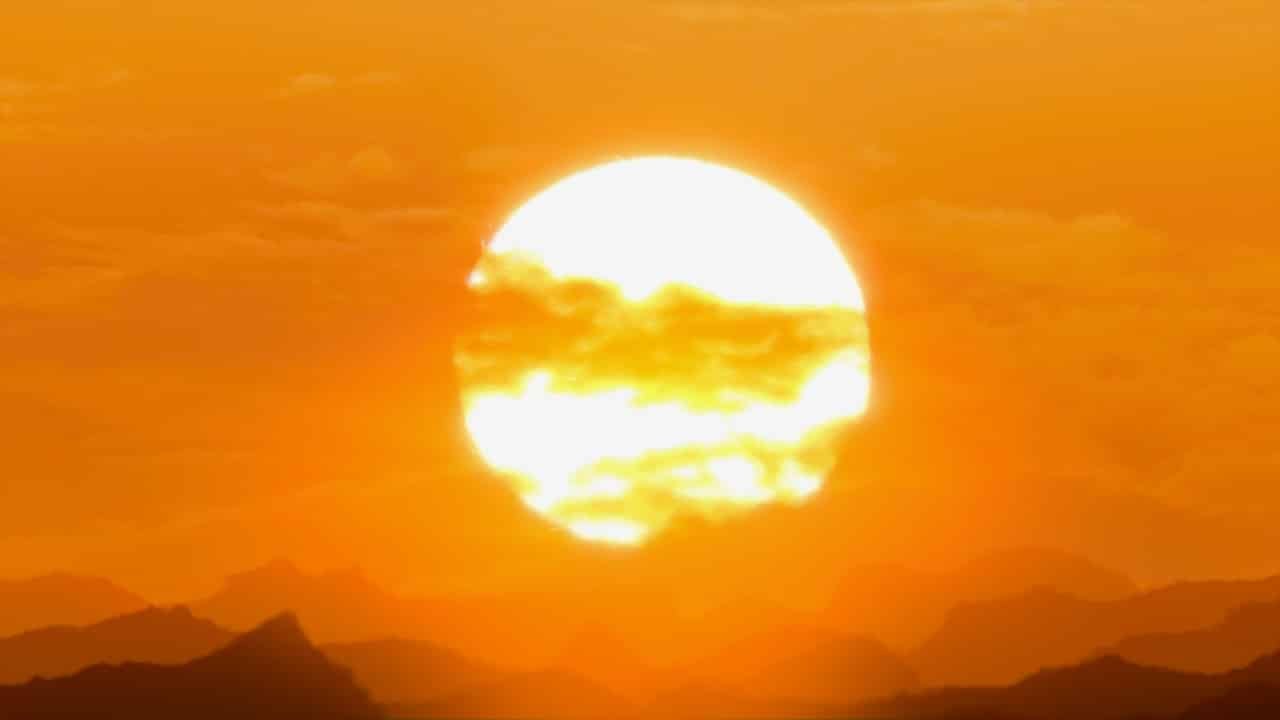
During this phase of violent transition, two physical phenomena will act simultaneously and oppositely on Earth’s orbit, dictating the rules of celestial mechanics. The colossal increase in solar volume, which could reach proportions hundreds of times greater than the current diameter, will intensify the drag of gravitational tides. This force will relentlessly pull celestial bodies into the expanding furnace. In return, the star will eject massive amounts of material into the vacuum through extremely strong solar winds, altering the balance of the entire system.
This considerable loss of density will weaken the gravitational anchor that keeps the planets locked in their original paths. Scientist Mats Esseldeurs, linked to the Institute of Astronomy at the Belgian university KU Leuven and responsible for the research, led the mapping of these complex variables. The researcher detailed in an official statement that escape from Earth depends exclusively on a sensitive balance between the two dynamics. If the red giant’s mass loss occurs at an accelerated rate, our world’s orbit will expand to a safe zone; If gravitational drag is predominant, incineration will be inevitable.
System located in the constellation Puppis serves as a natural laboratory
Previous scientific literature carried a high degree of uncertainty due to different mathematical approaches to stellar mass dissipation and tidal friction. To validate the new equations and move beyond the purely theoretical field, the team of astrophysicists directed their instruments to L2 Puppis. It is a dying star located about 200 light years away from the Milky Way, which functions as a perfect temporal mirror. This celestial body once had characteristics very similar to those of the Sun and is now going through its terminal phase, providing an accurate glimpse into our own cosmic future.
Spectrographic measurements indicate that L2 Puppis ejects approximately one millionth of its total mass every twelve months, a volume considered extremely high by stellar standards. Around this dying star, telescopes detected a thick disk of cosmic dust harboring a gas giant with an estimated mass of between twelve and sixteen times that of Jupiter. The intact existence of this massive exoplanet in a close orbit around a disintegrating star provides the empirical proof needed to support the planetary survival thesis.
Incorporating this observational data into stellar evolution algorithms has drastically reduced the margin of error in predictions about the solar system. High-precision gravitational calculations considered the internal architecture of mature stars and fluid mechanics during matter ejection. The final result of the computer simulations traced the Sun’s life trajectory from its formation to its definitive extinction, confirming that orbital separation is the most robust scenario for the Earth’s sphere.
Inevitable destruction will strike the solar core’s closest neighbors
Although the terrestrial globe has gained survival in updated theoretical models, the same fate does not apply to the rocky worlds that orbit in the innermost zones. The expansion of the solar corona will mercilessly swallow celestial bodies that do not have enough orbital leeway to escape the annihilation zone. Extreme radiation and direct friction with the red giant’s outer layers will cause the solid surfaces of these neighboring planets to completely vaporize.
The chronology of destruction in the inner solar system will follow steps well defined by celestial mechanics, forever altering the configuration we know today:
- Mercury will be the first celestial body to be disintegrated, due to its extreme proximity and lack of atmosphere to create any type of resistance.
- Venus will undergo a process of global melting of its crust before being swallowed by the maximum expansion of solar plasma.
- The Earth will gradually migrate to an outward route, escaping the zone of direct incineration by a narrow mathematical margin.
- The Sun will eject its last gaseous layers, shrinking until it becomes a dense white dwarf with an afterglow.
The white dwarf stage represents the stellar corpse, a glowing core about the size of Earth but with a density millions of times greater. In this distant scenario, our planet will orbit a faint point of light in a frozen environment. The structural survival of the rock does not mean the maintenance of the biosphere, as the globe will be devoid of the energy necessary to sustain any form of life based on carbon or liquid oceans.
European mission will seek new data on worlds in risk zones
The absolute confirmation of this theory and the refinement of the calculations will depend on a new generation of space observation instruments that will come into operation this decade. The European Space Agency is preparing the launch of the PLATO observatory, scheduled to be sent into space in 2026. The equipment was specifically designed to track planetary transits and stellar oscillations with a sensitivity unprecedented in the history of astronomical exploration.
The main focus of the new telescope will be to identify rocky worlds orbiting stars at different stages of aging, searching for analogues to our system. Cross-referencing the information captured by PLATO with the models developed by the Belgian university team will make it possible to accurately map the planetary survival rate throughout the galaxy. Science advances by replacing the determinism of destruction with a more refined understanding of the forces that shape the universe.





