
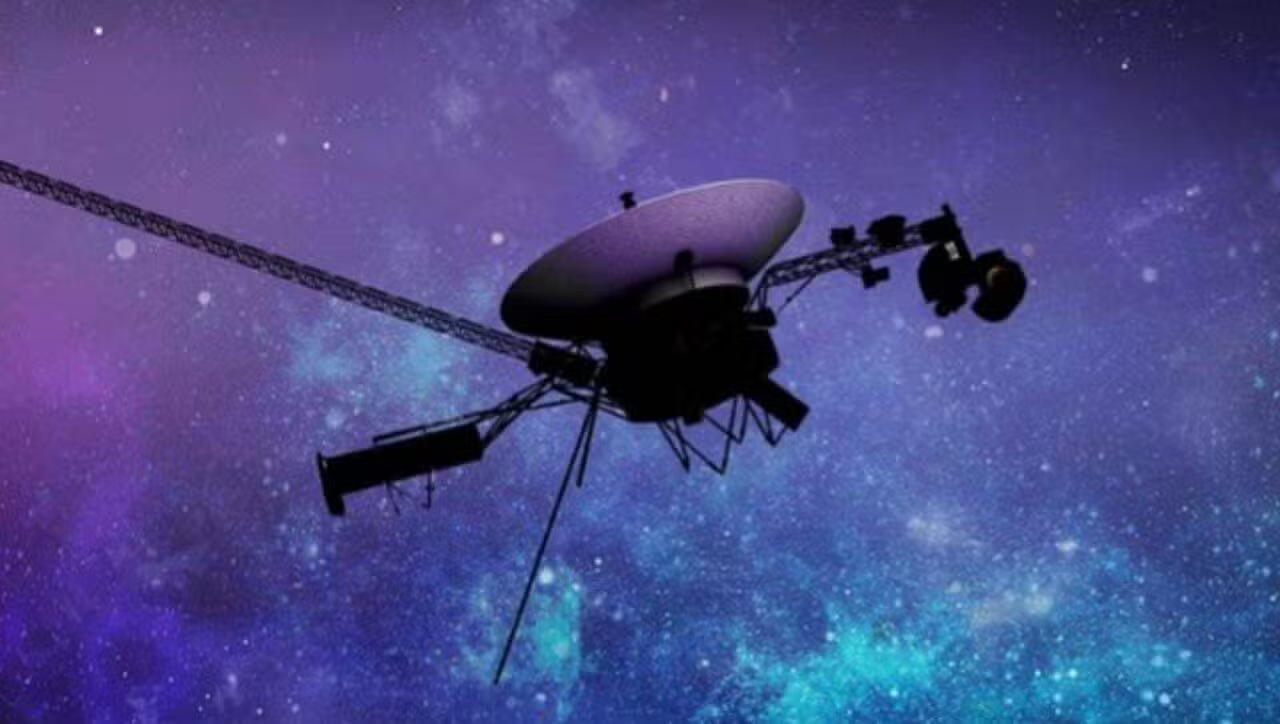
Voyager 1 crossed into interstellar space inAugust 2012, but remains within the Sun’s gravitational reach, meaning that its true exit from the solar system, beyond the Oort Cloud, is predicted not to occur before 30,000 years.
NASA confirmed that the Voyager 1 probe entered the interstellar region in August 2012. This milestone was reached after the spacecraft passed the heliopause, which is the border where the influence of particles and magnetic fields from the Sun decreases and gives way to the interstellar environment.
Although it seems like a definitive farewell, Voyager 1 actually became the first human artifact to perform direct measurements of the interstellar environment. No other spacecraft has traveled so far from Earth, marking a historic achievement.
However, the probe did not completely abandon all significant definitions of the solar system. The Sun’s gravitational pull extends far beyond Voyager 1’s current trajectory, all the way to the distant reservoir of icy bodies known as the Oort Cloud.
For this reason, the deadlines are impressive. According to information from NASA, Voyager 1, which travels at a speed of approximately 1.6 million kilometers per day, is only expected to reach the Oort Cloud in around 300 years and could take around 30,000 years to completely cross the outer edge of this cloud. Thus, a spacecraft can be considered interstellar by one definition and still be within the broader gravitational framework of the Sun by another.
Where the Voyager 1 probe actually crossed into space
The boundary that Voyager 1 crossed in 2012 was the heliopause. The heliosphere is the vast area shaped by the solar wind, which consists of a continuous stream of charged particles emitted by the Sun. Within this region, the magnetic and solar particle environment predominates.
Outside the heliosphere, the interstellar medium establishes itself as the predominant plasma environment. Voyager 1 did not have a fully functioning plasma instrument when it crossed this boundary, making confirmation more complex than a simple meter reading.
To infer the crossing, the researchers used other measurements, including plasma wave data, which indicated that the spacecraft had entered a plasma environment significantly denser than that of the heliosphere. NASA officially announced the crossing in 2013, identifying August 2012 as the exact moment Voyager 1 reached interstellar space.
NASA’s mission page currently clearly describes that Voyager 1 crossed into interstellar space in August 2012 and continues to collect data. This area is characterized as the region beyond the heliopause, external to the Sun’s bubble of energetic particles and magnetic fields.
This represents a genuine boundary in the physical environment surrounding the spacecraft, and is not a mere communication strategy. Voyager 1 is, in fact, collecting samples from a region no other spacecraft has reached, measuring conditions beyond solar protection. However, the heliopause is not the only conceivable limit of the solar system.
The Oort Cloud: the gravitational boundary of the solar system

The Oort Cloud is a distinct structure. It is not a bubble formed by the solar wind, but rather a distant and theoretical layer of icy bodies that surrounds the Sun, the planets and the Kuiper Belt. NASA describes it as the most remote region in the solar system, located far beyond Pluto and the outer edge of the Kuiper Belt.
Because it is in such a distant location, no spacecraft has yet been able to reach it, and NASA does not have direct images of this cloud. Their existence is mainly inferred from the behavior of long-period comets, which can appear from all directions, unlike the flatter orbit of most planets and Kuiper Belt objects. In 1950, Jan Oort proposed that these comets originated from a distant, spherical layer of icy bodies.
NASA’s scale estimates place the Oort Cloud at distances that make the heliopause appear relatively close. The cloud is described as occupying a space approximately 5,000 to 100,000 astronomical units (AU) from the Sun, with one AU being the distance between the Earth and the Sun. The space agency’s information page also presents a more conservative estimate for its inner edge, believed to be between 2,000 and 5,000 AU from the Sun, with the outer edge between 10,000 and 100,000 UA.
Voyager 1 crossed the heliopause just over 100 AU from the Sun. This distance was enough to exit the bubble of solar particles, but not enough to reach the inner edge of the Oort Cloud.
Understanding the Ambiguity of the Solar System’s Exit
This is where the terminology can become confusing. If by “solar system” we mean the region dominated by the solar wind, then Voyager 1 has already left it. However, if the term designates the area of objects gravitationally linked to the Sun, the probe is still within a much wider structure.
Both interpretations are common in public discussions, which can make Voyager’s status seem contradictory. The spacecraft has entered interstellar space, but has not yet traversed the outermost population of bodies orbiting the Sun. The first statement concerns the local plasma environment, while the second concerns gravity and orbit.
This distinction is crucial, as it changes the magnitude of the achievement. Crossing the heliopause did not represent the end of Voyager 1’s “solar history”, but rather the end of a phase of solar influence and the beginning of a new type of measurement. The solar wind no longer surrounds Voyager 1 in the same way as before, but the Sun’s gravity still shapes the distant cloud of comets that the spacecraft has not yet reached.
NASA’s own Oort Cloud page vividly illustrates this contrast without the need for exaggeration. Sunlight takes about 17 hours to reach the heliopause. However, after leaving the Sun, light can take 10 to 28 days to reach the inner edge of the Oort Cloud and perhaps up to a year and a half to reach the outer edge of the cloud. The heliopause is distant, but the Oort Cloud operates on a completely different scale of magnitude.
The persistence of Voyager 1, launched in 1977
Voyager 1 was launched on September 5, 1977, shortly after Voyager 2, but on a faster route. It performed flybys of Jupiter in 1979 and Saturn in 1980, then proceeding north, away from the ecliptic plane. Its Voyager Interstellar Mission began in 1990, expanding the spacecraft’s purpose from mere planetary flybys to exploring the outer limits of the solar influence and beyond.
Spacecraft power has declined over the decades. NASA’s current pages on Voyager indicate that some instruments have been retired to save energy, including Voyager 1’s Low Energy Charged Particle (LECP) instrument in April 2026. Despite this, the spacecraft’s mission remains active, continuing to return selected data from beyond the heliopause.
This contributes to the impact of the Oort Cloud timescale. Voyager 1’s scientific life is measured in decades. Its physical journey, however, is estimated at tens of thousands of years. Long after its instruments cease operating, the spacecraft will continue its outward trajectory, taking with it the Golden Record and the engineering decisions of the 1970s to regions that none of its builders will ever be able to directly observe.
The difference between timescales for Voyager 1
The statement “left the solar system” is therefore rather simplistic unless the specific boundary is named. Voyager 1 has crossed the heliopause, is in interstellar space and is beyond the Sun’s particle bubble. However, it is also very far from the Oort Cloud, the distant reservoir of comets that defines the outermost gravitational boundaries of the solar system.
From a human perspective of time, Voyager 1’s crossing in 2012 was a historic event. However, on the time scale of the solar system, it was just an initial step. The spacecraft has crossed a frontier and is on its way to another that is so far away that its future crossing no longer belongs to mission planning, but to the deep time of the universe.