
Researchers find blue octopus almost 2 km deep in the Pacific

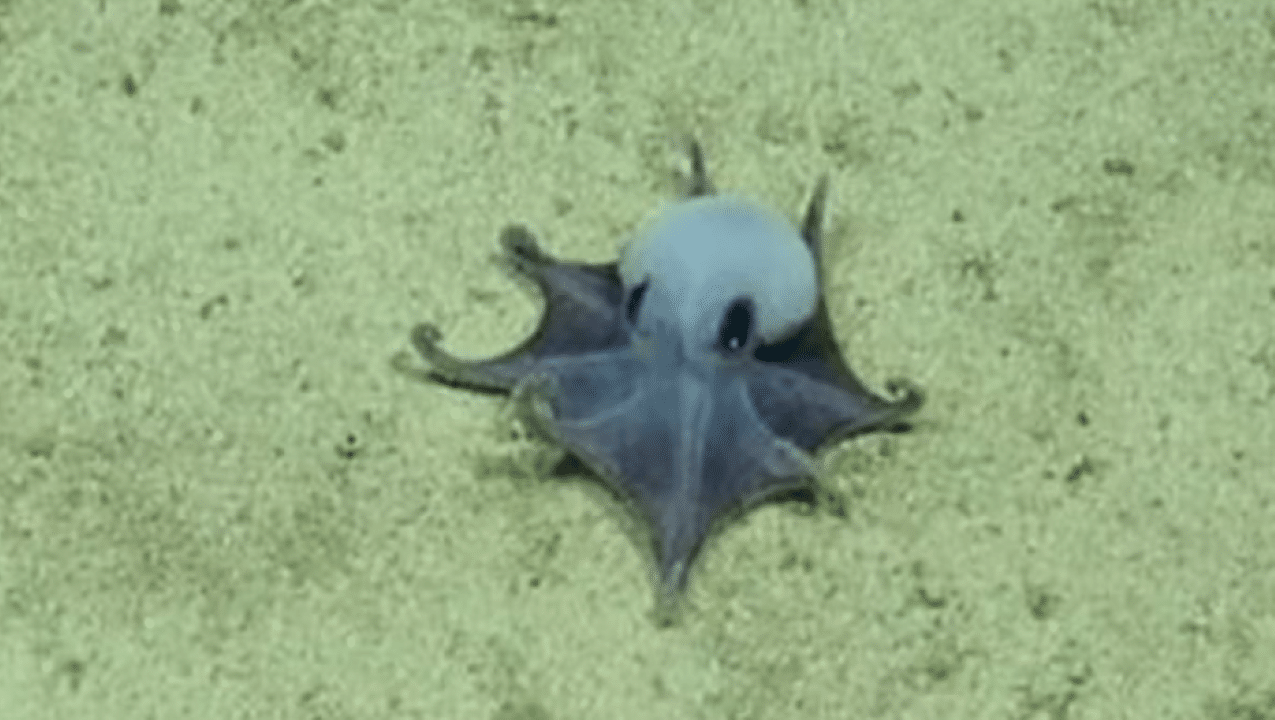
A marine discovery in the depths of the Pacific Ocean has revealed the existence of a small blue octopus, comparable in size to a golf ball, that lives approximately 1,800 meters below the surface. The find, near Darwin Island in the Ecuadorian Galápagos archipelago, occurred during a scientific expedition and was detailed in a recent study, bringing new perspectives on biodiversity in extreme environments.
The unique specimen, whose coloring and morphological characteristics intrigued scientists, was spotted by a remotely operated underwater vehicle (ROV). The expedition, led by the research vessel E/V Nautilus in collaboration with the Charles Darwin Foundation and the Galapagos National Park Directorate, marks an important advance in the exploration of little-known ecosystems.
Rare discovery in the deep waters of the Ecuadorian archipelago
The precise location of the blue octopus, in the vicinity of Darwin Island, reinforces the importance of the Galápagos Islands as a biodiversity hotspot, not only in its surface waters, but also in its abyssal regions. This environment, characterized by permanent darkness, very low temperatures and high pressure, is home to a range of creatures with unique adaptations. The fact that the animal is small, the size of a golf ball, and has an intense blue color, already indicates peculiar characteristics for life at such depth.
Research at great depths is crucial to understanding the entirety of life on the planet, as vast areas of the oceans still remain unexplored. Each new discovery contributes to mapping the distribution of species and the intricate ecosystems that thrive under extreme conditions, often far from direct human influence but vulnerable to climate change and pollution.
Enthusiasm and challenge: a unique example for science
The scientists’ initial reaction upon sighting the octopus was one of great surprise and excitement. Janet Voight, curator emeritus of invertebrates at the Field Museum and lead author of the study, expressed her fascination. “Right away, I knew it was something really special. I had never seen anything like it,” Voight reported in a statement, highlighting the rarity and beauty of the find. The peculiarity of the blue octopus, being such a new and distinct species, immediately classified it as a high-priority object of study.
No entanto, a equipe científica enfrentou um desafio considerável. There was only a single specimen of the blue octopus available for analysis, and its delicacy precluded traditional dissection methods. In cases of extremely rare and fragile species, invasive techniques could destroy vital structures and irreparably compromise the collection of valuable data. Preserving the integrity of the specimen was essential to ensure that all of its unique characteristics could be studied without prejudice.
Innovative methodology reveals secrets without damaging the animal
To overcome the dilemma of analyzing the specimen without destroying it, the researchers employed a cutting-edge technique: microcomputed tomography. This non-invasive methodology allowed the production of detailed three-dimensional images of the octopus without the need for physical alteration of the organism. Microtomography is similar to medical tomography, but on a much smaller scale, capable of capturing anatomical minutiae with high resolution.
The application of this technique was crucial in revealing the internal structure and morphological characteristics of the blue octopus, providing information that would be impossible to obtain through traditional dissection. This innovative approach not only protected the rare specimen, but also demonstrated how technology can be instrumental in advancing marine biology and the taxonomy of delicate creatures. The ability to study fragile organisms in detail without damaging them opens new frontiers for biodiversity research.
Details of the discovery of the blue octopus in the depths
The expedition that revealed the little blue octopus was a collaborative effort that brought together expertise and technology to explore one of the most remote environments on the planet. The data collected by the underwater vehicles allowed scientists to document the habitat and living conditions of this unique creature.
- Location:Near Darwin Island, in the extreme north of the Galápagos archipelago, Ecuador.
- Depth:About 1,800 meters below the surface of the Pacific Ocean.
- Animal size:Comparable to that of a golf ball.
- Research vessel:E/V Nautilus, equipped for deep water exploration.
- Expedition partners:Charles Darwin Foundation and Directorate of the Galápagos National Park.
- Location Tool:Remotely operated underwater vehicle (ROV).
- Main researcher of the study:Janet Voight, curator emeritus of invertebrates at the Field Museum.
Future perspectives for in-depth research
The discovery of the blue octopus not only adds a new species to the catalog of marine life, but also highlights the vast and still unknown biodiversity that resides in the ocean depths. Each new creature found serves as a reminder of the complexity and resilience of abyssal ecosystems, which are often isolated and subject to extreme conditions that shape extraordinary life forms.
This type of research is vital for understanding evolutionary biology and biogeography, as well as offering insights into how life adapts in challenging environments. Continued expeditions in areas like the Galápagos, which are natural laboratories of evolution, are essential to identify and protect species before they become extinct or before their habitats are impacted by human activities. The protection of the deep oceans, with their unique landscapes and beings, is a growing commitment of the global scientific community.





