

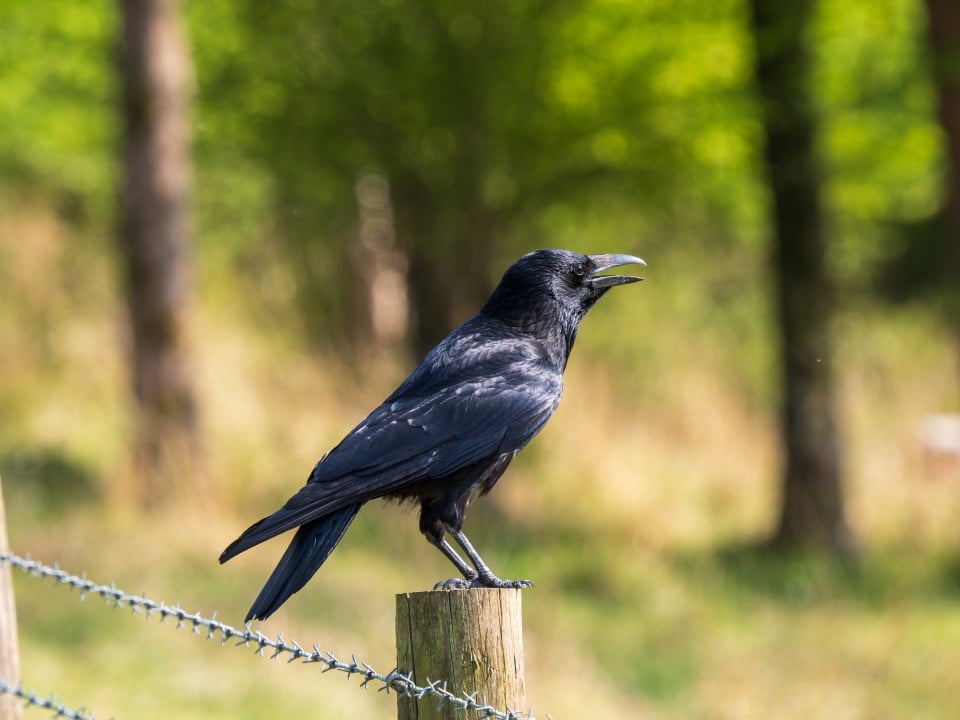
Researchers discovered that crows have surprising mathematical abilities, being able to understand and apply concepts of probability to make decisions that guarantee more rewards. The study details how these birds process statistical data logically, challenging the long-held idea that complex mathematical reasoning is exclusive to humans and some highly developed primates.
The practical experiments revealed that, when exposed to different choice scenarios associated with varying chances of gaining food, the crows evaluated the options in a purely rational way. They set aside mere instinct or the habit of repeating previous choices to focus strictly on the alternative that presented the greatest mathematical advantage.
Full coverage: Latest News (EN)
How crows make decisions based on probabilities
During laboratory tests, birds were trained to associate different visual stimuli with different probabilities of receiving a food reward. The researchers presented combinations of symbols that represented varying chances, ranging from low probability to almost certainty of obtaining the food.
The crows demonstrated extremely analytical behavior throughout the sessions:
- Risk analysis:The birds dynamically calculated which image offered the best statistical return.
- Consistent Choice:Given a choice scenario, the crows consistently selected the option with the highest probability of success.
- Cognitive flexibility:When the probabilities associated with the symbols changed, the animals quickly adapted their choices to the new mathematical scenario.
This behavior indicates that these birds not only memorize simple patterns, but carry out true statistical processing in real time to optimize their chances of survival and nutrition.

The brain structure that allows mathematical calculation
The most revolutionary aspect of the discovery lies in the neurobiology of these animals. Humans and other mammals use the prefrontal cortex to perform logical operations and complex decisions. Crows, however, do not have this specialized brain structure, which is a characteristic unique to mammals.
Instead of the prefrontal cortex, birds use a brain region calledcaudolateral nidopallium(NCL). Although anatomically very different from the human brain, the NCL has independently evolved to perform exactly the same cognitive function of data-driven decision-making. This is a classic example of convergent evolution, where nature develops different biological solutions to solve the same information processing problem.
What bird intelligence reveals about the human mind
The discovery that the bird brain can process abstract statistical concepts without a neocortex opens new frontiers for neuroscience and the development of artificial intelligence. It demonstrates that the neurological building blocks necessary for mathematical reasoning are more flexible than previously thought.
By understanding how a brain structure so different from ours can achieve similar logical results, scientists can obtain new clues about the evolution of human intelligence itself. This advance suggests that the ability to calculate probabilities and make rational decisions is such a fundamental evolutionary tool that it has found ways to manifest itself in different ways across the tree of life.