
James Webb discovers third giant planet in famous Beta Pictoris system


NASA’s James Webb Space Telescope has made a remarkable discovery by finding a new giant planet outside our solar system, an exoplanet, that was hidden in one of the most studied planetary systems in the Milky Way. The system, known as Beta Pictoris, now reveals even greater complexity to scientists.
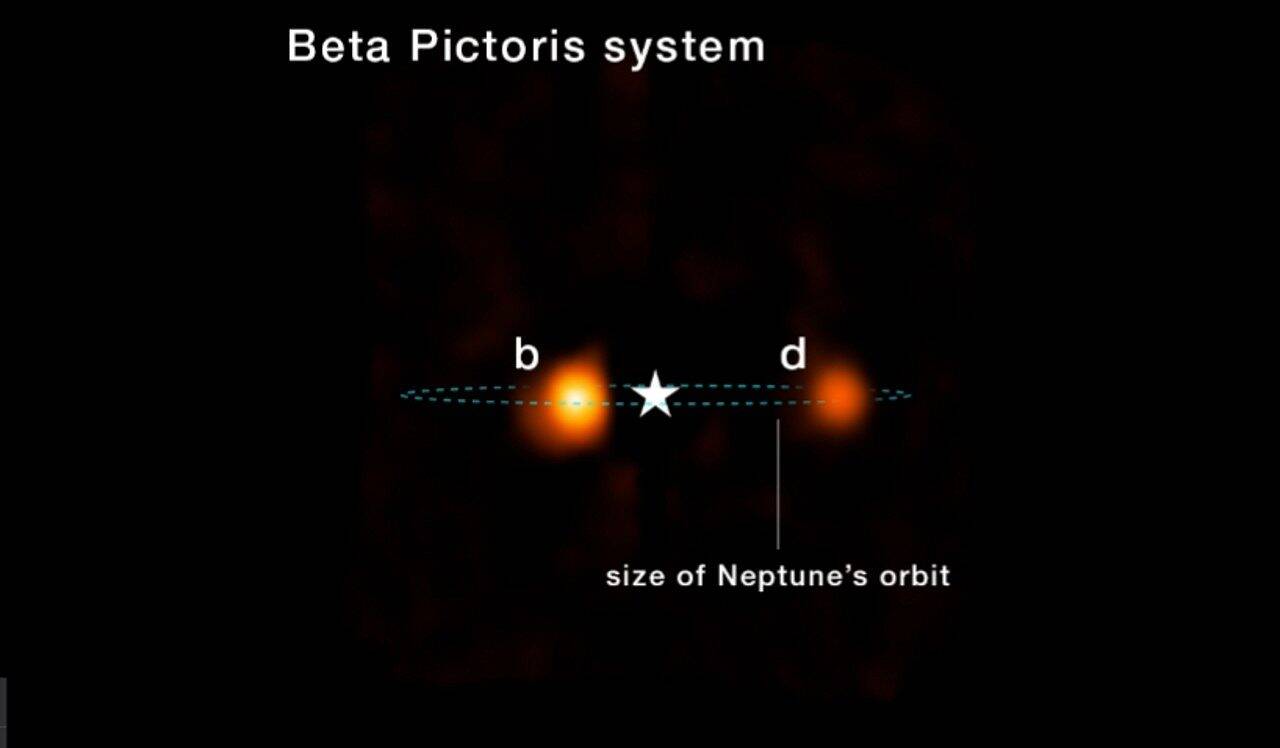
The young star Beta Pictoris was already famous for hosting two giant exoplanets: Beta Pictoris b, one of the first to be directly imaged, and Beta Pictoris c. The arrival of Beta Pictoris elevates the system to the status of only the second known to have at least three imaged planets. Unlike its siblings, Beta Pictoris d was not detected by a direct glow, but by identifying its unique atmospheric chemical signature, a groundbreaking technique that could redefine the search for new worlds.
“This revelation adds a new piece to an already incredibly intriguing planetary system,” said Aidan Gibbs, lead author of the new study published in Astrophysical Journal Letters and a postdoctoral researcher at the University of California, San Diego. “Beta Pictoris has been an essential laboratory for understanding the formation and evolution of planetary systems, and now we have another planet to help us unravel this story.”
New revelations in an already known system
Situated 63 light-years from Earth and estimated to be 23 million years old, Beta Pictoris is a neighboring star system in the Milky Way that offers a rare opportunity to observe interactions between newly formed planets and the disk of dust and debris left over from their creation.
The team of astronomers estimates that Beta Pictoris d has a mass at least twice that of Jupiter, making it the smallest of the three gas giants discovered so far in the system. Simulations indicate that it orbits its star at approximately 30 astronomical units, a distance similar to that of Neptune in our own solar system. Despite having the widest orbit of any known planet, it remains within the inner edge of the debris disk.
Although scientists were not searching for another planet with Webb, Beta Pictoris d appeared while using the telescope’s NIRSpec (Near Infrared Spectrograph), which was being used to investigate Beta Pictoris b’s atmosphere. For this, the NIRSpec Integral Field Unit was used, capable of generating both an image and a spectrum for each pixel.
“We weren’t looking for a new planet,” Gibbs said. “Our goal was to understand something we already knew. Then this unmistakable signal appeared in the data where we didn’t expect it.”
The signal manifested itself as a series of peaks and valleys in the spectroscopic data, a feature that was not expected in a uniform spectrum of light reflected by dust. It was a clear pattern of carbon monoxide absorption lines, arranged like a “barcode,” a typical indicator of giant planet atmospheres.
Because spectroscopy reveals not only the chemical composition but also the movement of objects, the team was able to calculate the radial velocity from the data. They confirmed that the planet’s speed, position, and alignment with the debris disk were consistent with a body orbiting Beta Pictoris, ruling out the possibility that it was a background star or a brown dwarf with carbon monoxide in its atmosphere.
“There was an unexpected bright light source in the Integral Field Unit image, but we learned not to blindly trust bright patches in the images,” explained Jean-Baptiste Ruffio, a research scientist at the University of California, San Diego, and principal investigator of the initial Webb observations that led to the discovery. “These spots could be instrument artifacts or other structures in the debris disk. By obtaining a spectrum simultaneously with the image, we were able to quickly validate our suspicions.”
Additional observations with Webb’s Mid-Infrared Instrument (MIRI), conducted through a Director’s Discretionary Time request, identified water vapor and methane. These detections provided robust confirmation of the planet’s identity and allowed for a more detailed analysis of its atmosphere.
Unlike conventional imaging approaches, the spectroscopic technique allowed scientists to not only identify the planet, but also begin studying its atmosphere from the first observation.
“A spectrum contains an incredible amount of information,” Ruffio highlighted. “You don’t just discover that there is a planet; you immediately begin to learn about its temperature, chemical composition and movement.”
An independent imaging study, led by Ben Sutlieff of the University of Edinburgh and Markus Bonse of the European Southern Observatory, corroborated the team’s findings. Using data from the European Southern Observatory’s Very Large Telescope (VLT) and Webb’s NIRCam (Near Infrared Camera), the research autonomously confirmed the existence of Beta Pictoris d.
Overcoming cosmic obstacles with new techniques
Beta Pictoris d remained unknown for many years due to its location within one of the most luminous debris disks ever observed.
The dust disk acts like a dense haze, scattering the star’s light and making neighboring planets and structures difficult to distinguish using common imaging techniques. The spectroscopic method employed with Webb, however, managed to bypass this dust, isolating only the narrow, specific molecular signatures of a planetary atmosphere.
Scientists suggest that the presence of this new planet could help explain the remarkably defined inner rim and other enigmatic features of the famous debris disk. In fact, astronomers had already predicted the existence of a planet with characteristics similar to those of Beta Pictoris d to justify the disk’s unusual structure.
In addition to deepening our understanding of the Beta Pictoris system, this discovery represents a significant advance and a new tool for searching for and identifying exoplanets.
This is the first planet detected through a combination of moderate-resolution spectroscopy and direct imaging, demonstrating that astronomers can now identify worlds in complex environments through their atmospheric signatures, without relying exclusively on traditional coronagraphic imaging techniques.
Researchers plan to continue analyzing Webb’s observations to refine information about the planet’s temperature, atmospheric composition and orbit. This promises an even deeper understanding of one of astronomy’s most iconic planetary systems.
The James Webb Space Telescope is the world’s premier space science observatory. Led by NASA in partnership with ESA (European Space Agency) and CSA (Canadian Space Agency), Webb is committed to unlocking mysteries of our solar system, exploring distant worlds and investigating the origins and structures of the universe and our place in it.





