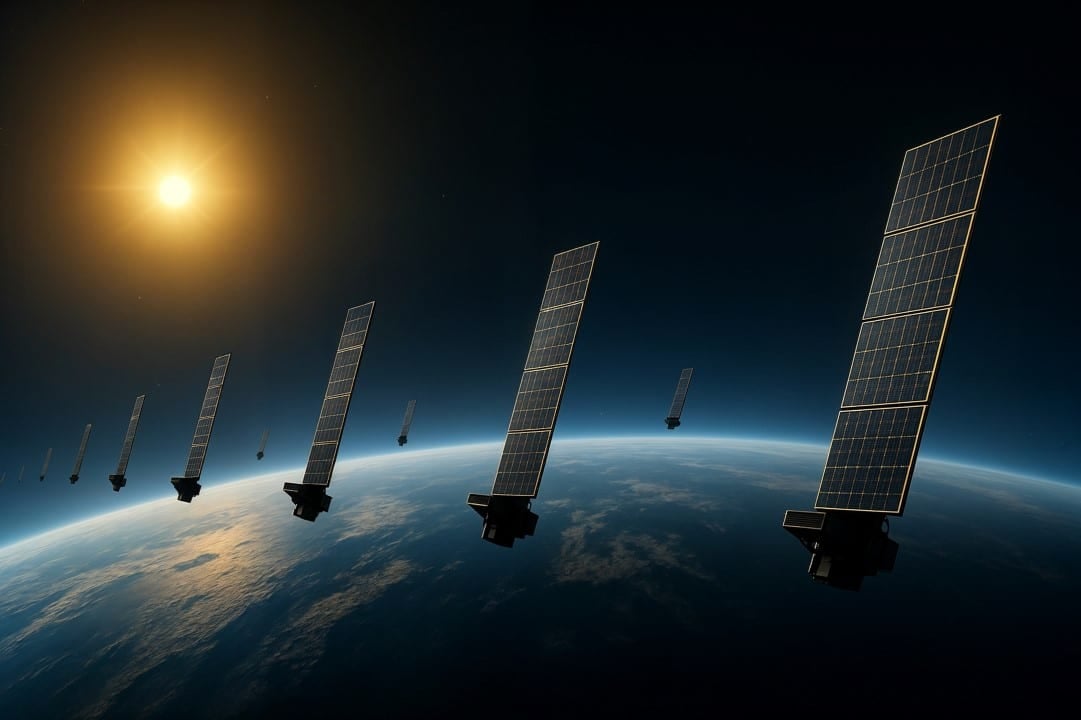
SpaceX’s Starlink satellites perform weekly diversion maneuvers and experts warn of risks in space


Recently, SpaceX’s Starlink satellites performed more than 355,000 collision-avoidance maneuvers over the past year, with each unit dodging debris and other spacecraft on an almost weekly basis. This volume represents a growing challenge to the sustainability of the space environment.
The data was released by SpaceX in its most recent semi-annual report to the Federal Communications Commission (FCC). According to the document, between December 2025 and May 2026, there were 207,152 diversion maneuvers, an increase of almost 60 thousand compared to the 148,696 in the previous semester. The annual total exceeded 355,000, more than three times the number recorded in 2024, meaning an average of more than 40 satellite maneuvers per year between June 2025 and May 2026.
Experts express concern that the situation could soon become uncontrollable. Hugh Lewis, professor of astronautics and space sustainability expert at the University of Birmingham, UK, said the community is “moving towards a situation where there will be a collision involving an operational satellite in the constellation.” He stressed that this will occur “despite all these maneuvers”, not due to the lack of diversion attempts.
This increase in maneuvers coincides with the expansion of SpaceX’s internet constellation and the growth in the total number of satellites in space over the last five years. Starlink went from approximately 6,000 satellites in 2024 to more than 10,000 in June 2026. In the same period, the total number of operational spacecraft in orbit rose from around 10,000 to approximately 16,000.
The SpaceX constellation operates at altitudes ranging between 480 km and 550 km, using an autonomous collision avoidance system. This system initiates a maneuver when the probability of impact exceeds 3 in 10 million. While Lewis acknowledges SpaceX’s “excellent work” in managing orbital traffic, he warns that rapid growth cannot proceed without significant risks.
According to Lewis, preventive maneuvers reduce the probability of a collision to about one in a million, a number that, individually, seems insignificant. However, the expert highlighted that the problem lies in the aggregate risk: “If you do a million maneuvers and have a residual probability of one in a million, you end up with an aggregate risk across your entire constellation that you can’t get rid of.”
Lewis also mentioned that with the forecast continued increase in maneuvers (SpaceX has asked the FCC for permission to expand its constellation to 100,000 satellites), the company could reach one million diversion maneuvers over Starlink’s lifetime as early as June 2027. By 2030, the constellation could perform more than one million maneuvers annually. In this scenario, the risk of a collision, even one in a million, may no longer be insignificant.
Tommaso Sgobba, director of the International Association for the Advancement of Space Safety, said that the growth in the number of maneuvers to avoid collisions is a predictable certainty for the sector.
Sgobba explained, in an email communication, that “the more satellites are placed in an orbit, the more pairs of satellites there are that can potentially intersect.” He emphasized that “adding satellites not only increases the risk linearly, but multiplies the number of possible pairs. Doubling the satellites into an orbital layer approximately quadruples the number of pairs that need to be monitored.”
Furthermore, Sgobba pointed out that the calculated collision probabilities are quite imprecise. This is because the effects of atmospheric drag, which constantly vary with space weather, are currently impossible to predict accurately.
According to him, the large uncertainties in satellite trajectory predictions mean that “operators do not have the tools to distinguish a real threat from statistical confusion.” Sgobba added that “satellites often bypass ‘ghosts’, consuming fuel and shortening their operational lifetime in the process.”
SpaceX, with the largest constellation currently in orbit, assumes most of the responsibilities for orbital maneuvers. Instead of communicating with other operators to decide who should divert, Starlink satellites automatically avoid objects whether fragments of space debris or other operational satellites whenever there is a conjunction alert.
Other ambitious constellations, such as Amazon LEO and China’s Thousand Sails (Qianfan), are in the deployment phase, actively contributing to the high number of satellites in low Earth orbit.
Lewis indicated that the only safe way to manage multiple constellations would be to ensure that their orbits do not intersect. However, available information suggests otherwise. The Thousand Sails constellation, for example, should occupy orbital regions similar to those of Starlink. Additionally, many newly announced orbital data center projects plan to operate in specific regions that are convenient for their operations, which increases the likelihood of overlap.
“The ideal would be to separate the constellations,” said Lewis. However, he reasoned that this raises questions about orbital support capability and first-mover advantage, as “if I go into a specific altitude with my constellation, then no one else can use it.”
Sgobba argues that the expected numbers of collision avoidance maneuvers, based on the number of satellites, must be disclosed to regulatory agencies before granting launch licenses.
“Currently, there is no clear requirement for a company to report, prior to launch, how many collision avoidance maneuvers a constellation of this size and density will require annually, and whether the satellites have sufficient fuel and automation to perform them,” Sgobba wrote. He concluded that orbital congestion is “not an accident waiting to happen, but a manageable and predictable engineering workload”, arguing that regulators should address the issue by requiring these numbers upfront rather than reacting to incidents after the fact.