
Bridgestone innovation puts flat-free tires to real tests in Japan

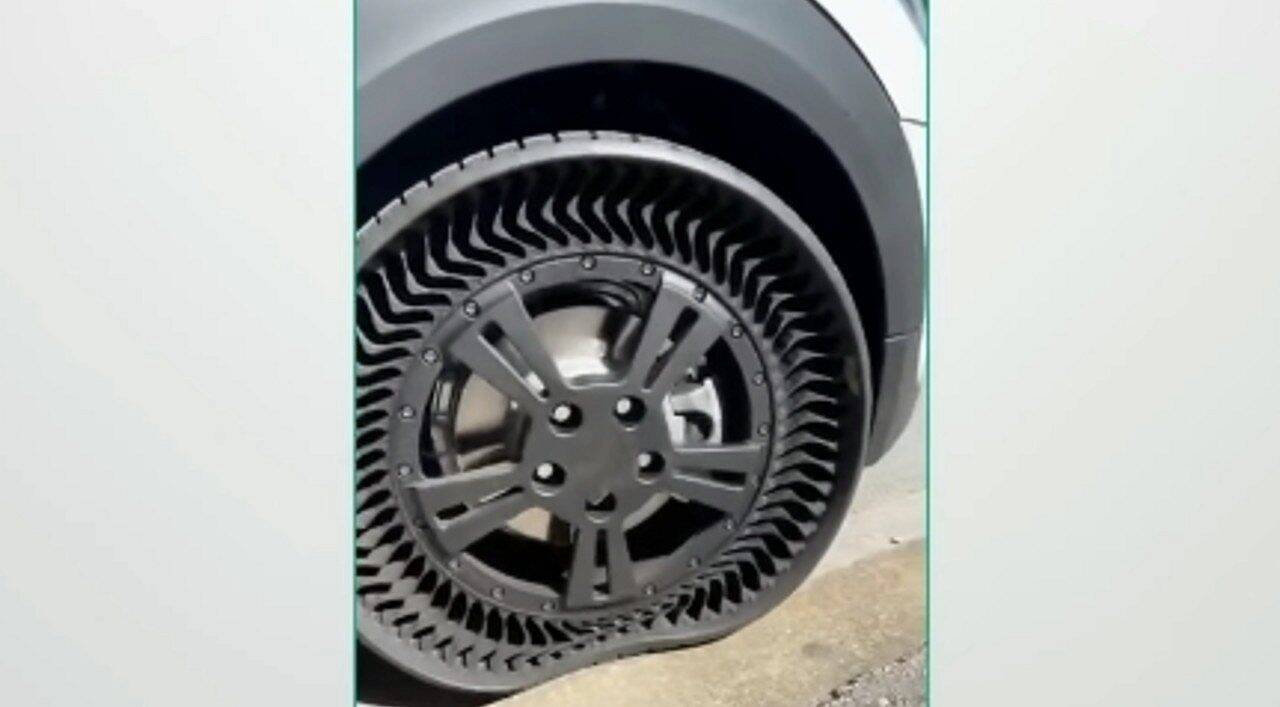
The automotive industry has been searching for a definitive solution for decades to one of the most common and frustrating problems faced by drivers around the world: a flat tire. This scenario of dependence on pneumatic pressure begins to change in a concrete way with Bridgestone’s latest initiative. The Japanese manufacturer has begun practical testing of its airless tire technology on public roads, choosing the city of Higashiomi, located in Japan, as the open-air laboratory for this crucial phase of development. Unlike controlled presentations at technology fairs, the company equipped a real fleet of small electric and autonomous vehicles to operate in the region’s daily traffic.
These automobiles, which visually resemble traditional golf carts, fulfill an important social function in the Asian province. They are primarily used for the safe movement of elderly citizens, a growing demand in a country that has one of the oldest populations on the planet. The choice of this audience and this specific type of transport was not accidental, as it offers the perfect scenario to monitor the behavior of the material under continuous use, ensuring passenger safety while engineers collect vital data on the wear and efficiency of the product in real asphalt conditions.

The elimination of the need for constant calibration represents a paradigm shift in vehicle maintenance. Traditional tires lose pressure naturally over time or due to sudden temperature variations, which directly affects fuel consumption and the car’s stability. By removing air from the equation, the manufacturer seeks to deliver a component that maintains its structural characteristics intact from the first day of use until the moment of disposal, drastically reducing unforeseen stops and accidents caused by explosions in motion.
The advanced engineering that underpins the AirFree concept
To understand how a vehicle manages to remain stable without the support of compressed air, it is necessary to look at the internal architecture of the project, commercially called AirFree. The technology replaces the pneumatic chamber with a complex network of intertwined structural spokes. These rods, which attract attention due to their blue color, are made from a highly resistant thermoplastic resin. This material was chosen for its ability to support the weight of the car while absorbing imperfections in the ground, functioning in a similar way to an independent suspension system coupled directly to the wheel.
The model that currently runs through the streets of Higashiomi already represents the third generation of this technological development. Engineers were able to refine the chemical composition of the resin, making the materials considerably more flexible than in previous versions. This improved malleability solved one of the biggest problems with the first prototypes: the excessive rigidity that transferred all the bumps from the hole directly to the occupants’ spine. Now, the impact is distributed in a dissipated way throughout the circular structure, guaranteeing a level of comfort comparable to that of conventional passenger tires.
The environmental appeal of this innovation is another important factor for modern industry. Millions of tires are discarded prematurely every year simply because they have suffered irreparable punctures on the sides or deep tears in the tread. The Bridgestone system was designed from the perspective of the circular economy. Both the rubber tread and the thermoplastic resin spokes can be fully recycled. Additionally, the structure allows the outer rubber band to be refurbished or replaced when worn, extending the life of the main skeleton and reducing the volume of petroleum-derived waste in landfills.
Strict conditions and limits of the current experimentation phase
Despite the enthusiasm generated by images of vehicles driving without air in their tires, the technology still operates under severe safety restrictions. The current production model has been approved to reach a top speed of just 20 km/h. This conservative limit is essential because the resin’s deformation dynamics at low speeds are completely different from the material’s behavior when subjected to the stress of an expressway. The low speed ensures that any unforeseen structural failure does not result in loss of directional control.
Another limitation imposed by the engineering team is the geographic restriction. Higashiomi’s electric vehicles operate exclusively on pre-defined and mapped routes. This rigorous control of the route allows the manufacturer to know exactly the type of pavement, the slope of the roads and the obstacles that the tires will face on a daily basis. Predictability of the environment is key to isolating variables when analyzing telemetry data, allowing researchers to understand exactly how the resin reacts to repetitive cycles of compression and decompression over months.
The combination of short routes, familiar asphalt and reduced speed creates the ideal nursery for the project to mature. Bridgestone uses this municipal fleet as a proof of concept. Depending on the structural integrity demonstrated by the blue rays after thousands of kilometers driven in these mild conditions, the company will have the necessary mathematical basis to justify heavier investments and move on to tests with larger and more powerful vehicles.
Main barriers to adoption in passenger cars
The transition from slow electric cars to sedans and SUVs that travel at 120 km/h on highways requires overcoming formidable obstacles from physics and materials science. The Japanese manufacturer is transparent in admitting that there is still no official schedule for the average consumer to be able to walk into a store and buy a set of airless tires for their garage car. Complexity increases exponentially as speed increases.
Researchers focus their current efforts on solving critical problems that impede mass commercialization. Among the main technical challenges that automotive engineering needs to solve in this decade, factors that directly affect the safety and viability of the product stand out:
- The dissipation of extreme heat generated by continuous friction of the resin at high speeds, which can cause melting or premature fatigue of the internal structure.
- Control of acoustics and rolling noise, since the absence of a closed air chamber changes the way the sound of contact with the ground echoes into the cabin.
- Maintaining lateral stability during sharp curves at high speed, when the vehicle’s weight shifts violently and requires maximum rigidity from the tire edges.
- The ability to withstand heavy dynamic loads without the thermoplastic spokes undergoing permanent deformation after long periods of parking.
The race to master this technology is not a lonely one. The global market is witnessing a fierce dispute between the biggest powers in the sector. Michelin, in partnership with General Motors, presented the Uptis project to the world in 2021, which shares the same philosophy of eliminating compressed air and puncture resistance. The presence of multiple conglomerates investing billions in research and development signals that the transition to non-pneumatic tires is seen as the next major evolutionary leap in land mobility.
Horizons beyond Earth and applications in space exploration
While civil engineering teams struggle to adapt the technology to the asphalt of large cities, another Bridgestone department is looking upward. The company recognizes that the concept of structural spoke support has immense potential for environments where traditional rubber and compressed air are absolutely useless. The most ambitious focus of the AirFree project is the development of components for exploring the lunar surface.
In outer space, inflated tires face relentless enemies. The vacuum of space would make any air chamber expand until it burst, while extreme temperature swings, from freezing cold in the shade to scorching heat in the sun, would destroy common rubber compounds within hours. Additionally, the lunar soil, known as regolith, is covered in glass-sharp rocks that would tear through any soft material instantly.
To overcome this hostile environment, the manufacturer is working on a metallic variation of the airless tire. Replacing thermoplastic resin with special metal alloys capable of flexing and returning to their original shape, the company designs the wheels that will equip future manned exploration vehicles. This synergy between the development of solutions for Japanese urban traffic and aerospace engineering demonstrates how the quest to eliminate a simple tire puncture could end up driving the technology necessary for continued human presence beyond planet Earth.




