
Christopher Nolan’s The Odyssey: new adaptation explores classic epic with authorial style


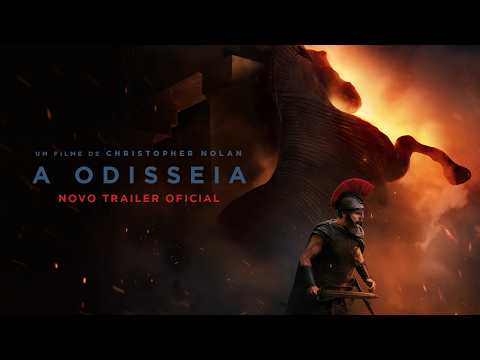
Filmmaker Christopher Nolan, known for his unique approach to the seventh art, once again delves into a complex narrative with his film version of “The Odyssey”. The work, which is an adaptation of Homer’s epic poem from the 8th century BC, is the direct sequel to “Iliad”, one of the pillars of Ancient Greek literature. The ability for an ancient story to continue to be reinterpreted in contemporary formats demonstrates the timelessness of certain human creations.
It is essential to highlight that Nolan’s work, like the original poem, navigates between fiction and historical reality. Although cities such as Troy existed and war may have occurred, elements such as the famous wooden horse and divine interventions are widely considered myths. Interestingly, even Homer’s very existence is a matter of debate among historians, suggesting that the epics may have originated from a collective oral tradition in Ancient Greece.
When approaching a universe full of gods, cyclops, sorceresses and fantastic apparitions, the adaptation does not aim for rigid historical accuracy. The essence of “The Odyssey” lies in its mythological, fantastic and epic character, which profoundly influenced world literature. Christopher Nolan demonstrates mastery in adapting a work so intricate and rich in details, even if some moments of rhythm can be questioned.
Christopher Nolan’s signature in the editing: between genius and rhythmic challenges
Christopher Nolan’s productions often subvert the chronological linearity of events, a striking feature of films such as “Amnesia”, “Interstellar”, “Oppenheimer” and “Tenet”. This inventive editing is a signature of the director, which demands the audience’s maximum attention and transports them through temporal universes created by him. In “The Odyssey”, this concept is applied with excellence, complemented by the text’s narration, which explores Ulysses’ journey in an engaging way. This approach not only distinguishes his productions, but also raises an intriguing question about the adaptation of an ancient work like ‘The Odyssey’, which was born from oral tradition and has already undergone countless reinterpretations; Nolan’s fragmented narrative, in this context, can be seen as a new way of honoring the mutable and reinterpretable nature of the epic.
However, the rhythmic fluidity of the film can generate some discomfort, especially in the build-up to the climax. The long preparation for a revelation essential to the outcome can cause unnecessary expectations in the viewer. Despite following what the original book proposes in similar sections, the experience of reading and watching the work differs significantly.
As in “Oppenheimer,” some events serve as narrative turning points. In “The Odyssey”, the sirens’ song is equal in impact to the atomic bomb test scene in the 2024 Oscar-winning film. Both moments use technical and sound resources to intensify the experience, something that will be explored in more depth later.
The cast shines in “The Odyssey”: memorable performances from the protagonist to the supporting actors
Matt Damon’s performance as Odysseus stands out as another great performance in his career, although it doesn’t surpass his work in “Good Will Hunting.” The film’s most impactful scenes often feature Damon’s on-screen presence. The actor embodies the epic hero, while capturing the arrogance and pride inherent to the human nature of the protagonist in the original story.
Tom Holland delivers his most dramatic work to date, solidifying his ability to go beyond the role of Spider-Man. The actor demonstrates vast potential for professional growth, indicating that his career should expand significantly beyond the Marvel universe.
Anne Hathaway delivers yet another notable performance, despite less robust development for her female character, a point occasionally noted in Nolan’s works. In “Oppenheimer”, characters such as Kitty Oppenheimer, played by Emily Blunt, and Jean Tatlock, played by Florence Pugh, had limited narrative arcs, often serving as support for the protagonist. In “The Odyssey”, there is a similarity, but with a slight evolution in the supporting characters; Queen Penelope, however, appears little on screen and has an impact that is less than her due.
In addition to the three protagonists, five performances deserve special recognition: Robert Pattinson as Antinous, John Leguizamo as Eumaeus, Himesh Patel as Eurylochus, Charlize Theron as Calypso and Samantha Morton as Circe, who bring depth and charisma to their roles.
John Leguizamo, playing Eumaeus, Odysseus’ faithful blind shepherd, often serves as the audience’s perspective on the narrative. Nolan uses the character intelligently to guide the viewer through several scenes and, mainly, to illustrate the people’s deep admiration for their king.
Robert Pattinson takes on the role of Antinous, one of Queen Penelope’s suitors, and delivers a performance that transforms him into a detestable figure, exactly as the character demands. This is the first time his performance has evoked such aversion, surpassing even his role in “The Drama”, which still possessed a touch of comedic sympathy.
Himesh Patel, known for his work in “Yesterday”, shines as Odysseus’ loyal companion after the journey to Troy. The British actor, who has always deserved greater prominence, finally receives the recognition he deserves in a production of great magnitude.
Charlize Theron, although her character Calypso does not have a complete development, is fundamental in helping Odysseus to narrate his own story, revealing the events to the public. The interactions between the two characters serve as the introduction to the epic adventure’s answers.
In just a few minutes, Samantha Morton, playing the sorceress Circe, manages to encapsulate one of the most memorable misadventures of Odysseus’ crew. The actress is capable of provoking a diverse range of emotions in the viewer, leaving a lasting impression.
The visual and technical construction of “The Odyssey”: recreating myths and war scenes
The representation of the Odyssey’s mythical encounters is exquisitely crafted, with a more “realistic” view of the figures, despite their fantastic and mythological nature. The meeting with Polyphemus, the Cyclops son of Poseidon, conveys all the tension of the moment and Odysseus’s sagacity, which would result in the curse that would haunt the rest of his trip, already marked by the horrors of war.
The island of the Laistrygonians, cannibal giants, although brief, offers an intriguing representation chosen by Nolan. The costume, with Templar-inspired armor, deliberately clashes with the historical period, serving to suggest that these beings do not belong to the earthly world, giving a touch of strangeness.
The film’s technical highlight is the mermaid sequence. All of the crew have wax in their ears to avoid the enchantment, except Odysseus, who chooses to listen but is tied to the mast. The audience’s experience is similar: you don’t hear the sirens’ song, just the sound muffled by the wax and the protagonist’s screams of pain. This scene draws a clear comparison to the nuclear bomb test in “Oppenheimer”, where the sound of the explosion does not keep up with the speed of light. Both moments provide immersion and authenticity to the production.
The film’s photography is highly praised, although there are some reservations regarding the costumes. However, it is crucial to remember that this is a work of fiction, and the visual choices are in line with various historical accounts, especially in the scenes of the Trojan War. These scenes are epic and avoid stylized cinematic choreography, portraying the crudity of a real war: cowardly attacks, war crimes, sexual abuse and other brutal situations.
Another scene that causes fascination is Odysseus’s visit to Hades to communicate with the dead. The prevailing darkness, the blood of the sacrifice and the black sand, the color of coal, create a funereal atmosphere that completely envelops the spectator, transporting him to the underworld.




