
Light experiment recreates black hole to prove Stephen Hawking’s radiation

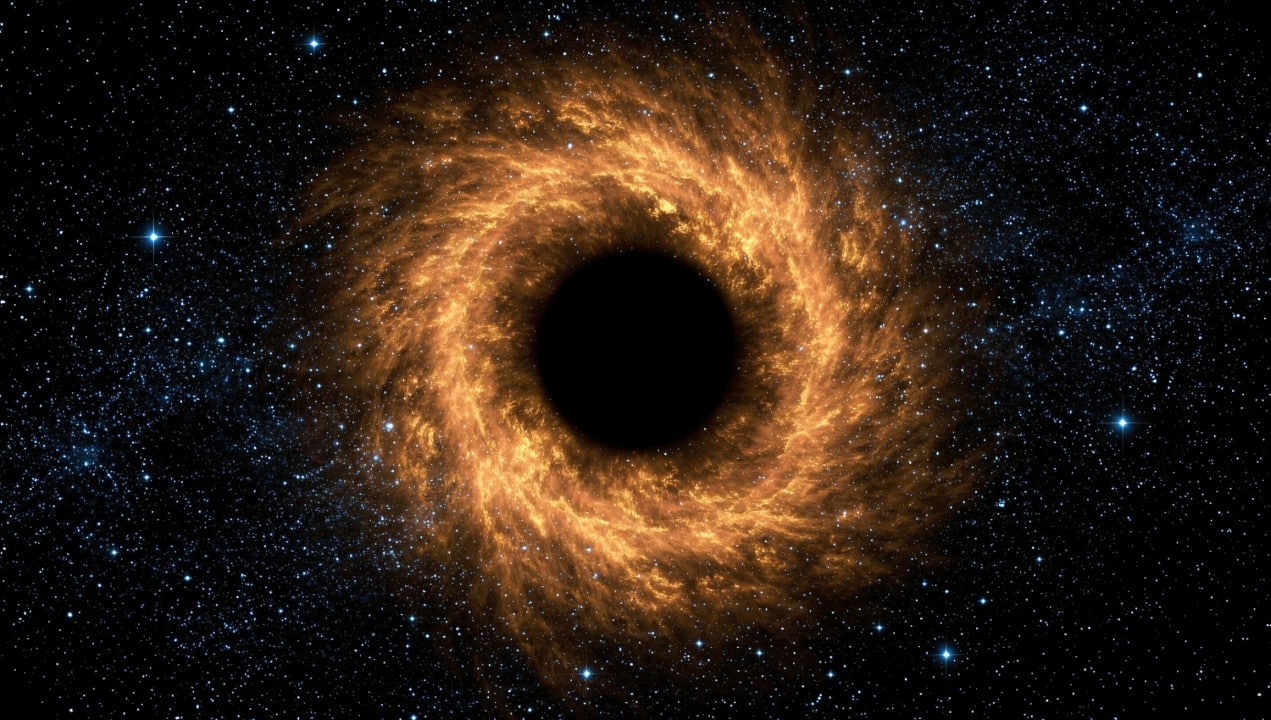
Scientists have released a landmark discovery about the physics of Hawking radiation, by managing to create a miniature black hole from light in a controlled environment. The research, published July 1 in the journal Nature, offers unprecedented insight into one of the most intriguing phenomena in the universe.
For the first time, physicists have extracted a black hole’s most famous emission from a fiber optic filament and directly observed how that light reacted in the simulated black hole that originated it.
The study gives researchers a rare and direct understanding of Hawking radiation — the faint thermal release that Stephen Hawking predicted should emanate from black holes. Furthermore, the discovery offers a first indication of the minimum impulse that could theoretically cause a real black hole to gradually evaporate, as detailed by the team in the new paper.
The data obtained demonstrated that the light behaved exactly as Hawking predicted: like the glow of a heated body, with a defined temperature and a spectrum that progressively attenuates towards higher frequencies. This occurred even under conditions where the traditional description of a black hole, found in textbooks, would be considered inadequate.
Convergence of major physics theories in experiment
Hawking radiation is renowned for being at the point of intersection of the most grandiose conceptions of modern physics.
Jacob Bekenstein anticipated that black holes have entropy and temperature, and Stephen Hawking later calculated the thermal radiation they would emit, as explained by Ulf Leonhardt, a physicist at the Weizmann Institute of Science in Israel and co-author of the study. Leonhardt highlighted that, in Hawking-Bekenstein radiation, quantum physics, general relativity and thermodynamics merge — areas that, under normal conditions, are often at odds.
This conflict is profound, as general relativity describes space and time as fluid and continuous entities, while quantum mechanics portrays a universe of discontinuous and unpredictable jumps. To date, no theory has managed to fully reconcile these two perspectives.
This complex interaction is precisely what makes studying Hawking radiation so challenging. Astronomers have never directly observed Hawking radiation from a real black hole, and it is likely they never will, as its glow is too faint to be detected at cosmic distance. For this reason, physicists use laboratory analogues that follow the same equations, creating simulations of black holes from moving water, ultracold atoms and, as in this study, light.

How to create a simulated black hole using light
The fundamental principle behind any black hole analogy lies in a moving medium. As exemplified by Leonhardt, “imagine a swimmer in the sea with a current stronger than he can swim; he will be swept away. This is exactly what happens beyond the event horizon, and it is for this reason that nothing can escape a black hole.”
The event horizon of a black hole is the point of no return, where space itself moves faster than anything can travel. To replicate this condition, the team needed a material that simulated displacement at the speed of light. The solution found was ingenious: using light itself to create this “material”.
In optical applications, a material that appears to move at the speed of light is essential. Leonhardt explained that, to achieve this objective, light itself is used, as in nonlinear optics, it behaves in a similar way to a material.
In practice, the researchers emitted an intense, ultra-short “pumping” pulse into a photonic crystal fiber — a glass filament that has tiny air channels along its length. This feature allows for precise adjustment of how light propagates. As the pulse advanced, it subtly altered the refraction of the glass, generating a kind of moving barrier that moved at high speed. Then, a second “probing” pulse, much weaker, collided with this moving front. At the point where the probing pulse could no longer keep up, an artificial horizon formed, giving rise to the analogue of a black hole.
Observation of emission and its influence on the black hole
The crucial revelation occurred in the ultraviolet range. The theory advocates that Hawking radiation is generated in pairs: one particle manages to escape, while the other, which carries “negative” energy, is its reflection and would be swallowed by a real black hole. In the fiber experiment, this partner manifested as ultraviolet light.
Leonhardt detailed that photons in the ultraviolet range were counted that corresponded to Hawking’s partners beyond the horizon. He reported that they had a wavelength of around 233 nanometers, and that was the detected signal.
Understanding how the glow was produced was as crucial as observing it. For many years, researchers speculated that the fiber generated its Hawking radiation through a cascade process, involving multiple steps of light conversion before the radiation emerged. However, the team found that a single direct interaction is responsible for the process, with the pumping and probing pulses producing the Hawking pair in one clean step. This is a significantly simpler model that the researchers say can be extended to other analogies and, eventually, to real black holes.
Since the energy must come from somewhere, the emission of Hawking radiation should impact the source that generated it. For a genuine black hole, this influence manifests itself in the loss of mass and, on unimaginable time scales, its complete evaporation — a process that Hawking described in his landmark 1974 paper. To date, no experiment has been able to record this retreat.
In this experiment, the team was able to observe such an effect. The production of radiation caused a small portion of the light from the pump pulse to shift to a slightly different color, leaving a telltale asymmetrical pattern in the spectrum. This asymmetry, which has not been seen in previous studies, is the hallmark of the reverse reaction, or recoil — the analogue of the black hole that subtly “pays” the energetic cost for its own brightness.
Next steps for quantum black hole physics
The research result also addresses one of the most intricate enigmas in black hole physics: the trans-Planckian problem. By tracing Hawking radiation to its origin, the calculations enter a realm that no physicist can guarantee—the Planck scale, the infinitesimal dimension where space and time are believed to lose their conventional meaning and all known physics ceases to exist. In other words, Hawking’s prediction apparently rests on a foundation that may be shaky.
Leonhardt explained that any light that moves away from the horizon scatters intensely. Therefore, it must originate in waves smaller than the smallest scale in nature, where the physics is unknown. The question was whether this would still produce Hawking radiation, and the team answered that question in the experiment. Remarkably, the glow maintained its thermal characteristics even in this extreme regime.
The team’s next objective is concrete. Until now, they have employed conventional laser light, which reproduces the spectrum of Hawking radiation but not its deeper quantum complexities. The next step is to “enter the quantum world,” said Leonhardt. They plan to investigate how to reach the quantum regime and observe phenomena like entanglement — the enigmatic connection that should link each escaping Hawking particle to its lost partner.




