
Astronomers’ discovery reveals distant galaxy as source of cosmic neutrinos through star formation

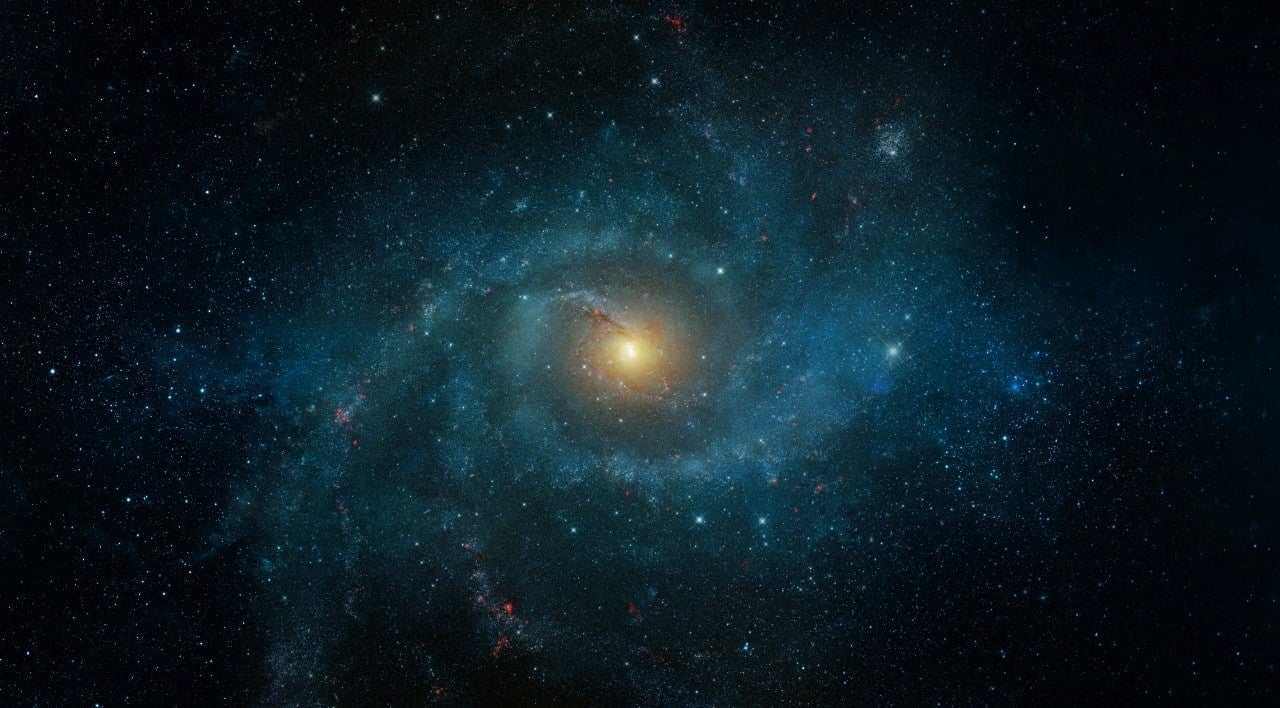
Astronomers used the Atacama Large Millimeter/submillimeter Array (ALMA) to locate the source of a powerful neutrino emission, relying on an unusual cosmic phenomenon that acted like a natural telescope, as reported Thursday, June 19, 2026, by the National Institutes of Natural Sciences. The discovery brought results that exceeded initial expectations.
Scientists initially believed that a supermassive black hole was the driving force behind a distant, exceptionally bright galaxy linked to the neutrino signal. However, analyzes revealed that the galaxy’s energy comes from an extremely intense star formation process. This finding offers crucial clues that could help clarify the origin of many of the mysterious high-energy neutrinos in the universe.
Tracking the trajectory of the most elusive particles in the cosmos
Neutrinos are among the most enigmatic particles known to science, traveling in vast quantities through space and even around Earth with little interaction with matter. Although some neutrino-producing galactic foci have already been identified, these known sources are not sufficient to justify the considerable volume of high-energy neutrinos that have been detected.

To investigate the origin of one of these particles, an international consortium of researchers, which included scientists from MITOS Science Co., LTD., National Central University, Chung Yuan Christian University, Tohoku University, Fukui University of Technology and the National Astronomical Observatory of Japan, carried out additional monitoring using ALMA and other telescopes.
Unraveling the enigma of the “Shadow Blaster” galaxy
Galaxies previously identified as generating neutrinos were generally activated by supermassive black holes. However, when analyzing JCMT0402−0424, researchers found no trace of the energy emissions typical of a black hole of this magnitude.
The galaxy is heavily obscured by a layer of dust, which makes it difficult to see in visible light. On the other hand, it emits an intense glow at submillimeter wavelengths. Due to its hidden nature and extreme brightness at these frequencies, the team named it the “Shadow Blaster.”
How gravitational lensing revealed the interior of the Shadow Blaster
Astronomers were able to peer into the interior of the Shadow Blaster galaxy thanks to a fortuitous alignment with another galaxy located between it and our planet. The gravitational force of the foreground galaxy distorted and amplified the radio waves originating from Shadow Blaster, functioning, in practice, as a natural celestial observatory.
Once again, radio observations did not indicate the presence of a high-power black hole. Instead, the data pointed to a different energy source: The gas and dust spread throughout the galaxy appear to be heated primarily by intensive star formation.
Researchers have also identified a dense “compact core” in the central region of Shadow Blaster, where large volumes of gas and dust are concentrated in an area only about 1,500 light-years across. An environment with such extreme characteristics is fully capable of generating neutrinos.
Redefining understanding of the sources of high-energy neutrinos
The results suggest that galaxies with a high rate of star formation may constitute a significant and previously underestimated source of high-energy neutrinos, changing the landscape of astrophysics.
According to the team, compact, dust-rich galaxies with bursts of star formation have the ability to contribute a substantial part of the high-energy neutrino background. Scientists’ analysis indicates that these galaxies may be responsible for up to 20% of the total high-energy neutrinos observed in the Universe, and confirmation by future studies could drastically redefine scientific understanding of the production of these elusive particles.





