
Observatory reveals ‘Van Gogh’s sky’ with 570 megapixel camera

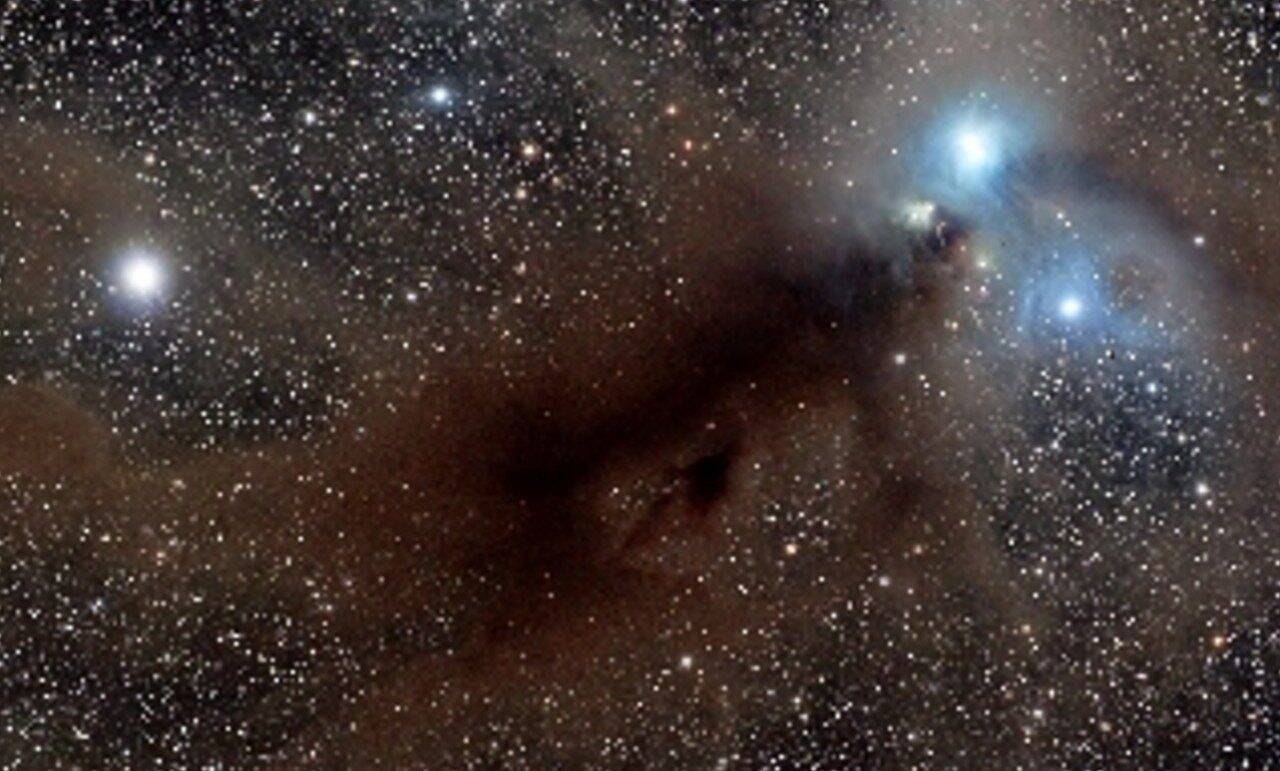
A new and impressive phase in cosmic exploration has begun with the advancement of optical capture technologies in large terrestrial observatories. Scientists have managed to record deep gaseous structures with such surprising clarity that it resembles the most famous works of art in human history. This detailed mapping of the Corona Australis molecular cloud is crucial to deciphering the secrets surrounding the birth of planetary systems, with the official release of the image by the Dark Energy Camera expected in July 2026.
How was the image of the Corona Australis molecular cloud captured?
The spectacular record of this “stellar maternity” is the result of an international initiative focused on mapping dark energies and deep cosmic structures. According to technical information shared by the scientific teams responsible for the NSF NOIRLab, the high-resolution equipment managed to capture unprecedented details of this galactic neighborhood. The study focused on the Corona Australis molecular cloud reveals the complex and intricate distribution of cosmic dust in space.
For capture, ideal atmospheric conditions were required in the Chilean desert, a strategic location where the telescope is installed to avoid light distortions coming from urban areas. This highly sensitive instrument has the ability to filter different wavelengths, managing to separate the light reflected by gases from the vast darkness of deep space. The data currently collected serves as a fundamental basis for astrophysicists investigating the speed of stellar evolution.
- July 2026:Date of official release of the image by Dark Energy Camera, work of an international consortium.
- Short Distance:Mapping of a stellar nursery a mere 430 light years away from the Solar System.
- Sidereal Cluster:Simultaneous detection of the NGC 6723 group, visible in the background of the captured spacescape.
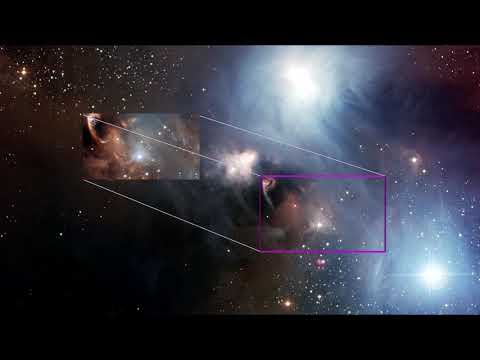
Understand the particularities of the Corona Australis molecular cloud
This specific area of space stands out for being one of the closest star-creating regions to our own Earth’s atmosphere. The high density of the dark filaments prevents visible light from stars behind this gaseous curtain from passing through. Such blocking results in a striking visual contrast, highlighting the delicate bluish textures formed by the reflection of radiation from cosmic dust particles.
The complex is home to dozens of young stars that continue to accumulate mass through continuous physical processes of gravitational accretion. The powerful winds generated by these newborn stars carve cavities in the clouds, creating dynamic shapes that challenge the computational models of modern astrophysics. Tracking this stellar nursery allows scientists to predict how our own Sun behaved billions of years ago in the primordial system.
🚨La Noche Estrellada de Van Gogh es una de las obras de arte más increíbles que existen. Sin embargo, científicos descubrieron que también contiene un principio físico oculto. 👇
— Rodrigo Vázquez (@rodvaN) July 20, 2026
Te explicamos aquí:https://t.co/88DNxsNf7A pic.twitter.com/pQ06SgJD9G
- Relative proximity that facilitates the study of phenomena on shorter wavelength scales.
- Remarkable presence of reflection nebulae that shine in a very peculiar bluish hue.
- Zones of dense dust that act as thermal cocoons, essential for the compression of new gaseous nuclei.
- Complex gravitational interaction with ancient star clusters, located in secondary spatial planes.
The blue textures characterize this gaseous region, which is a cradle for young stars in formation, highlighting their activity.
Details of the 570 megapixel technology in Chile
Capturing an image with this rich detail requires a complex arrangement of semiconductor sensors that operate at temperatures close to absolute zero. The Dark Energy Camera uses dozens of high-sensitivity chips, meticulously arranged in a perfectly aligned focal plane within its optical body. This precision engineering makes it possible to photograph vast areas of the sky without any loss of sharpness at the edges of the studied field of view.
The main mirror of the Víctor M. Blanco Telescope is responsible for capturing the weak light emanating from the Corona Australis molecular cloud and directing it to digital sensors. Subsequent computational processing corrects electronic noise generated by the internal heat of the circuits, producing a map with very high chromatic fidelity. This technological advancement solidifies digital observation tools as essential pillars of the science of mapping the universe.
- Corona Complex:Distance estimated at 430 light years from Earth, crucial for the direct study of the formation of new planets.
- NGC 6723 cluster:Distance estimated at 29 thousand light years, fundamental for the analysis of extremely old stellar populations.
The artistic connection between the cosmos and Van Gogh
The arrangement of the dust filaments and the luminosity gradients in the image create an illusion of fluid movement that is vividly reminiscent of textured impressionist brushstrokes. This particular visual effect occurs because the galaxy’s magnetic forces align grains of matter along invisible magnetic field lines. The light emitted by neighboring stars interacts with these structures, creating a scene that directly resembles the classic painting of Western painting.
Astronomers highlight that this happy convergence between the patterns of cosmic nature and human artistic sensitivity plays a fundamental role in the dissemination of academic discoveries. By associating the beauty of the Corona Australis molecular cloud with cultural icons, science is able to bring the lay public closer to complex discussions about spatial quantum physics. The enthusiasm generated by these artistic images drives the interest of new generations in a scientific career.
What the NGC 6723 cluster reveals in the background of the image
Below the curtain of bluish gas, the image reveals the striking presence of a group densely populated by thousands of ancient stars from our galaxy. The globular cluster NGC 6723 serves as an ideal laboratory for understanding the first steps in the chemical evolution of the deep interstellar medium. The visual proximity perceived in photography is, in fact, just an illusion of perspective, caused by the optical alignment of celestial bodies.
While the nursery of stars is relatively close to us, the globular group is located on the outskirts of the central bulge of the Milky Way. The ability to simultaneously capture two such distinct objects in a single exposure demonstrates the incredible dynamic range of modern optical instruments. Analyzing these different distances helps calibrate the cosmic rulers used to measure the ongoing expansion of our vast universal fabric.





