
Comet C/2026 A1 (MAPS) surprised scientists as it passed close to the Sun


A recently discovered comet has offered a unique opportunity for scientists to track its dangerous trajectory towards the Sun. Identified on January 13, 2026 by French researchers at the AMACS1 observatory, located in San Pedro de Atacama, Chile, C/2026 A1 (MAPS) is a Kreutz-type flyby comet known for passing in extreme proximity to our star. On July 23, 2026, the scientific community continues to analyze the data and impacts of this approach.
Astronomy professor Chris Mihos, from Case Western Reserve University, explained that C/2026 A1 (MAPS) had a close approach of just 160,000 kilometers to the solar surface. This distance is considered extremely short and poses a high risk that the comet will completely disintegrate during its passage in April this year.
However, there was also the possibility that C/2026 A1 (MAPS) could survive the passage and instead intensify its brightness. A notable historical example is the Great Comet of 1882. It followed a similar orbit and was so bright that it could be seen in broad daylight, offering a rare spectacle for amateur and professional astronomers.
The dangerous journey of comet C/2026 A1 (MAPS) close to the Sun
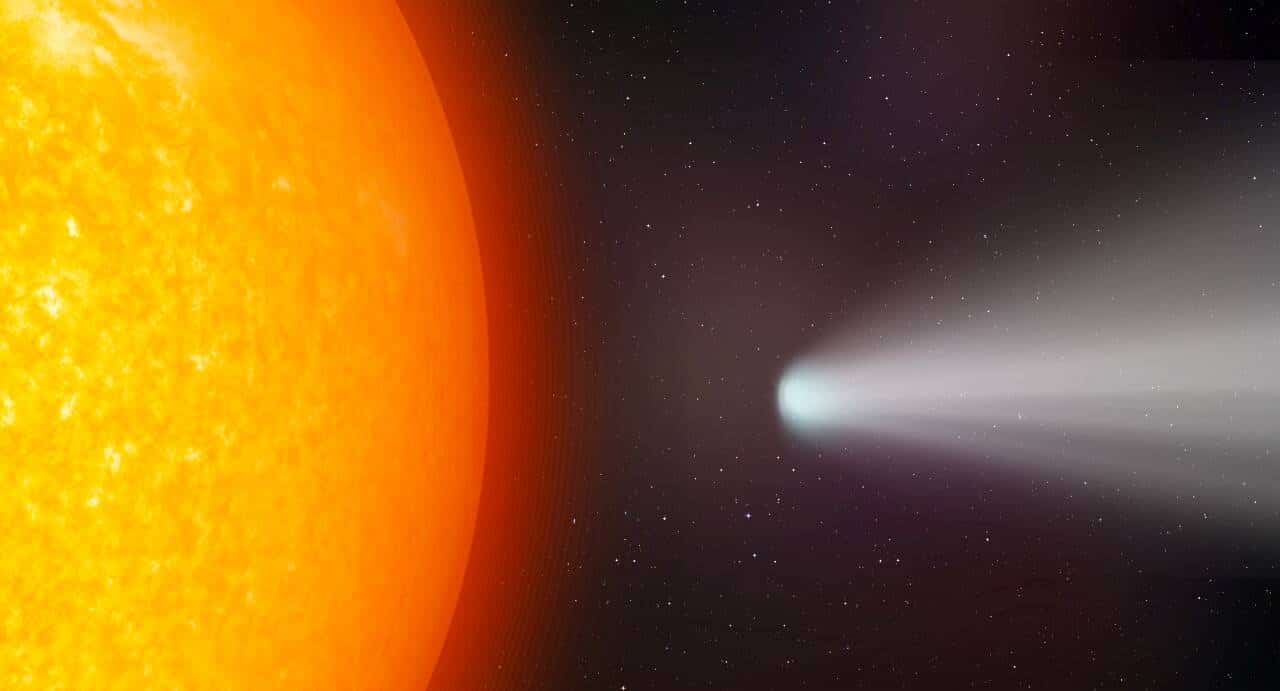
Comets are celestial bodies formed by ice and dust that orbit the Sun in different trajectories. According to Professor Chris Mihos, when these objects enter the inner solar system, the heating caused by the Sun causes them to begin to vaporize. This process is responsible for the formation of the comet’s characteristic tail, the result of the transformation of ice into gas and dust.
Kreutz’s flyby comets represent a specific and particularly dramatic class of celestial bodies. They are believed to have originated from the fragmentation of a larger comet many centuries ago. The main characteristic of these comets is their extremely elongated orbits.
Although they spend most of their time far from the Sun, they eventually pass through the solar corona, our star’s outer atmosphere. In this region, temperatures can reach millions of degrees Fahrenheit. Such conditions are capable of rapidly pulverizing any object primarily composed of ice, making the survival of these comets a challenge.
/ Shutterstock.com
The complexity in anticipating comet behavior
The unstable nature of comets is an intrinsic characteristic, directly linked to their less cohesive composition. As they approach the Sun and begin the vaporization process, the internal structure of these objects undergoes significant transformations. This affects not only their rotation, but also how they release material and move through space.
This ongoing dynamic makes the behavior of comets quite difficult to anticipate accurately. Small changes can have big impacts on its trajectory and structural integrity. For this reason, each observation of a grazing comet becomes a valuable source of data for understanding these cosmic phenomena.
Scientific Opportunity for Early Discovery of C/2026 A1 (MAPS)
Comet C/2026 A1 (MAPS) stood out on the astronomical scene for a particular reason. Among all the Kreutz-class comets ever identified, it was discovered at the greatest distance from the Sun, as pointed out by Professor Chris Mihos. This peculiarity allowed for longer observation of its approach and behavior as it moved towards our star.
The extended observation period leading up to the comet’s passage offered astronomers a valuable chance. They were able to monitor the structural evolution of a grazing comet in real time. By tracking C/2026 A1 (MAPS)’s response to intense solar heating, scientists have been able to deepen their understanding of the formation and resilience of these fragile celestial bodies.
Mihos explained that detailed observation of the comet’s behavior provided important data about its internal cohesion. These include how its orbit changed, whether it survived its close pass to the Sun, and how its tail formed and evolved. This information is essential for unraveling basic aspects of the cometary structure.
What was the search for viewing the comet in April 2026 like?
Even after the passage, exact confirmation of the survival of comet C/2026 A1 (MAPS) remains a point of analysis for scientists. If the comet remained intact, there was a brief opportunity to observe it without the need for specialized equipment. Professor Chris Mihos had informed, before the passage, that “if we managed to see anything of it, it would only be after its passage through the Sun on April 4th”.
He had added that in the week following the solar flyby, the comet and its tail, had they survived, could be seen low in the western sky just after sunset. This observation window was crucial to confirming the integrity of the object after the extreme encounter with the star.
Whether comet C/2026 A1 (MAPS) shone brightly on the horizon or disintegrated as it approached the Sun, its journey offered a glimpse into the fragility of objects forming at the edges of the solar system. It also demonstrated what happens when they venture into extreme proximity to the star that holds them together. Mihos concluded, at the time, that “we never know for sure what is going to happen, so it is interesting to observe and see”, a premise that remains true in astronomy.





