
Euclid Telescope identifies 13.1 billion-year-old supermassive black hole

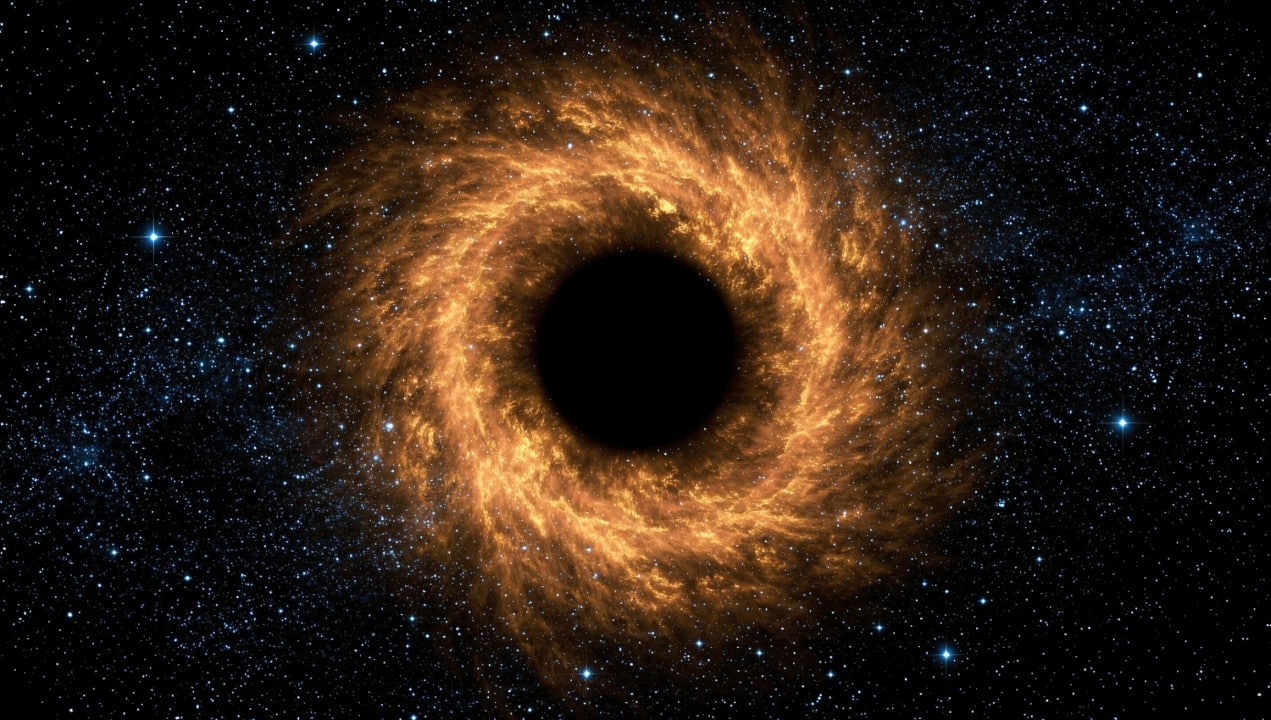
Scientists from an international team announced the discovery of a supermassive black hole that existed about 13.1 billion years ago. The observation was carried out with the help of the European Space Agency’s (ESA) Euclid space telescope and sets a new record in the search for more distant quasars. The discovery offers crucial clues to understanding the formation of these structures in the early universe.
The importance of quasars as lighthouses in the ancient universe
Quasars are celestial objects known for their extreme luminosity, generated when matter is attracted to a supermassive black hole located at the center of a galaxy. This process causes intense heating, emitting powerful light that can be detected billions of light years away. They are considered fundamental elements for studying the universe in its early phases, as they serve as markers of distant galactic activity.
The researchers, based at Leiden University in the Netherlands, focused their search on identifying these quasars. Finding them is a challenge that increases with distance, but current technological capabilities have allowed significant advances in this area.
The role of the Euclid Space Telescope in cosmic research
Launched in 2023, the Euclid Space Telescope began large-scale observations in the year 2024. Its main advantage lies in its ability to capture a wide field of view using long-wavelength infrared light, essential for observing extremely distant objects, whose light has been stretched to longer wavelengths due to the expansion of the universe.
The research team, made up of scientists from Japan, the United States, Europe and other countries, combined the data obtained by Euclid with information collected by the Subaru Telescope, located on Hawaii Island. Subaru, in turn, observes a vast field of view in short-wavelength visible light, and bringing this data together was fundamental to identifying the new quasars.
New perspectives on the formation of black holes
Among the 31 quasars discovered in this phase of the project, 12 were dated as existing more than 13 billion years ago. Two of them stand out for having existed approximately 670 million years after the birth of the universe, which places them in an extremely young universe, around 13.1 billion years ago. This discovery sets a new record for the oldest and most distant quasars ever found.
Associate Professor Masafusa Onoue of Waseda University and a member of the team expressed surprise at the finding. He stated that it is “surprising that supermassive black holes should already exist in such a young universe”, underlining the mystery surrounding the rapid formation and growth of these structures at such an early period in cosmic history. The existence of such massive objects in such a remote era challenges current theories about the evolution of the universe and galaxies.
The future of observations with the Euclid Space Telescope
The main goal of the Euclid Space Telescope is to create a comprehensive three-dimensional map of the universe by observing billions of galaxies to uncover the large-scale structure of the cosmos. The project has a planned duration of six years, and to date, data from a period of one and a half years has been analyzed for this discovery.
Professor Onoue projects that, throughout the entire project, “between 200 and 300 quasars will be found, and the record for the most distant quasars will be broken.” The expectation is that the in-depth study of these quasars in the young and distant universe will provide more robust knowledge about the origins and development of supermassive black holes and their relationship with the evolution of galaxies.
Main points of the discovery
- Record age:Supermassive black hole existing 13.1 billion years ago identified.
- Observation Tool:ESA’s Euclid Space Telescope was crucial to the detection.
- Quasars:They are intensely luminous celestial objects, driven by black holes in distant galaxies.
- Implications:The discovery deepens the mystery of how such massive black holes could form in such a young universe.
- Next steps:The Euclid project will continue to map the universe, hoping to find hundreds of more quasars and break new records.





