
Mysterious creature in Australia: video reveals moth larva camouflaged as a leaf


Planet Earth constantly surprises with the vast range of living beings, and even today, new and rare species continue to be revealed.
The occurrence took place on March 1, 2026, when a peculiar creature was spotted in Mareeba, Queensland, Australia.
Initially mistaken for moss or a fern leaf, the species turned out to be, in fact, a living organism, generating curiosity about its true nature.
Uncovering the strange creature seen in a palm tree
The mysterious entity was found on a private property, camouflaged in a peacock palm, also known as a fishtail palm.
Its physical configuration resembles a fern leaf, with lateral extensions that look like wings departing from its central body.
The body is covered by a green, furry layer, similar to moss, and its way of moving prompts the question: what species would this be?
At certain moments, the organism exhibits a peculiar behavior, as if it is trying to rise.
Its movements are unpredictable and unique, combining an unusual appearance with even more eccentric locomotion.
Given these characteristics, many wonder which living being it belongs to.
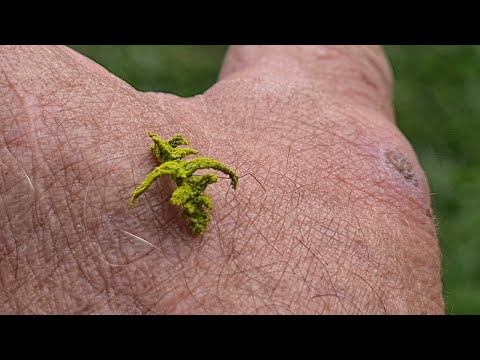
What is the true identity of the curious Eucyclodes larva?
To the surprise of many, the enigma surrounding the creature has already been solved.
In reality, the creature is a larva of the moth known as Eucyclodes, whose shape differs drastically from what is usually imagined for butterfly or moth caterpillars, maintaining the surprise factor even after the revelation.
Larvae with similar characteristics have already been documented in Australia. Entomologist and nature photographer Matthew Connors suggests that the peculiar appearance of these larvae is due to their camouflage strategy, which makes them look like other natural elements to avoid detection by predators. This mimicry ability is a notable example of evolutionary adaptation in biodiversity-rich ecosystems, such as Australia, where selective pressure for survival is intense.
This behavior explains the unique appearance, which allows the larva to be easily confused with plant leaves or pieces of moss.
Observing such unusual species leads us to reflect on the vast number of intriguing living beings that can go unnoticed in our daily lives, encouraging greater attention to nature.





