
Discover the capacity of players in Big Walk, the new House House title

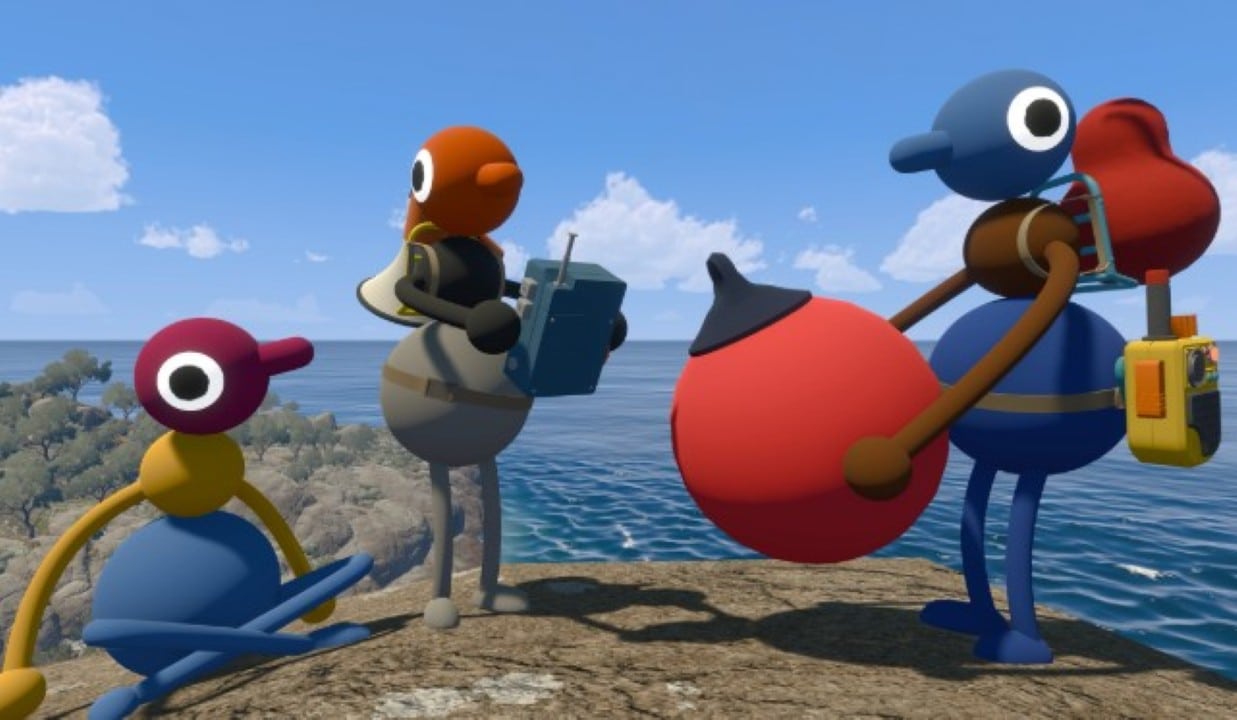
The Big Walk game, developed by House House, the same studio behind the hit Untitled Goose Game, was created with the premise that human interaction is essential. Puzzles are intentionally designed for groups, communication is an integral part of the challenges, and the experience scales directly to the number of participants. Before starting your sessions, it’s important to understand the details about solo mode, the ideal number of players and how to optimize each match.
Uncovering solo mode in Big Walk: is it possible to play alone?
Although it is technically possible to start a Big Walk session without the presence of other players, exploring the scenario alone, progress will be quite limited. The game’s core design prevents a single participant from advancing significantly.
Most of the challenges in Big Walk are explicitly designed to require collaboration from multiple players. This is not a suggestion, but a fundamental design condition. Many puzzles rely on coordination between team members, and voice communication is crucial to solving. Lone players will quickly face obstacles and the game offers no alternatives to overcome them.
It is essential that players do not expect to complete Big Walk’s puzzles individually. The experience is predominantly cooperative, and attempts to play alone will quickly become ineffective, compromising the fun.
An interesting feature is that online multiplayer generally offers a superior experience compared to local sessions in the same room. This is because some puzzles place intentional restrictions on voice communication as part of the challenge. These limitations work best when players are in separate locations, relying on the game’s own audio cues, rather than conversing directly in the same room.
Understanding the player limit in Big Walk sessions
Big Walk allows for participation from 2 to 12 players per session, a wide range that significantly impacts gameplay dynamics. The gaming experience changes considerably depending on the number of people in the group.
Smaller groups of 2 to 4 participants often result in more cohesive and focused cooperative sessions. On the other hand, larger groups tend to generate more chaotic and frenetic matches, where coordination becomes a greater challenge, but energy and unpredictability increase. Neither approach is inherently superior, but each offers a distinct gameplay feel.
For those playing with strangers or with a group of varying abilities, it is advisable to start with a smaller session. This makes it easier to communicate and solve initial puzzles before considering increasing the number of participants.
Variations in Big Walk gameplay depending on the number of participants
In Big Walk, resources and item storage space are limited for the group. With more players, there are more “hands” available for tasks, but items do not multiply indefinitely, requiring larger groups to think carefully about distribution. With fewer players, each person has more resources at their disposal, but the raw ability to solve complex puzzles simultaneously is smaller.
The puzzles themselves do not change between games; the map and structure of challenges remain constant. What changes is the team’s strategy and the way responsibilities are divided, all determined by the size of the group. A match with 12 players, facing the same set of puzzles, will be a completely different experience than a match with just 3 participants.
The following table details how group size influences the Big Walk experience:

| Group size | Playing style | Pressure on resources | Communication demand |
| :————– | :—————— | :———————— | :————————————– |
| 2 to 4 players | Focused cooperative | Low per player | High coordination |
| 5-8 players | Balanced Chaos | Moderate | Organized functions help |
| 9-12 players | Large-scale chaos | Loud, items scattered | Difficult without structure |
Big Walk’s compatibility with different platforms and crossplay
Yes, the crossplay feature is fully supported on Big Walk. This means you can fill a session with PS5, PC, Mac and Switch 2 players without any problems. This feature makes it much easier to reach the 12-player limit, especially if your circle of friends uses different platforms to play.
An important note: Voice communication on Nintendo Switch 2 may require additional accessories depending on the player’s configuration. If you are organizing a large group with participants using the Switch 2, it is recommended that you plan this issue in advance.
Strategies for maximizing the multiplayer experience in Big Walk
After an in-depth analysis of the game’s design, some patterns stand out for players looking to start their first sessions in Big Walk, ensuring a more fluid and fun experience.
- Assign roles in advance:With limited space to carry shared items and resources, assigning someone to manage inventories in larger groups avoids the clutter that can disrupt pacing in the middle of a puzzle.
- Prefer to play online, not locally:Voice chat restrictions in certain challenges are intentional. Playing in different locations allows these restrictions to work as intended, rather than being bypassed by players in the same room.
- Vary the group size:Since the puzzles remain the same but the strategy for solving them changes, playing again with a different number of players really changes the approach to each challenge. A riddle that a group of 8 people solved through trial and error may require detailed planning with just 3.
- Enjoy crossplay:Crossplay ensures you’ll never run out of options to complete a session. Use it to get closer to the 12-player limit on your first playthrough, then try smaller groups once you’re familiar with the layout of the puzzles.
Big Walk aligns with a strong tradition of adventure games that prioritize creative cooperative design over combat. It promises to be one of the most exciting multiplayer releases of the year for fans of collaborative experiences.




