
Euclid Telescope identifies older quasars and advances study of early universe


The Euclid Space Telescope made a significant discovery by identifying 31 new quasars, including the most distant one ever observed. This revelation, aided by the use of machine learning, marks a new chapter in the investigation of these celestial objects, essential to understanding the universe in its earliest moments.
Quasars are extremely bright sources of light in the cosmos, formed when gas and dust are attracted to a supermassive black hole at the center of a galaxy. Due to their intense luminosity, they function as landmarks, allowing scientists to observe the primordial universe, billions of years in the past.
The redshift measurement indicates how much the light from an object has stretched due to the expansion of the universe, revealing its distance and, consequently, the antiquity of the cosmic period being observed. Since 2011, when the first quasar with a redshift above 7 was found, only nine such objects had been identified in 15 years.
With this new achievement, the European Space Agency’s (ESA) Euclid space telescope has doubled the number of known quasars with a redshift of 7 or greater. This milestone was reached in just a year and a half of operation of the Euclid wide-area survey, demonstrating the effectiveness of the new approach.
“These celestial bodies may offer crucial clues to understanding the formation of supermassive black holes,” said Joseph Henawi, professor at the universities of California, Santa Barbara, and Leiden. “These giants, with masses billions of times greater than that of the Sun, already existed in some form when the universe was still very young.”
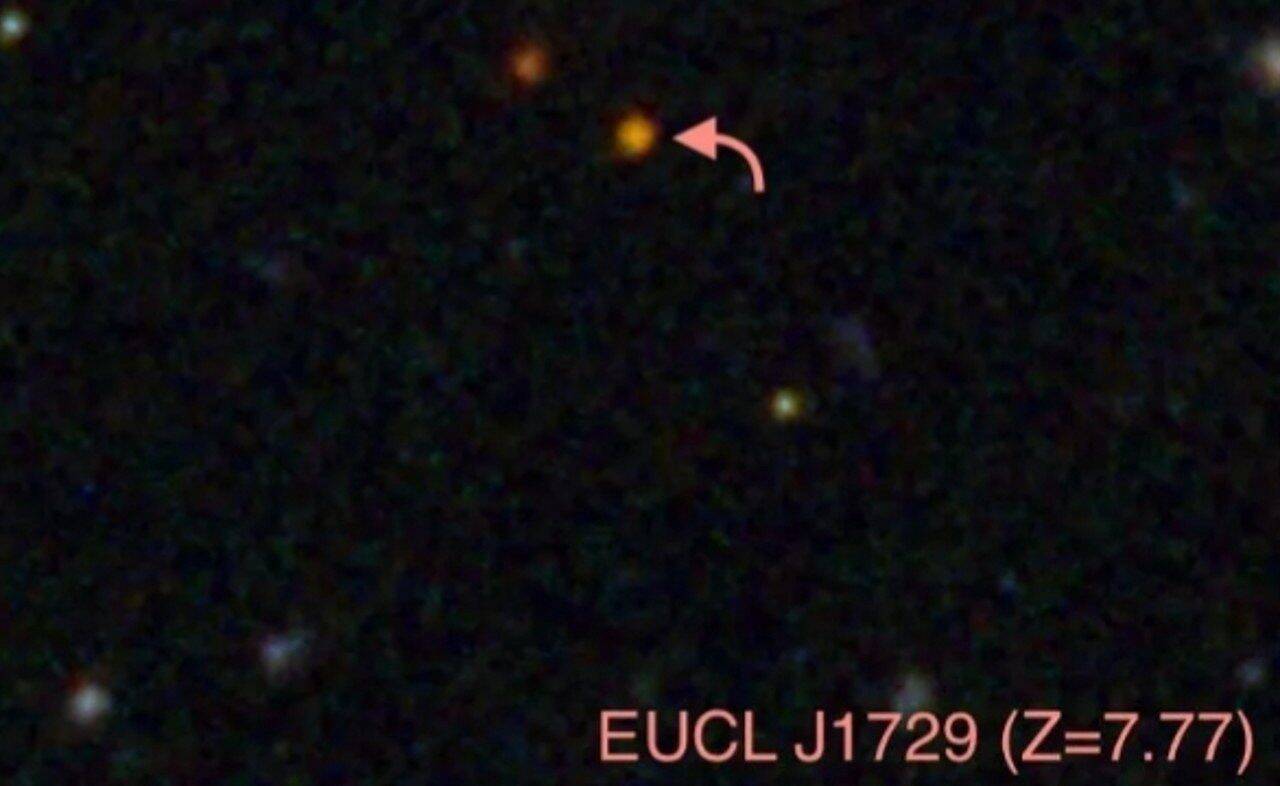
New Brand of Ancient Quasars Established with Advanced Technology
Among the newly discovered quasars, two stand out for having redshifts of 7.69 and 7.77, surpassing the previous record of 7.64, recorded in 2021. These new record holders, considered the “oldest”, are more than 13 billion light-years from Earth, reflecting the state of the universe just 670 million years after the Big Bang. The object EUCL J1729 is an example of these primordial quasars, located in deep regions of space.
Identifying these remote quasars presents complex challenges. They are extremely rare and emerged at a time when few galaxies were large enough to house them. Furthermore, the faint light emitted by them can easily be confused with that of stars within the Milky Way.
Detecting distant quasars is also hampered by the changing wavelength of their light, which moves from ultraviolet to near-infrared due to the expansion of the universe. The Earth’s atmosphere emits light in this same range, making observations with ground-based telescopes even more complex.
To overcome these barriers, the Euclid telescope employed an innovative observing strategy. Operating outside Earth’s atmosphere, it combines wide-area surveys in visible and near-infrared light with the power of machine learning.
Euclid’s ability to observe vast portions of the sky with high precision, without the interference of atmospheric light, was fundamental. Furthermore, the application of statistical methods and multiple algorithms made it possible to filter tens of millions of celestial objects, efficiently distinguishing quasars from similar stars and galaxies.
Subsequently, the researchers carried out spectroscopic observations — which separate light into its different wavelengths — on 123 pre-selected candidates. Using the Keck telescopes in Hawaii, the Magellan telescope in Chile, and the Large Binocular Telescope (LBT) in Arizona, 31 of these objects were confirmed to be authentic quasars.
The traditional approach to quasar research used to be a process of individual discovery and spectroscopic confirmation. With a statistically robust sample of 31 objects, science can now investigate the properties of early quasars more systematically, as a group.
Details about how the Euclid Space Telescope works
The Euclid Space Telescope, managed by the European Space Agency (ESA), operates in orbit outside the Earth’s atmosphere. Its privileged position allows observations to be made without the distortions caused by the atmosphere, crucial for capturing the faint and distorted light of very distant celestial objects.
Unlock the secrets of primordial supermassive black holes
Further research was conducted on the second oldest quasar discovered. The findings indicate that this object is rich in dust and gas, existing within a galaxy that is undergoing intense star formation. These features could offer valuable insights into the environment in which the first supermassive black holes developed.
The origin of these quasars dates back to the period of cosmic reionization. At this stage, the first stars and galaxies are believed to have emerged, ionizing the neutral hydrogen gas that filled space and thus shaping the subsequent evolution of the universe.
The team of researchers plans to use the James Webb Space Telescope to further study the properties of quasars. The work includes measuring the mass of each black hole, analyzing the chemical composition of the surrounding gas and monitoring the progression of cosmic reionization using light.
In parallel, the ALMA telescope (Atacama Large Millimeter/submillimeter Array), operated in collaboration by the National Astronomical Observatory of Japan, the United States and Europe, in northern Chile, will be used to investigate dust, gas and star formation in the galaxies that host these quasars. These observations are expected to provide a clearer understanding of how the first giant galaxies evolved.
“My ultimate goal is to link all these results into a single timeline and complete a ‘quasar chronicle’ of the first billion years of the universe”, revealed Henawi, showing great expectations. The discovery of a quasar with a redshift greater than 8 in the future could unravel what celestial bodies were like in the first 630 million years of the universe.





