
Giant prehistoric amphibian skeleton is restored by volunteers

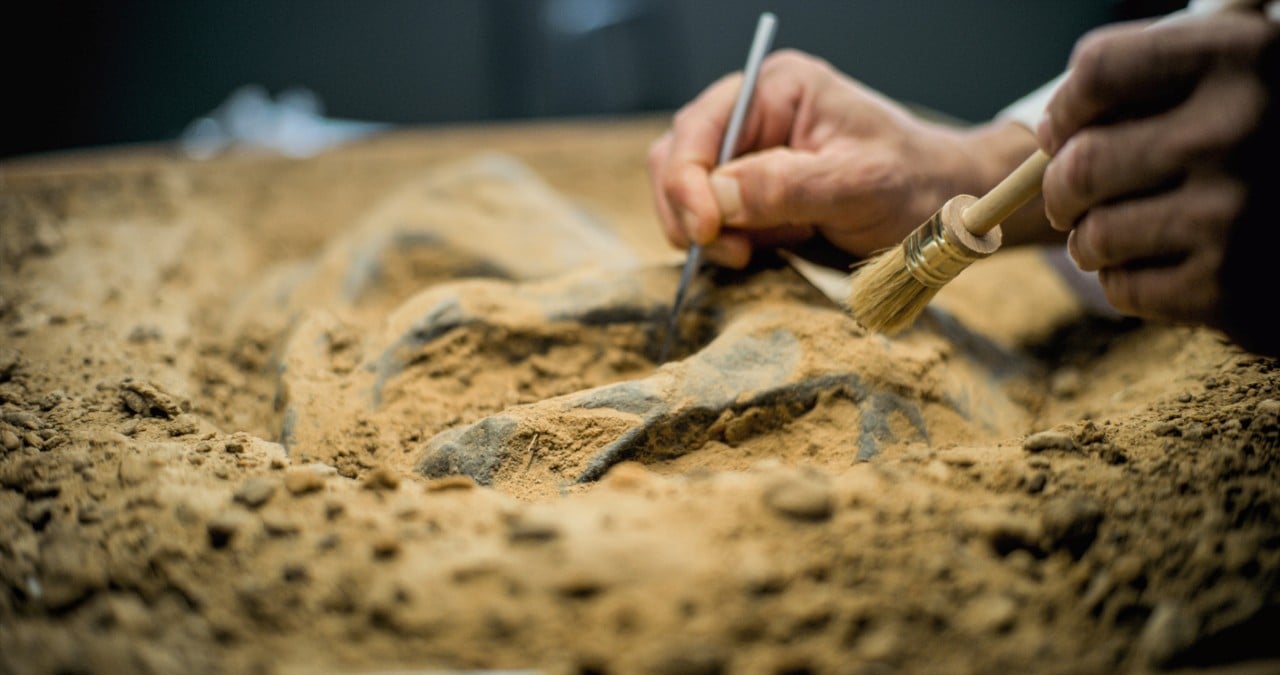
A glass-walled laboratory on the ground floor of the Copernicus Science Center in Warsaw, Poland, has been transformed into a worksite where volunteers, armed with chisels, brushes and protective glasses, remove rock from the bones of a colossal prehistoric amphibian.
On the other side of the transparent panel, visitors watch the laborious task of cleaning the almost six meter long bone. Children point enthusiastically, while adults reflect on the imposing creature these bones once represented.
This detailed restoration is part of an unusual public science project, which mobilized more than 2,000 volunteers to assist Polish scientists. The objective is to restore the skeleton of a Mastodonsaurus, a fearsome aquatic predator that lived at the dawn of the dinosaur era.
The work requires extreme precision. Every millimeter of bone is carefully separated from the surrounding rock with a pneumatic chisel, the fine tip of which loosens the rock material. Ultraviolet light is used to differentiate the bone from the adjacent rock.
Volunteers have diverse backgrounds, including managers, cleaning professionals and tattoo artists, without being geologists or paleontologists. They receive special training and protective equipment before beginning their two-hour chiseling sessions, always under supervision.
“I imagine that these bones have been under the earth for 240 million years and I am the first human being to touch them,” said Tatyana Kozyk, the coordinator of the volunteer teams, expressing how impressive the experience is. “I’m still trying to process this experience.”
The anatomy and period of Mastodonsaurus, an ancient aquatic predator
Considered one of the largest amphibians ever to exist, Mastodonsaurus lived approximately 240 million years ago, during the Middle Triassic. This species inhabited aquatic environments before dinosaurs dominated the planet, being an ambush hunter that fed mainly on fish and smaller amphibians.
Researchers estimate that the animal could reach almost six meters in length. It had a broad, flat head, long jaws and sharp conical teeth, with an appearance reminiscent of a crocodile, although it belonged to a distinct branch of the vertebrate family tree.
When the restoration is completed, the Mastodonsaurus skeleton will be the largest ever displayed in a museum in the world. The bone weighs 1,300 kilos, according to Tomasz Sulej, paleontologist and professor at the Institute of Paleobiology of the Polish Academy of Sciences.
Tomasz Sulej and his colleague Wojciech Pawlak, from the Faculty of Geology at the University of Warsaw, are responsible for the discovery of the skeleton, found in 2023, in southern Poland. The idea of inviting volunteers for the restoration also came from the duo.
Sulej states that there are no other Mastodonsaurus skeletons of this size known anywhere in the world, and the discovery promises to expand scientific knowledge about the species.
“The structure of the body is different from what we knew until now,” said the researcher. “This is completely new information for the scientific world.”
Other Mastodonsaurus skeletons have been found in places such as Germany and Russia, Sulej said, but they generally measure between two and three meters in length.

Reflections on the deep past and future of the planet based on the project
Dorota Serafin, a 51-year-old manager from Warsaw who volunteers on the project, described the experience of working with the remains of an ancient animal as “relaxing and philosophical, even mystical.”
Serafin plans to attend other sessions and later take his family to the Copernicus Science Center when the restored skeleton is displayed. The expectation is that the exhibition will take place in October or November.
In addition to the surprising experience of touching the remains of an animal that lived hundreds of millions of years ago, contact with Mastodonsaurus offers an opportunity to reflect on the future, according to those involved in the project.
The amphibian inhabited Earth’s waters after the largest known mass extinction and shortly before the emergence of dinosaurs. As humanity ponders the potentially catastrophic effects of climate change, Sulej says the story of Mastodonsaurus offers hope.
“Mastodonsaurus lived after the great extinction, which shows one thing: that nature always rebuilds itself,” said Sulej. “It is not true that humans can destroy life on this planet. Nature and life always find ways to survive.”





