
James Webb Telescope reveals hidden giant planet in Beta Pictoris system

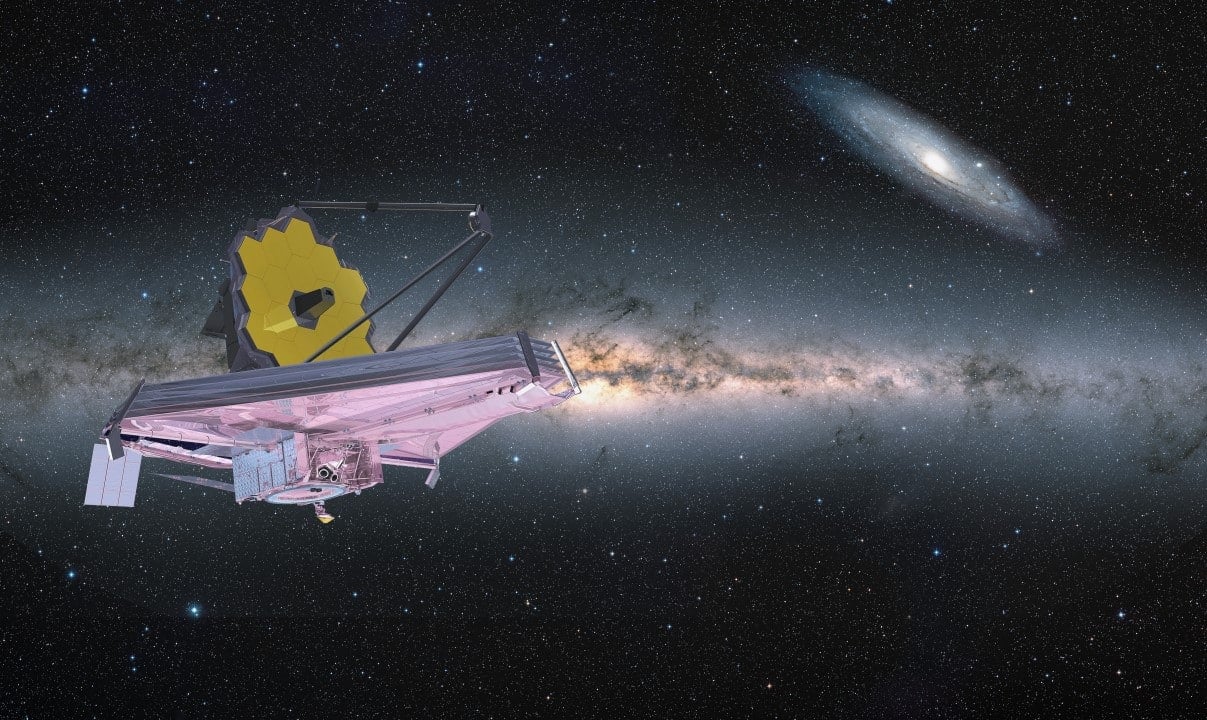
NASA’s James Webb Space Telescope (JWST) has made a remarkable discovery by identifying a giant planet, named Beta Pictoris d, that was previously hidden within a bright debris disk in one of the most closely observed star systems in the Milky Way. The detection, announced in a new scientific study published on July 15, 2026, was made possible by analyzing the exoplanet’s atmospheric chemistry, an innovative approach that overcomes the challenges of direct imaging in complex environments.
The revelation of Beta Pictoris d makes this the second known system to host at least three direct-imaging giant planets. Unlike its neighbors, Beta Pictoris b and Beta Pictoris c, the new planet’s presence was initially confirmed by its chemical signature in the atmosphere rather than as a distinct point of light, opening a promising path to finding other hard-to-see worlds.
A new strategy for finding exoplanets
Astronomers were not primarily aiming to find a new celestial body when the discovery occurred. The team was using Webb’s Near Infrared Spectrograph (NIRSpec) with its Integral Field Unit to investigate the atmosphere of Beta Pictoris b when unexpected signals from Beta Pictoris d appeared in the data. Instead of a smooth spectrum, which would be expected from light reflected from dust, the researchers observed repeated peaks and troughs, a pattern that corresponds to the carbon monoxide absorption lines characteristic of the atmospheres of giant planets.
This spectroscopic approach demonstrated its ability to see through dense dust clouds that would obscure detections by conventional methods. By isolating the narrow molecular signals produced by a planetary atmosphere, Webb was able to bypass the visual clutter caused by the bright debris disk, which scatters the star’s light like haze.
The characteristics of the newly discovered Beta Pictoris d
Beta Pictoris d is a giant planet that defies expectations by hiding in such a visible environment. Current estimates indicate that it has at least twice the mass of Jupiter, making it the least massive among the three known giant planets in the system.
- Mass:At least twice the mass of Jupiter.
- Orbit:Positioned about 30 astronomical units (AU) from the star, a distance comparable to that of Neptune in our solar system.
- Position in the system:It holds the widest orbit among the three discovered planets, but still remains within the inner boundary of the system’s debris disk.
This intriguing configuration may even help explain some of the unusual features of the debris disk, such as its well-defined inner boundary, which astronomers had previously theorized was shaped by an invisible planet, similar to Beta Pictoris d.
The Beta Pictoris system: a laboratory for planetary formation
Located 63 light-years from Earth and estimated to be 23 million years old, the Beta Pictoris system has been a crucial point of interest for astronomers. Their relative youth and proximity allow for in-depth study of how newly formed planets interact with the remaining disk of dust and debris from the formation of the star system.
Aidan Gibbs, lead author of the new study and postdoctoral researcher at the University of California, San Diego, highlights that the discovery of Beta Pictoris d adds a new piece to an already fascinating planetary system. The system has long served as a natural laboratory for understanding the formation and evolution of planetary systems, and the new planet contributes significantly to that narrative.
Confirmation and next research steps
After the initial detection, Jean-Baptiste Ruffio, a research scientist at the University of California, San Diego, and principal investigator for the first Webb observations, performed follow-up observations. These analyzes utilized Webb’s Mid-Infrared Instrument (MIRI) and detected methane and water vapor in the planet’s atmosphere, providing further confirmation of its planetary nature and revealing more about its atmospheric composition.
Ben Sutlieff of the University of Edinburgh and Markus Bonse of the European Southern Observatory conducted independent image analysis that supported the discovery. They used observations from the European Southern Observatory’s Very Large Telescope and Webb’s Near Infrared Camera (NIRCam) to confirm Beta Pictoris d separately. The ability to investigate the planet’s atmospheric properties soon after its discovery is a significant advance, since a spectrum contains an incredible amount of information about the object’s temperature, chemistry and motion. Researchers plan to continue examining Webb data to refine estimates of the planet’s orbit, temperature and atmospheric composition, seeking a more complete picture of this important planetary system.





