Although finds of bones and teeth from prehistoric animals tend to spark greater interest among researchers, a recent publication highlights the crucial importance of fossilized wood in understanding millions of years of Earth’s geological history. Plant remains are fundamental to unraveling the evolution of our planet.
Research focusing on fossilized wood found in the Kyffhäuser Mountains, located in the Saale River basin, in northern Germany, indicates that wood has the highest chemical affinity for mineralization among resistant organic tissues.
This specific example of wood comes from large trees from a forest that thrived in the Carboniferous period, long before the age of the dinosaurs. The trees were buried in riverbeds in a tropical area of the supercontinent Pangea, a place that experienced cycles of dry and flood seasons.
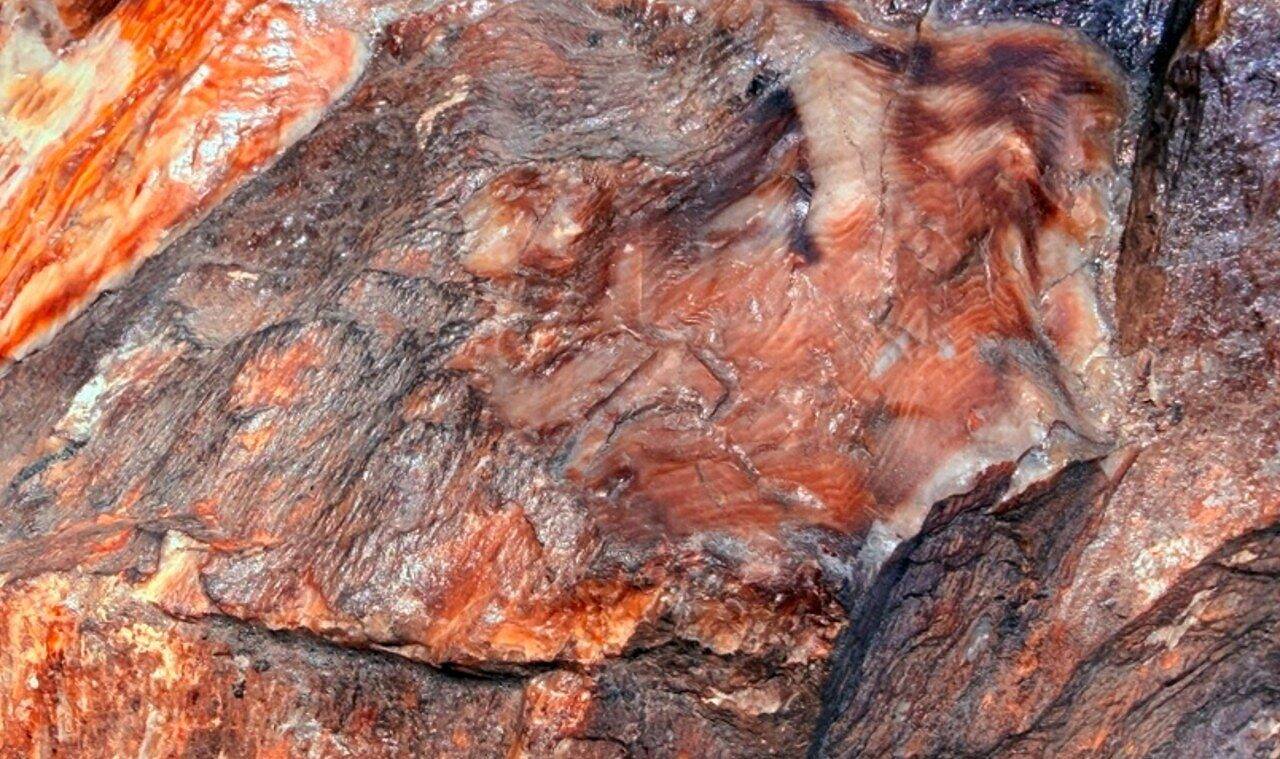
According to the study, after burial, the wood underwent four stages of mineralization over millions of years. Each cycle generated a distinct type of quartz, providing crucial data about the basin where the vegetation developed.
Dr. Steffen Trümper of the University of Münster in Germany commented in a statement that it is “astonishing that a fossil, often the size of a palm, can record the geological history of an entire region for hundreds of millions of years.”
Fossilization processes that reveal Earth’s past
The research details that, between 304 million and 299 million years ago, specific conditions allowed silicic acids to enter buried wood. This resulted in the formation of opal, which managed to preserve the structure of the plant material’s cell walls.
Later, in the period between 299 and 290 million years ago, the fossils were covered by sediment and exposed to temperatures between 50°C and 70°C. This heating converted the opalized wood into delicate quartz crystals. These events were crucial to the preservation of evolutionary lineages that no longer exist today, with conifers being their closest living relatives, as reported by Trümper and his team, although other changes in the fossils have been less observed.
The team of scientists found that, as enough layers of strata accumulated over the already mineralized wood, the combination of heat, pressure and salinity caused most of the fine-crystal quartz to be replaced by thicker quartz-hematite crystals. This process, however, resulted in the loss of preservation of anatomical structures in the affected areas.
The researchers describe a subsequent and prolonged period of inactivity, preceding exposure to high temperatures, ranging between 170°C and 290°C. This condition gave rise to another type of quartz, euhedral crystals, which are block-shaped.
The last phase of transformation included the formation of barium quartz, identified by the emission of blue light when bombarded by electrons, a phenomenon known as cathodoluminescence.
The most relevant aspect of these four quartz transformations is that each of them required specific temperature and pressure conditions. More importantly, fossilized wood was able to retain precise evidence of when each of these geological stages occurred, becoming a true record of time.
How uranium-lead dating reveals geological epochs
Quartz crystals absorb uranium from the environment during their formation, but not lead. Over time, uranium slowly disintegrates into lead, and the ratio of these elements allows geologists to determine the period since the crystals were created. Although lead can be incorporated into or removed from crystals through other routes, requiring caution, Trümper said his team considered these factors. The researcher further stated: “In fact, we were quite surprised that the clock that started with the initial mineralization at the end of the Carboniferous was not completely turned back during the later processes.”
This methodology offers science a new and powerful tool for tracking the evolution and displacement of continents over eons.
By analyzing the age of the remaining crystals from each formation phase, Trümper and his team created a chronology of the transformations. They identified the formation of hematite-quartz between 257 million and 260 million years ago, euhedral quartz from 180 million to 150 million years ago, and barite-quartz about 100 million years ago.
Geological changes demand exact temperature and pressure conditions, directly linked to the depth at which the wood was located in each period. Thus, the team was able to reconstruct a history of the amount of material that covered the ancient wood at different times. The final conversion, for example, required depths between 3 and 5.5 kilometers.
Currently, the fossilized wood is found on the surface, in a curious location, in front of the Kyffhäuser Monument, which is one of the tallest statues in Germany. This superficial position suggests to geologists the occurrence of a significant uplift of the land in the recent geological past. All these events together reveal the geological history of the region over 300 million years.
Trümper explained in a note that “the tiny fluid inclusions in the quartz were particularly revealing, as they preserve information about the exact conditions during the crystal’s growth.” He added that “because fossilized wood occurs in many rock formations around the world, this opens up a valuable source of information. It provides science with a new tool for tracking the evolution of continents.”
However, just as not all forests turn into fossilized wood, most fossilization processes do not complete all the steps observed at Kyffhäuser. 80 kilometers to the south, in Manebach, conifer trunks have also undergone mineralization.
The study authors note that in Manebach, “the delicate preservation of cellular structures is much better than in Kyffhäuser, and even intracellular fungi can be found.” Despite this, attempts to analyze the fluid inclusions and date the Manebach fossils using the uranium-lead isotope system did not produce effective results.
Trümper explained that by applying lasers to Manebach’s samples, “larger pieces broke off of the sample instead of the small pieces needed to analyze the isotopic composition.” The team is not yet sure how common this problem is in other analyzes of fossilized wood.
However, Trümper mentioned that a recent study of fossilized wood in China describes a site that “looks promising” for documenting a sequence of transformations similar to that seen at Kyffhäuser.