
Space agency advances with laser drone project to map caves on the Moon

The development of an unmanned aerial vehicle powered by light beam technology received financial and strategic approval from NASA. Announced on August 4, 2026, the initiative aims to penetrate the dark depths of the geological formations of our natural satellite. This bold step promises to usher in an unprecedented era of scientific discovery, allowing humanity to access underground galleries that have never been touched by terrestrial equipment.
How new autonomous equipment will overcome the limitations of traditional rovers
Created by scientist Elor, the project’s central pillar is the ability to navigate completely independently. The flying equipment was designed to enter lunar cavities immersed in absolute darkness, areas where traditional wheeled vehicles completely lose their usefulness. This approach breaks with current aerospace engineering paradigms, focusing on regions that until then were considered impossible to study closely.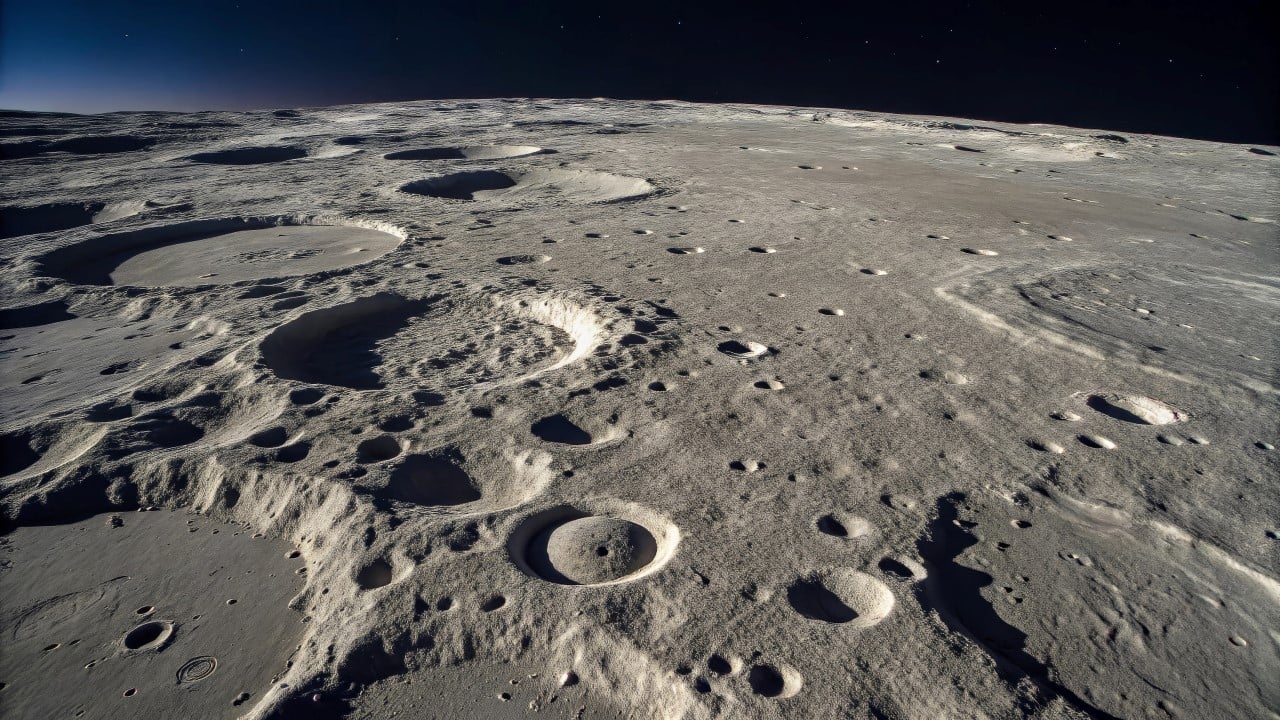
The success of this endeavor depends on overcoming an extremely hostile environment. Inside these galleries, the lack of natural lighting, the absence of positioning satellites and the lack of any prior cartography create a frightening scenario for robotics. It is exactly at this point that the laser sensors come into action, ensuring not only the safe movement of the device, but also the collection of topographic data in a location isolated from any infrastructure.
Full system autonomy is not just a luxury, but an absolute technical necessity. The time it takes for a radio signal to travel between Earth and lunar orbit makes real-time remote control impossible, forcing the machine to process information and act on its own. Such a technological leap marks a definitive transition in the way we build probes, eliminating dependence on direct human command in high-risk missions.
The strategic importance of ancient volcanic galleries for future colonies
The subsoil of the neighboring star is home to immense corridors formed by the flow of magma billions of years ago, during a period of intense volcanic activity. For the astronomical community, these gigantic caves — some estimated to be hundreds of meters wide, capable of housing entire cities — are true vaults of information about the geological history of the solar system. More than that, they emerge as the most promising locations for installing inhabited bases, serving as natural shields against the lethal environment of space.
Staying on the lunar surface means facing constant bombardments of cosmic radiation, impacts from small meteors and brutal thermal fluctuations. In contrast, the interior of these magmatic tunnels offers a surprisingly stable climate and a robust physical barrier against external threats. Understanding the structural integrity of these sites is the first practical step towards enabling the prolonged stay of astronauts under the Artemis program and future commercial missions.
A flying vehicle adapted for this darkness has the potential to maneuver through narrow crevices and map halls that no other robot could reach. Detailed analysis of these pristine rocks will help decipher the mysteries about the origin of the celestial body, as well as facilitate the search for reserves of frozen water. Finding accessible ice at these depths would be a logistical game-changer, providing oxygen and fuel for future colonists.
The engineering obstacles to keeping equipment running in the dark
Getting this idea off the ground requires solving complex design and power supply puzzles. As solar panels are useless underground, the robot will need to carry very high-density batteries or alternative sources. The project’s creator, Elor, highlighted the difficulty of the task, explaining that the operation will consume a lot of energy due to the lack of light and that the absence of GPS signals will make three-dimensional navigation a true acid test for the algorithms.
Extra care in development is to ensure that the machine does not contaminate the study site. According to the researcher, the system needs to be completely cleaned so as not to interfere with the readings of scientific instruments that will analyze an ecosystem that has been untouched for millennia. This severe restriction, added to the need to make decisions without the help of the land base, is forcing engineers to create new generations of artificial intelligence applied to frontier exploration.
The difference in the work led by Elor lies in the way different innovations talk to each other, overcoming competing projects that try to solve the cave problem. She points out that the combination of these cutting-edge tools will drastically expand the distance we can travel and the time we can spend investigating underground. The expectation is that this same architecture will be applied in the future to missions destined for the red planet.
The role of the American agency in promoting disruptive technologies
The financing of this conceptual aircraft is part of a strategic investment package from the United States space agency aimed at outside-the-box ideas. The government institution is actively hunting for proposals that would serve as a foundation for continued human settlement on lunar soil and, in the coming decades, on Mars. All of this is part of a larger plan to expand our species throughout the cosmos.
The director of NASA’s Advanced Research and Technology area, Greg Stover, made it clear that gradual evolution is no longer enough. In an official statement, he highlighted that the agency has set lofty goals to return to the Moon permanently and continue towards Mars, which requires giant leaps in innovation. For the executive, financially supporting radical concepts like this is the only way to foster the technological revolutions that the world expects from the aerospace sector.
The bet on a lava tunnel explorer perfectly embodies this philosophy of seeking the unprecedented. Instead of just putting better wheels on an old Jeep, the focus now is on inventing an entirely new class of autonomous machines. This shift in perspective ensures that science can investigate corners of the universe that are physically impossible to access today with standard technology.
How the system could be adapted for future missions to Mars
The team responsible for the design projects that the fruits of this work will not be restricted to Earth’s orbit. The vast networks of Martian caves are also prime targets for astrobiology, as they may house preserved chemical records of surface weathering. This versatility of use justifies the high investment and expands the horizon of practical applications of the small flying robot.
For everything to work in harmony, the device will condense multiple advanced systems into an extremely compact chassis. The ability to integrate these functionalities without compromising weight is what makes the project viable, standing out for the following pillars:
- Flight intelligence: Algorithms that allow you to avoid obstacles and plot routes without any human help.
- Precision cartography: Sensors capable of generating three-dimensional plans of completely dark caves.
- High-density batteries: Miniaturized power modules that guarantee hours of operation away from sunlight.
- Clean sensors: Measuring equipment that does not emit gases or residues that could alter local samples.
If given the green light to be manufactured and launched in the next space windows, this equipment will provide the missing piece in the puzzle of extraterrestrial geology. He will be responsible for confirming whether the lunar abysses are really safe to house the first human settlements outside our planet. Although the project is still taking its first steps on the drawing boards, it reaffirms the agency’s commitment to rewriting the rules of robotic exploration in the solar system.





