

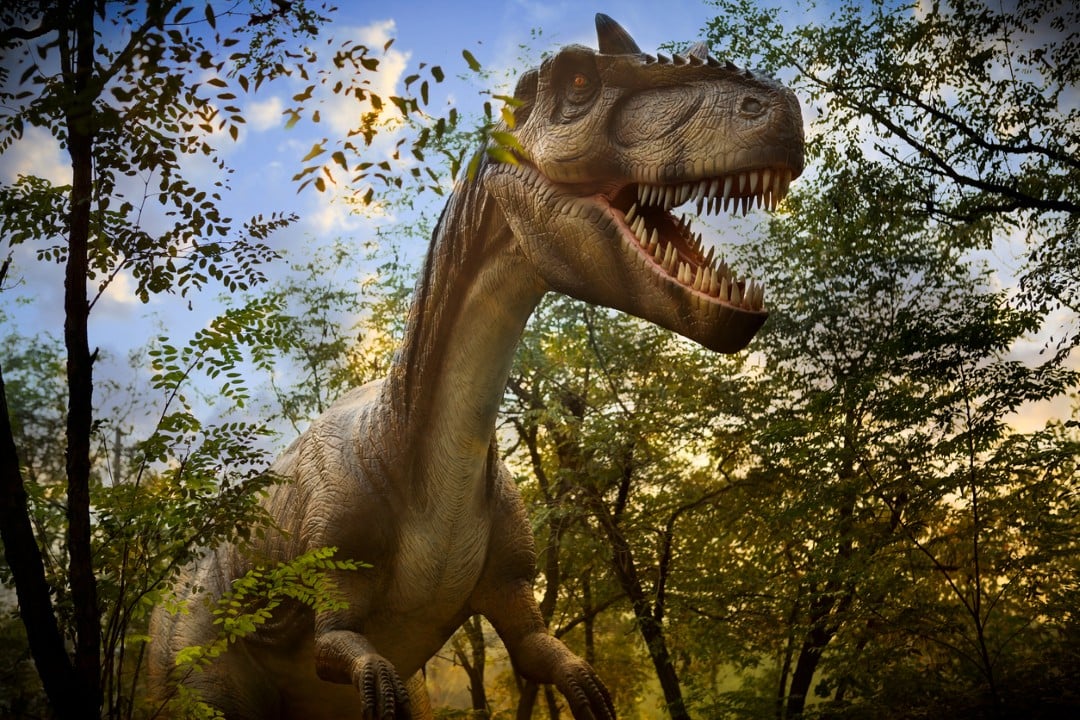
Research released by the journal Evolution, conducted by scientists from the American Museum of Natural History and Princeton University, sheds light on one of the great enigmas of evolutionary history: why dinosaurs, known for their grandeur, did not develop truly tiny species, unlike their avian descendants.
The team of researchers used mathematical models to analyze the evolution of size in vertebrates. They observed that, although energetic and physiological factors justified the size of mammals, birds and turtles, these same factors did not explain the absence of non-avian dinosaurs with very small dimensions. The main hypothesis is that the dispute for resources with small ancestral mammals may have prevented the evolution of dinosaurs to sizes comparable to rodents or sparrows, common in today’s fauna.
Roger Benson, co-author of the study and curator of dinosaur paleobiology at the Macaulay Museum, commented on the uniqueness of the discovery: “While the fascination with giant dinosaurs is universal, we focus on the other end of the spectrum. The absence of truly small dinosaurs is as intriguing as the presence of giants. Historically, dinosaurs limited the evolution of mammals to larger sizes before the end of the Cretaceous. Now we propose that mammals, in turn, restricted the development of smaller dinosaurs.”
The largest dinosaur specimens could exceed 80 tons, but the smallest known non-avian dinosaurs weighed around 450 grams, the equivalent of a large rabbit. This measurement is more than two hundred times greater than the bee hummingbird, the smallest global bird at 1.75 grams, or the Etruscan shrew, the smallest mammal at approximately 1.8 grams. Even the dwarf gecko, the smallest reptile, weighs just 0.15 grams.
More on this story: Study reveals why there were no mouse-sized dinosaurs
Fossil record shows the absence of small dinosaurs

About 75% of mammal species and 90% of currently existing bird species are smaller than the smallest non-avian dinosaurs ever identified.
Stephanie Lechki, lead author of the study and postdoctoral researcher at Princeton University, noted: “Contemporary ecosystems are predominantly occupied by small animals. To understand the evolution of today’s biodiversity, it is crucial to investigate why tiny dinosaurs apparently did not evolve.”
Although one might think that the lack of evidence is due to the difficulty of finding fossils of small animals, whose delicate bones fossilize less frequently, Benson and Lechki refute this idea. They point out that fossil beds containing dinosaurs often preserve much smaller specimens, such as mammals, lizards and amphibians. The presence of mouse-sized dinosaurs, therefore, should have been recorded alongside these other animals.
Therefore, the fossil record indicates that non-avian dinosaurs of truly small size were uncommon or, possibly, never existed.
Ecological factors explain the limited size of dinosaurs
To further the investigation, the researchers employed mathematical models that simulate how natural selection influences body size, considering the physiology of energy assimilation and procreation. These models assume that organisms tend to evolve to dimensions that optimize energy conversion in the production of offspring.
Learn more: Study reveals crucial link between brain size and offspring in birds and dinosaurs, revealing giant eggs
The methodology worked to predict size distribution in mammals, birds and turtles, but failed to be applied to snakes, lizards and crocodilians. Even with the inclusion of several physiological variables, the models were unable to explain why most non-avian dinosaurs were significantly larger than predicted.
The results indicate that the size of dinosaurs cannot be attributed to physiology alone. It is likely that ecological factors, such as competition for food, predation and the availability of different environmental niches, were decisive in restricting the minimum size that non-avian dinosaurs could reach.
How the development of flight changed the evolutionary landscape of birds
The research also provides new insights into one of the most striking transformations in vertebrate evolution: the emergence of birds. Although direct descendants of dinosaurs, contemporary birds are notably smaller than the smallest non-avian dinosaurs. This size reduction in birds occurred rapidly after their emergence in the early Cretaceous.
Scholars have found that this tendency towards reduced sizes in birds is not just justified by physiology. They suggest that the development of powered flight revolutionized ecological opportunities for early birds. With the ability to fly, birds were able to transcend the environmental limitations that prevented their dinosaur ancestors from evolving to much smaller sizes.
On the same topic: Study of ancient teeth shows leap in mammal evolution after dinosaurs
Lechki explained that “flight enabled access to new forms of life. By occupying these new ecological niches, birds gained the freedom to develop sizes that were unviable for other dinosaurs.”
Future research promises to deepen knowledge about the ecological pressures that influenced the prevalence of certain body sizes and the absence of others. Benson concluded: “It’s a peculiar situation: Dinosaur ancestors could have been small, and so were their living descendants — birds —. However, dinosaurs themselves appear to have been prevented from reaching these sizes. We have not yet fully solved this mystery, but it is a vital area for understanding the fascinating biology of dinosaurs.”