

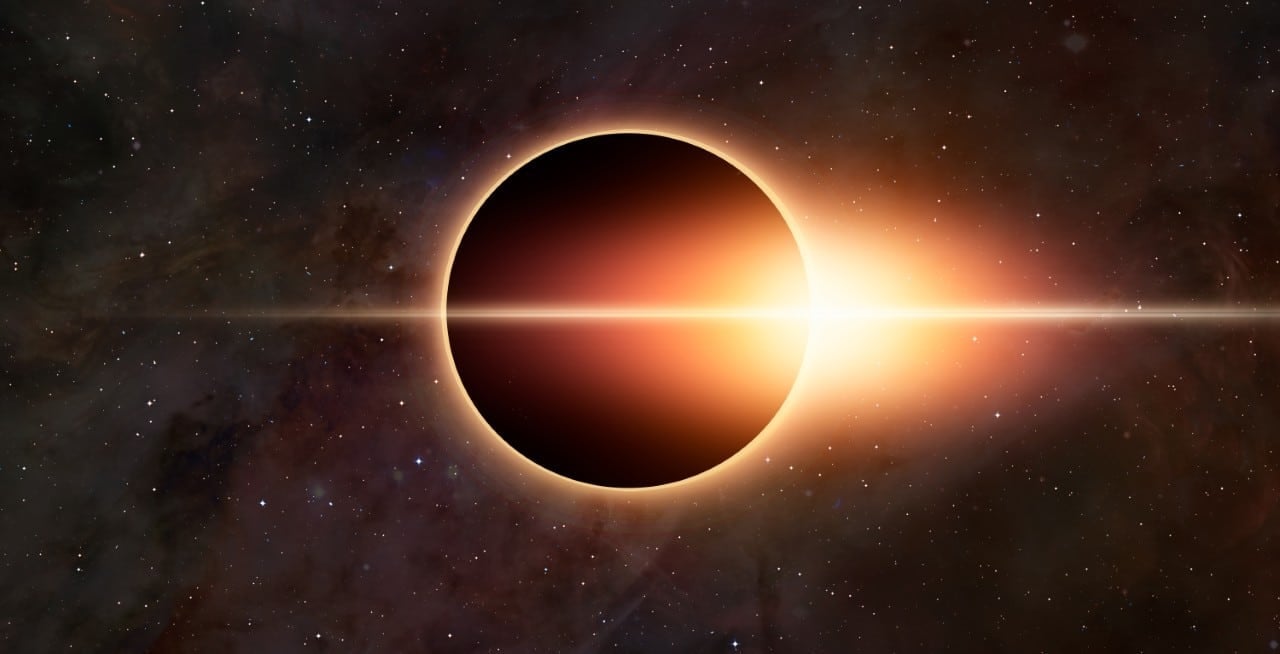
A celestial spectacle awaits millions of people on August 12, when a rare total solar eclipse will cross the skies of some regions of the Northern Hemisphere. The phenomenon, despite not being visible directly from Brazil, will have wide coverage online, allowing astronomy enthusiasts around the world to follow every moment of the Sun’s occultation by the Moon. Scientific organizations and space agencies have prepared special broadcasts to bring images and explanations about the event to the global public.
The path of the lunar shadow and privileged locations
The August 12 total solar eclipse will begin in Iceland, crossing parts of Greenland and Spain, before heading across the Atlantic Ocean. In a less common itinerary, the strip of totality promises impressive views for inhabitants and observers in these specific areas. The partiality of the eclipse, where only a portion of the Sun is obscured, can be noticed in much of Europe and in parts of North America.
More on this story: Total solar eclipse guide: learn how to safely observe the phenomenon and understand the science behind it
The phase of totality is expected to begin in Iceland at approximately 1:45 pm EDT (5:45 pm UTC), while in Spain, the phenomenon will begin at approximately 2:28 pm EDT (6:28 pm UTC). These times are crucial for those who plan to follow the broadcasts or are in one of the visibility regions.
How to follow the solar eclipse live online
For those not in the direct path of the eclipse, several platforms will offer live streams. The North American Space Agency (NASA), for example, is one of the institutions that will provide complete coverage, with images from multiple cameras positioned at strategic points along the totality band. In addition to real-time images, the broadcasts often include commentary from experts, explaining the science behind eclipses and the study methods used by researchers.
Watching the broadcast online represents a valuable opportunity for millions of people to witness the event, regardless of their geographic location. It’s a chance to participate in a global moment of scientific observation and natural beauty, directly from the screen of your devices.
The Science Behind a Total Solar Eclipse
A total solar eclipse occurs when the Moon passes directly between the Sun and Earth, completely blocking sunlight and casting a shadow over our planet. This perfect alignment is relatively rare, as the Moon’s orbit is slightly tilted in relation to the Earth’s orbit around the Sun. When the alignment happens, the solar corona – the Sun’s outer atmosphere, which is usually overshadowed by the celestial body’s intense glow – becomes visible, revealing an ethereal and unique spectacle.
Learn more: NASA will display total solar eclipse on August 12th with unprecedented research
Scientists take advantage of these moments to study the solar corona, which plays a fundamental role in understanding space weather and solar physics. Direct observation of the corona, without the use of special instruments that block sunlight, offers valuable data that is not obtainable under other circumstances.
Why Brazil will not have direct visibility of the phenomenon
The total solar eclipse on August 12th will not be visible in Brazilian territory, whether in total or in part. The trajectory of the lunar shadow is concentrated in regions of the Northern Hemisphere, such as Greenland, Iceland, Spain and the Atlantic. Brazil, located in the Southern Hemisphere, will be outside this route.
For Brazilian observers, the best way to experience the event will be through live broadcasts, which promise to capture the magnificence of the eclipse in high quality. This lack of direct visibility does not diminish the scientific importance or interest in the event, which continues to be a global astronomical landmark.
Preparation for future events and safety tips
Although Brazil is not in the path of the August 12 eclipse, other astronomical events are expected in the coming years. Eclipses, meteor showers and planetary conjunctions continue to spark interest among the public and the scientific community. It is always recommended that, for direct observations of solar eclipses, people use appropriate protective equipment, such as specific eclipse glasses or solar filters for telescopes. Unprotected viewing can cause permanent damage to your vision.
Watching events like the total solar eclipse on August 12, even from a distance, reinforces humanity’s connection with the cosmos and the inherent curiosity about the universe that surrounds us.